Amongst many other things, Hito Steyerl's film November (2004) provides – within the realm of contemporary art practice – a startling reflection on some of the themes that I have been starting to explore on this blog.
The film traces the enigmatic figure of Andrea Wolf through a series of circulating media representations. Wolf - the film tells us - was a teenage friend of Steyerl, and the star of Steyerl's first movie, a home-made teenage feminist appropriation of martial art and exploitation tropes, shot on super-8 back in the 1970s. Only the action scenes were ever made, and the film involves a group of girls seeking out and beating up men for reasons that no longer seem clear to Steyerl herself, reprising imagery from Russ Mayer's Faster Pussycat, Kill, Kill!, a film that Steyerl notes is "tacky," and which is ideologically dubious to say the least, but which nonetheless seems here to have provided a model of identification within which feminist (or at least proto-feminist) desires could be negotiated by the young, somewhat radical, women who took part in Steyerl's shoot.
A still from Steyerl's early movie, reproduced in November shows Andrea Wolf, age of 18.
Wolf, however, also went on to lead a life involved in rather more actual radical politics, becoming involved in far-left groups in the orbit of the Red Army Faction, and ending her days in Turkey as a guerrilla with the Kurdish PKK. It was there that she met a tragic death, executed by the Turkish authorities. The fantasy violence of teenage identifications with media images are transformed into the messy real life violence of war. Wolf, however, was turned once again into a media image, in the guise of a political martyr, and made to circulate once more in the realm of imaginary identifications and kitsch fantasies.
Kurdish propaganda poster celebrating Andrea Wolf (with her assumed Kurdish name of Sehit Ronahi) after her death as a revolutionary martyr. These images were used on marches by PKK-sympathetic groups.
Within her exploration of the power of images – in their continual circulation and with their continual transformations of meaning, to feed into reality, producing myths that are then performed – Steyerl's film includes a meditation on the martial arts cinema with which she and Andrea Wolf alike were obviously so fascinated as youths – Steyerl making a home-made B-Movie homage to the genre as her first directorial experiment, and Wolf taking up karate as a part of her self-creation as a militant, as an act, if you like, of self-empowerment. In November, Steyerl also recounts the myth of Bodhidharma travelling from India to China and founding the Shaolin Temple, creating the archetype of the lone, wandering warrior, dedicated to truth and justice and fighting the strong and the tyrranical with bare hands alone. It was a myth spread globally by the martial arts movies that boomed in the seventies, even finding its way into avant-garde texts such as René Viénet's Situationist classic Can Dialectics Break Bricks? – a film I've started to discuss elsewhere on this blog, and which Steyerl quotes at a number of points in her own twenty-first century revisitation of the "kung fu" moment.
Still from Steyerl's early film, as reproduced in November.
Of course, as much contemporary scholarship has set out to show, the story of Bodhidharma and the story of a Shaolin rebellion is so much myth, constructed largely only in the twentieth century, under the radical modernising programmes of the Nationalists and Communists, which sought to co-opt the physical cultures of martial arts into a nationalist revival of the body politic. Much of the discourse around the martial arts (and out of which martial arts cinema emerges) seems to hinge on the obsessive and contrary acts of making and unmasking myth. It has recently become something of an industry to debunk the Chinese martial arts' claims to older and more subversive histories, with writers in particular such as Peter Lorge and Stanley Henning in the forefront.
But this, for me, is where Steyerl's complex negotiation of the territory trumps the demythologisers. Her film at once criticises and lays bare the treachery of images and myths, their mutability, their seductive but dangerous power, and their ability to never quite mean what you want them to mean, even in your own acts of appropriation; but it also seems to embrace the productive power of myth, and of popular culture as a site of its circulation. Myth is the very power (the puissance, as Lacoue-Labarthe put it)[1] to produce a self and a position in the world, however compromised such a position may become by the instability of representation, and the powers that already colonise the image. The grasping and active, critical renegotiation of myth, rather than its simple rejection, becomes an important emancipatory activity.
In marking this complexity and ambivalence, Steyerl manages to avoid the trap into which the martial arts mythbusters fall. Such mythbusters fail to grasp the mythological power of their own acts of demythologisation. Thus when the Jingwu academy, back in the early twentieth century, broke the image of the Shaolin Temple as the fount of martial arts (a myth at that point not actually that old), it was only to replace it with the myth of the patriotic Huo Juanjia and his death at the hands of Japanese oppressors. And similarly it seems hardly co-incidental that at the moment when there is a rage for Western Scholars such as Lorge and Henning who (to put it a little crudely and to exaggerate just a little) deracinate the cultural aspects of Chinese martial arts in order to turn them into objects of comparative study, this is actually also the moment of the rise of Mixed Martial Arts (MMA), perhaps one of the most reactionary forms of martial artistry since the kung fu craze, in its gender politics as well as its spectacularisation of violence as pay-per-view spectacle, and one that also pretends to a "scientific" and trans-cultural neutrality in order to assert its suppose superiority over backwards forms of ("foreign") traditional practice. Such a scientism is in its own way an ultimate form of magical and mythologising gesture, set now under capitalist imperatives for making money.
(Some interesting analysis of the mythical nature of MMA and the like has recently been given in the "Martial Arts Studies" edition of JOMEC, to which I also contributed – see in particular Paul Bowman's reflection on "realism" in contemporary martial arts, and Daniele Bolelli's analysis of the role of "Gladiator" movies in the forming the nature of the visual spectacle of MMA. But I digress...)
Steyerl's film is called November. Within the film, the title is explained through the contrast to the revolutionary moment of October, a moment where things appear simple and true, and revolutionary action can be grasped confidently. By November, things are looking much more tangled and messy, the revolutionary enthusiasm shown as always already compromised by – and fallen into – the false images on which it depended. Steyerl doesn't retreat from problematising a radical legacy in her self-construction as a critical leftist, noting the ways in which in real history the "good guys" (even Andrea Wolf) are often not nearly as innocent or lilly-white as their mediatised images. November is a time of distrust and scepticism. It's a time when identifications need to be rebuilt, but also when they need to be guarded against.
It seems to me that martial arts cinema as a global phenomenon was always a cinema of "November" - a cinema of the aftermath – springing up in the wake of the global wave of decolonisation and the protests of "1968." It was always a cinema where the real had passed into its simulations and its uncanny (and untrustworthy) imagistic doubles. The question might remain, however, of the "truth" that such images nonetheless might carry into the present.
November, then is a time of haunting. A time, as Derrida might suggest, quoting Hamlet "out of joint." (See his Spectres of Marx.) Steyerl seems to capture this haunted and haunting quality of media images very well, neither there nor not-there. To live in the realm of media images is to live a haunted existence.
Perhaps this is the point, more generally, with the martial arts film, too. Even if the myths they recount don't simply tie us to a simple continuity with the past, in the way that official Chinese Communist Party histories sought to imagine the Boxers Rebellion, the Taiping Rebellion, the uprisings of the Hongmen (Tiandihui), or further back peasant revolts such as that of Li Zicheng, in their own image, there seems to me to remain the question of what it is that returns in them, what haunts them, from elsewhere, as it were.
Note
[1] According to Lacoue-labarthe, myth "is a 'power' [puissance], the power that is in the gathering together of the fundamental forces and orientations of an individual or a people, that is to say the power of deep, concrete, embodied identity." See his Heidegger, Art and Politics, p.93.
An authentic and auratic performing body – Gordon Liu in Lau Kar-leung's 36th Chamber of Shaolin.
Having made two blog posts here recently, I realised that I should probably also add a link to my recent ("proper") article, "Lau Kar-leung with Walter Benjamin: Storytelling, Authenticity, Film Performance and Martial Arts Pedagogy," published in am exciting special edition of the journal JOMEC (JOurnalism, MEdia and Cultural studies) on the expanding new field of "Martial Arts Studies," edited by Paul Bowman.
NOTE TO THE UNWARY– THIS ARTICLE DEFINITELY CONTAINS SPOILERS!
In my last post, I started a comparison of a pair of films:
Guillermo de Toro’s Pacific Rim and
James Mangold’s Wolverine. Both of
these were released in 2013, and both seem to articulate a shared fantasy space
of the global realm, articulated around the Orient as a locus of desire and anxiety.
The films, of course, were released at a moment when – at the very least in the
Western imagination – the political and economic hegemony of the West, and of
America in particular, were increasingly being challenged by the growth of
China and the “Asian Tiger” economies. Recently, for example, it has been
projected that the twenty-first century will be an “Asian Century” in the same
way that the nineteenth century was British and the twentieth was an American
one. [1] I would bet good money that a search under the keyword “China” on any mainstream
Western news site (the BBC for example) will easily confirm the pervasiveness
of this as a media narrative, with articles dealing with China consistently
focusing on its growth, industrialisation and supposed impending economic
dominance over the West – peppered of course with criticisms of its human
rights record – to produce an overall picture of a set of fears that perhaps
hasn’t moved on enormously since the era when “yellow peril” was a frequent
idea. Recently, however, more sober analysis in the New Left Review has highlighted the extent to which, in spite of
the tectonic shifts in the global economy caused by the shock of 2008, such
prognoses are a matter of the Western imagination rather than stark economic
fact, with Peter Nolan and Jin Zhang, for example, showing just how far behind
American dominance far-Eastern corporations are, and the extent to which the
current markets are still stacked to perpetuate this situation. [2] (I use
the metaphor of “tectonics” with Pacific
Rim in mind, to which I will be turning shortly!).
The argument in my recent post, through a fairly basic
analysis of Wolverine, has been to
suggest that the plots of some recent American action movies are formed as a
response to such anxieties. What ensues is a renewed sense of the East as a
privileged object or space of desire and mystery, and the revivification of a
hardly reconstructed orientalism. A further dimension is added to this by the
way that Asia’s growth as an economic and political power has been mirrored by the arrival of popular-cultural and cinematic forms (we are concerned here in particular with action cinema)
imported to the West. Such a process started, of course, with the arrival of the Japanese chanbara during the “economic miracle”
of the 50s and 60s, followed by the kung fu movie at the height of Hong Kong’s
1970s electronics boom, the appearance of Korean cinema with the rise of the
Four Tigers, and an interest in swordplay (wuxia) films such as Crouching Tiger Hidden Dragon or Hero at the time when the PRC was coming to the fore as a global power. These genres,
rising to compete with Hollywood, have had a decisive impact on global cinema –
especially action cinema – and their tropes, images and ways of filming have
started to permeate Hollywood’s language, creating a situation where a cultural
as well as an economic hegemony seems to dissolve, and must be negotiated by
Western directors such as Mangold and del Toro.
In this post, I move on to look at how the same factors play
out in del Toro’s Pacific Rim.
Pacific Rim, to
give a brief overview, is set in a future in which giant Godzilla-like monsters
from a mysterious other dimension emerge from the intercontinental rift at the
heart of the Pacific Ocean, to attack humanity. (The monsters are named, after
the Japanese monster-movie genre, kaiju.)
To fight these monsters, humanity unites and builds a series of
hyper-technological giant robots, called in the film Jaeger (the German for “hunters”), each piloted by a pair of pilots
whose minds are united to form a single consciousness through a
psycho-cybernetic link. However, the war is not going well for mankind. The
film’s hero, Raleigh Becket (played by Charlie Hunnam), is a washed up Jaeger pilot, who has lost his brother
whilst on a mission. He has a chance to prove himself once more, and teams up
with the mysterious Mako (Rinko Kikuchi) – a Japanese woman who was saved as a
child by an African-American Jaeger pilot,
Stacker Pentecost (Idris Elba), who now plays the role of a father-figure for
her, but also the General in charge of what’s left of the Jaeger programme. Mako and Releigh are each suffering too much from
a mental trauma to be fully trusted pilots – Raleigh’s brother has died whilst
he was in an electronic “mind-meld” with him, and Mako’s parents were killed in
front of her whilst she was still a child. This being a movie, earth’s last
stand will, of course, be left to them.
The film’s Pacific setting – tying it to the concerns of Wolverine – seems, as the movie
progresses, to slide further and further East: the first monster attack, shown
at the very start of the film, is in San Francisco, and the final scenes are set
around Hong Kong, which is imagined in the mould of 1930s Hollywood Chinatown:
a dark and impenetrable world of criminal networks, money, and exotic
black-market commerce.
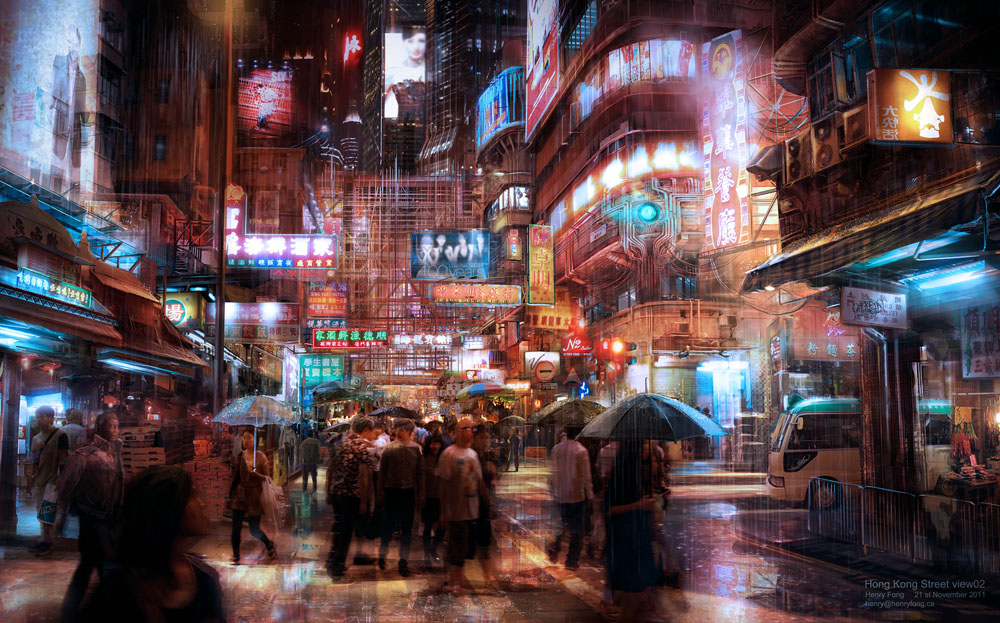
Concept art for the Hong Kong scenes in Pacific Rim.
In many ways, del Toro’s film, then, reiterates a series of
the tropes that we are offered in Wolverine.
At its core is an image of a “Pacific Rim” culture that might, perhaps, stand
in for the global and for contemporary processes of globalisation (and for a
dream of global reconciliation), and that connects, on the one side the
American Occident, and on the other the easternmost reaches of Asia. Like in Wolverine, the fantasised Asian city in
which much of the film is set is a locus of crime, gangsterism and decadence.
Like Wolverine, the film riffs on
Asian (and especially Japanese) cinematic genres, in particular this time playing
on and making a series of explicit intertextual references to the Godzilla movies of the 1960s, but also
providing us with some spectacular – if CGI-heavy – martial-arts style
choreography, with giant anthropomorphic robots fighting monsters, and even a “dojo”-type
scene where the hero and heroine square off with staves. Like Wolverine, Pacific Rim has a white American male protagonist, with the exotic,
oriental setting doubled by the prominence of an Asian female love interest.
Pacific Rim,
however,seems nonetheless a rather
different kettle of fish from Wolverine.
It’s an altogether more subtle and complex cinematic experience, and much
harder to run the kind of crude semiotic-style analysis I have recently performed
on The Wolverine. Perhaps I’m being
overly harsh on the film, (I’d ove to read any kind of counter-argument!), but I’m
not sure that there is much to be found in The
Wolverine that lies in excess of the kind of analysis that I have run on it,
but del Toro’s offering would, I think, be far from exhausted by a similar
exercise. This may well make the analysis I’ll try and set out here a rather
more unsatisfactory one than previously, bit I’ll do my best to make some sense
of it here, in any case.
The first thing that probably complicates the picture is the
“authorial” nature of the work. I just admit to not knowing enough about de
Toro as an auteur to really push this kind of analysis, but Pacific Rim certainly reiterates many of
the themes and motifs that have interlaced his other work: for example, the
opening of a portal between this world and a hellish and daemonic “other”
reality, that might itself, especially in combination with del Toro’s
surrealistic visual language, be equated with the dark zone of the id. And perhaps, as with for
example Pan’s Labyrinth, the film is also concerned with the influences of such an id on the nightmare of modern history. There is certainly, then, a potential
for reading a degree of critical intent, and even self-reflexivity in del
Toro’s evocation of the Pacific Rim geography as the setting of his film.
Perhaps, however, we might need to consider the nature of the very gesture of locating the id, and all the monsters
of the mind, in the Far East – its alterity transforming it into a kind of
space of projected Western nightmares.
In spite of the ways in which such a gesture might be
retrograde, Del Toro’s vision of the future is nonetheless altogether more
dystopian and critical in its relation to an American world order than Wolverine. When aliens attack, and
humanity is finally united to fight them, the ensuing world, resembling as it
does the current global order of media image and free-market corruption, is
hardly benign. It is depicted as a militarised, quasi-fascistic order in a
state of economic and military crisis, sustained through the infantilising
media worship of a warrior class, and with war turned into a video-game
spectacle. (Does this sound familiar anyone?) This order is underpinned by the
hopeless and ultimately futile labour of a proletarian mass building walls
against the aliens. The divide between an exceptional military elite and
the wall-building workers is dramatised by the protagonist’s fall and subsequent
rise between these two classes. This world-state seems, in many ways, the
uncanny double of the monstrous kaiju that
invade our reality from beyond, and the imperial dreams of their alien creators.
We can, of course, turn such a formulation around and find in the hellish
monsters the uncanny double of the imperialism of global capitalism. (An article
I published on the cultural history of sharks, might suggest as much, in
any case!)
It seems to me that the question of trauma – and of the
forms of splitting or fragmentation that accompany this – lie at the thematic
heart of the film. Such a split, in geopolitical terms, might be at the core of
the film’s picture of Pacific space, with the global imagined as a space of fracture and conflict – an interdimensional war, no less, even if
this is one imagined in terms of a battle between an “other” marked with an
Asian name (kaiju) and a “self”
marked with a European word (Jaeger).
These figures of trauma are also mirrored in the psychic traumas of the
protagonists, of course. In the film the Asian-American transcontinental divide
is envisioned in the form of a volcanic fissure – the crust of the earth
opening up where plates collide – which also doubles as a kind of a rupture in
space and time through which the kaiju arrive. This is
located in the Mariana Trench, a place of enormous depth. If the Pacific is a
human place, the film seems to suggest, it is a place that exists only on a series of edges, and these
have between them a black gulf of division, which in terms of the film’s
imagery equates with the dark heart of the unconscious. The Pacific Rim, however, is also a place where humanity (its Eastern and Western halves) are brought together – with the ocean as much a space of interchange, trade and linkage as it is of division, separation and conflict.
The Marxist in me would suggest that, of course, it is the
traumatic nature of capital and its turbulent histories that might constitute the
trauma that lies at the heart of the film. More specifically, however, it is,
perhaps, the histories of Western colonialism and imperialism. Interestingly,
the three central protagonists of the film, Raleigh, Mako and
Pentecost, form a racialised trinity (African, Euro-American and Asian), and it
is only in their uniting as a kind of a family that the kaiju can ultimately be defeated. (Though we might ask about the
cinematic conventionality of the fact that this will also involve Pentecost’s
sacrifice. As L L Cool J wryly notes in Deep
Blue Sea [dir. Renny Harlin, 1999], in a moment of cinematic reflexivity,
when being pursued bygiant
genetically modified shark, “I'm done! Brothers never make it out of situations
like this! Not ever!”)
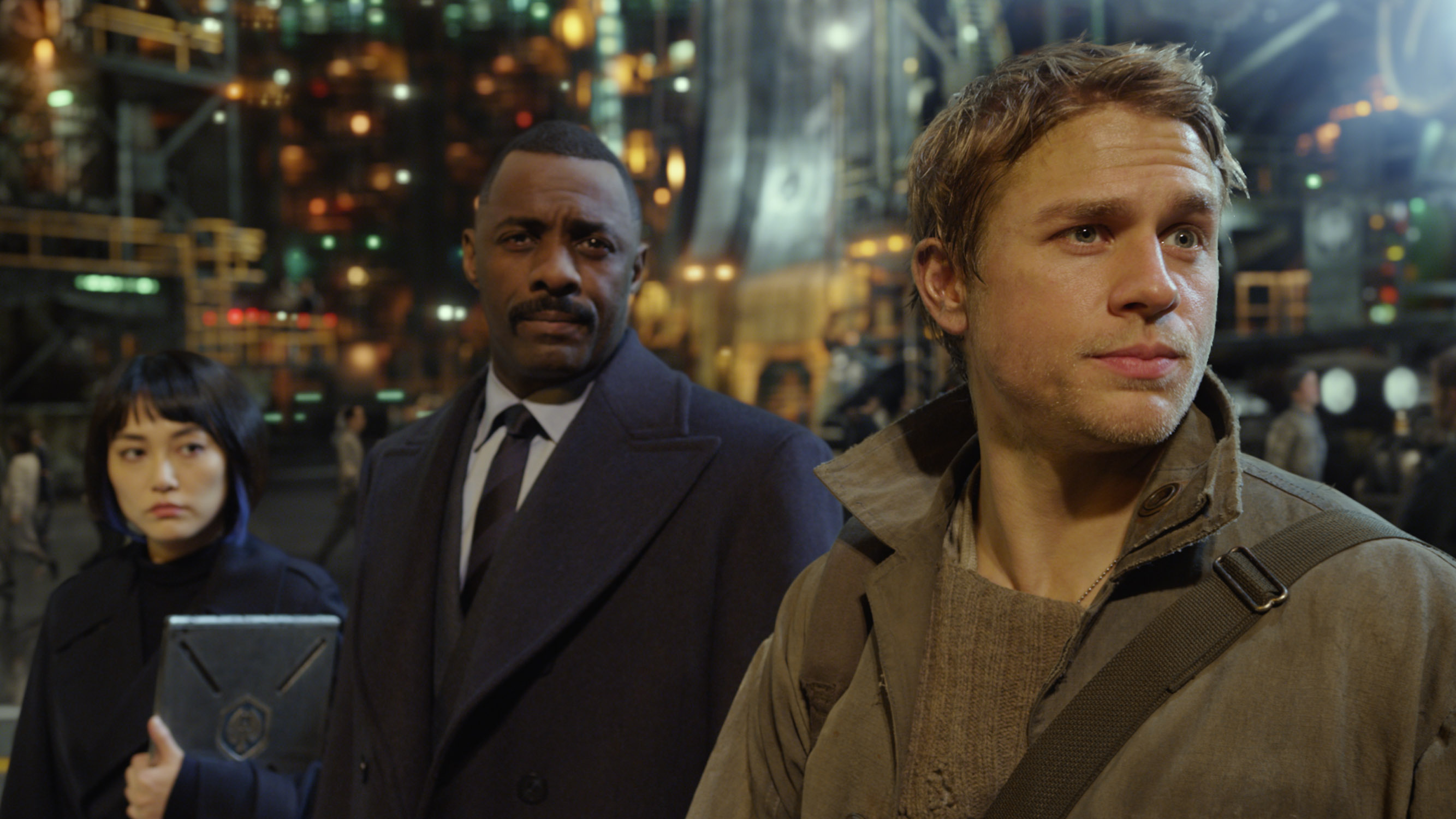
Mako, Pentecost and Raleigh – three races working together in Pacific Rim.
A further answer to the nature of the trauma in question,
which once again propels the film into the familiar territory we found ourselves in with Wolverine, might be the suggestion that this trauma is a matter of
the nuclear bombs dropped on Japan. The film’s key movie reference is, of
course, the Godzilla story, which first hit the silver screen in 1954. This in
turn, it is often argued, was an image that formed in response to the anxieties
about radiation in Japan at a time when the memories of Hiroshima and Nagasaki
were still fresh, and in the wake of the “Lucky Dragon 5” incident in which
Japanese tuna fishermen were poisoned by the radiation produced by US atomic
tests in the Pacific. It is perhaps, then, significant that in Pacific Rim the situation is only put
right by the insertion of a nuclear charge into the intercontinental fissure
from which the kaiju emerge – hence
symbolically closing the circle of a set of anxieties stemming from the US
atomic explosions of 1945. These explosions, furthermore, might also evoke a
whole Cold War history – Korea, Vietnam and the like – which has also
conditioned Hollywood’s vision of Asia as a zone of trauma.
The Pacific Rim also stands, however, not only as the image
of trauma, but also as a potentially utopian image, of redemption and the
restoration of wholeness and unity, an image of healing. Such wish fulfilment
can be seen on the one hand as carrying with it a progressive wish, but it can
also be understood as ideological in nature, staging a merely symbolic
resolution of real conflicts that its catharsis ultimately supports. In a film
named after an ocean, we might also think of this desire in terms of Freud’s
“oceanic” wish, the desire to be one with the cosmos, a deeply ambivalent
desire which is both about an absolute egoism in which the self swells to
encompass the Universe, but is also about the desire for a complete loss of the
self or ego.
This process of healing or uniting is thematised most strongly
in the figure of the “mind-meld” which is necessary to control the giant Jaeger. Wired together through the
neural “bridge,” the pilots find themselves “in” each other’s minds and
fantasies, feeling each other’s emotions. It is an erosion of difference, and
of the boundaries between self and other, an experience of absolute intimacy,
and a thematic opposition to the oceanic “rift” from which the film’s monsters
appear. The ability to form this bond between pilots seems to initially rest on
forms of similarity, shared experience and shared biology – that is to say, by
a form of shared identity. The film emphasises the importance of forms of
“compatibility” between co-pilots. One can bond with the “other”, this is to
say, only inasmuch as they are not really other at all. The first pilots we
meet, Raleigh and Yancy, are brothers. The film’s antagonist, Chuck Hansen (Rob
Kazinsky) is paired with his father (Max Martini), making a similar
familial-genetic (and all-male) bond. The Russians, if perhaps not family, and
if a male-female partnership rather than a homo-social one, are represented
with emphasised ethnic uniformity, making much of their linguistic difference, and
their shared “look”/haircut, etc. A Chinese crew, seen very briefly, also display marked facial similarities, and sport identical shaved heads.
Two pilots in harmony - undergoing a bridging of minds to control the Jaeger - video still from Pacific Rim
Interestingly, then, the key neural “bridge” of the film is between
characters with seemingly the most obstacles between their making this
connection: with Raleigh and Mako, it is a bridge between people with very
different experiences, races and a different gender, and even seemingly very
different temperaments. What Raleigh and Mako, perhaps share, is their status
as outsiders (i.e. their very difference) and, above all, their traumatised
pasts – their very fragmentation. This movement in the film, then, between characters who
bond through similarity (bond with “the same”) to characters who are able to
bond with those who are different from them could be understood in a series of different ways. It
might in some psychoanalytical readings equate to a certain maturation process,
recognising and coming to terms with difference, the existence of the other,
and the limits to the power of the self, and forming emotional and social (and,
ultimately sexual) bonds with “others”. [3] (One question might be whether such a
narrative, as presented in the film, is fundamentally hetero-normative.) such a
narrative might also be read on the geo-political level – given the
thematisation of such a space in the film, as marked by its very title. The
trauma, the scar, the rift which must be bridged is the gulf between East and
West. (As Kipling put it, back in the heyday of orientalism, “East is East and
West is West / And never the twain shall meet.”)
Charlie Hunnam as Raleigh and Rinko Kikuchi as Mako in Pacific Rim.
What Pacific Rim does,
then, is collapse the social/sexual with the geopolitical – and again we might
ask whether this is a matter of a kind of utopian wish in a split world, or an
ideological image which actually amounts to a form of imperial culture. Perhaps
the answer is not either/or, but both/and.
Such a recognition of the collapse between the psycho-sexual
and the geo-political brings us to the character of Mako. In some
ways, it is striking how the same kinds of stereotypes as we meet with in the
case of Wolverine are replayed here,
but it is also interesting the ways that del Toro’s film complicates the
picture.
Mako, then, may seem at first to integrate the two figures
of the Asian-woman-as-object-of-desire that are offered in Wolverine, Mariko and Yukio. Like Mariko. she is at points
delicate, vulnerable and passive, especially as the girl who is rescued by
Pentecost, and with regards to him she is dutifully submissive, as dictated by
filial piety. On the other hand – as we see her, for example, in the “dojo”
fight/training scene – she is also the lethal and phallic woman warrior like
Yukio. She remains, as a character, almost entirely defined by the image of her suppoesd racial/ethnic/cultural characteristics. To a large degree, in spite of these contradictions, and despite having
a complexity far beyond the Mariko/Yukio pair in Wolverine, Mako remains not a whole lot more than a cardboard
cut-out character.
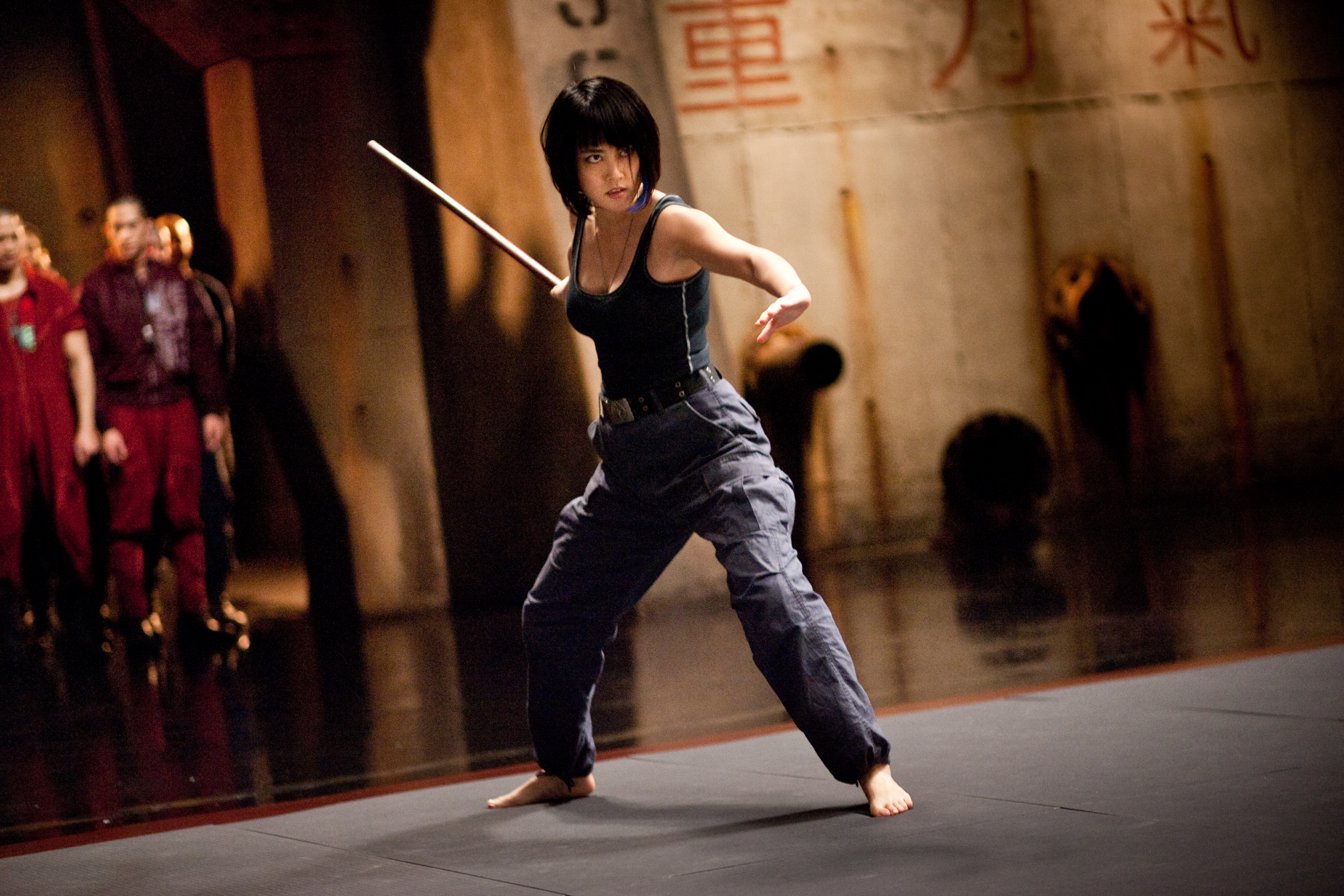
Mako strikes a martial arts pose during the "dojo" training scene in in Pacific Rim
However, in spite of these limitations, Mako certainly has a
lot more agency in the film than Yukio and Mariko do, becoming very much a partner and
co-protagonist to Raleigh. In this much, we are already doing fairly well for
Hollywood in terms of gender politics. It’s also interesting that Mako in fact
becomes the only character actually endowed with the eroticised cinematic gaze,
in a scene where she watches a shirtless Raleigh through the keyhole of his room, with the
white male body turned into the erotic object for an Asian female looker – a
scene that must be something of a rarity in the history of American cinema. In fact, Mako fits into a
much longer standing fascination in del Toro’s films with active (if girl-like) female
protagonists, such as, most obviously, Ofelia in Pan’s Labyrinth. This comparison might remind us to cast her as
a kind of fairy-tale princess. The nuances of a gender analysis of this figure of the fairly-tale girl in del
Toro’s work – and in film and literature more generally – are definitely beyond
my present expertise, however.
Pacific Rim as fairy tale.
The ending, of the film, then, in which Raleigh and Mako journey
together into the darkest depths of the Oceanic fissure (and, in fact, at the
same time into the dangerous “drifts” of their shared unconscious minds) to
destroy all monsters, and from which they emerge only by saving each other, to end
in a triumphal embrace, marks a real “partnership” in a very different form
from what we are offered in Wolverine.
The fantasy that this final coupling entails is very much in harmony, overall, with the analysis that I have been presenting here: in many ways Pacific Rim hardly escapes the basic
cultural structures or fantasies through which Hollywood has negotiated the
collision of East and West. It is worrying, in terms of the film’s bid to do
more than fall into clumsy racial stereotypes and retrograde orientalist
fantasies, that ultimately its eroticised vision of the geopolitical hangs on
the all-too-familiar pairing of a masculine occident and a feminine orient. (I
wonder: how might the film be transformed if Raleigh were to be cast as a white
woman and Mako an Asian man?) But Pacific
Rim – even in offering us a different kind of partnership, and one that is
at least more fully human – certainly seems to take a step towards working away
at the contradictions of Western cinema’s fantasies of the orient, “traversing”
them, and re-positioning us differently within them.
Raleigh and Mako at the end of Pacific Rim
I’m pretty sure that this post has hardly “cracked” the
enigma of del Toro’s film, and I remain quite conscious that I’ve largely been
dependent on a fairly literal reading of its narrative and said little about
the cinematic and visual aspects that perhaps actually make it an interesting
film to watch. I’m also rather aware that it’s been something of a rambling and
over-long piece, so I hope that some readers get this far, to the very end! I hope,
however, that it has been of interest to a reader, and helps in some way in
furthering an understanding of, or the development of a critical angle on, the
film in question.
I’d also be very glad to hear from anyone with other ideas
about the film or if anyone has any comments on the argument I’ve made here.
Pacific Rim (dir. del
Torro, 2013) and The Wolverine (dir. Mangold,
2013)
On this blog I've "started" a number of pieces of work with promises for continuation that have never been kept. Many of these are projects that are on the way to going elsewhere, possibly with views to future publication, so further posts on those projects here may well probably never see the light of day. Especially with the loads of teaching and administration that I seem to labour under these days. However, with the article started below I really do promise (honest!) to get a "part two"out during the Summer. It's even mostly written. And I've no intention of publishing this material elsewhere.
This piece of writing starts with a co-incidence – or rather
something that perhaps just seems like a co-incidence: a conjunction at the heart
of which lies a complex tangle of motivation that is both my own but also that of the contemporary American movie industry. On a long-haul flight from the UK
to America for a conference, I decided to dip into the in-flight movies. Over
the hours on the plane, not wanting to plump for the more exhausting fare of
the art-house offerings available, I found myself watching a couple of action
movies, and the films that I landed on (out of an admittedly huge choice) were
Guillermo del Torro’s distinctly auteurial spin on the popular generic effects
movie, Pacific Rim, and James
Mangold’s rather less directorially distinguished The Wolverine. What struck me was that in each of these films alike
I had been thrown into a Hollywood vision of the global which revolved around
the imaginary Far East as a locus of desire and a space of fantasy. Each (in
their different ways) reclaimed and reworked iconographic and technical elements
of Asian popular movies in their attempts to reinvigorate the phantasmatic
space of American action cinema. Each, I think, is also involved in a negotiation of cinematic language itself, as this has been reconfigured by Hollywood's brush with Asian film production. (The conjunction perhaps has a renewed interest at the present moment when a new remake of Godzilla has just been released...)
First, them, The Wolverine.
The Wolverine takes
us to Japan, rehashing an almost-unreconstructed set of orientalist stereotypes
and, over the course of the film, reasserting white/Western symbolic ownership
of the “action” genre, integrating motifs, from Asian genres, of the Yakuza,
ninjas, samurai, and so on, into an all-American superhero spectacle, at the
heart of which is the strong, masculine, “superior” white hero, who gets to
out-action the action specialists of the East, quite literally picking up their
weapons (the katana, etc.) and using them to defeat the “natives”. The
ideological message is clear: the American Way is naturally superior to its
alternatives.
Wolverine (played by Hugh Jackman), gripping the Japanese katana in The Wolverine (2013)
Over the course of the film, the eponymous hero wins the
heart of not one but two Japanese women, each standing for one of the paired
stereotypes through which Asian femininity is represented. One the one hand
there is Mariko (Tao Okatomo): a delicate, vulnerable “butterfly”, marked out
in the film’s narrative through an association with “traditional” ways of life
and modes of femininity. She is the damsel in distress who seems for the body
of the film its preferred erotic object. On the other hand there is the
sword-toting, subculturally dressed bodyguard Yukio (Rila Fukushima), a
“kick-ass babe” in whose company Wolverine in fact metaphorically sets off into
the sunset at the end of the movie (flying West on a plane, rather than on
horseback). But this, it seems, in the film, is an altogether more Platonic
friendship than the association set up with Mariko. The movie gets it both
ways: the hero gets the (exotic) girl(s), but returns to his monadic, asexual
state (as is common in the superhero genre). In terms of its gender politics, the film gets to assert the triumph of
the “empowered”, modern, phallic (Asian) woman over her castrated double, but
only on the proviso that she becomes de-sexualised, turned into a “buddy”,
perhaps a partner in some cross-gender, doubly sublimated “bromance” rather
than “romance” per se… The threat to white-Western masculinity constituted by
this fantasmatic object of desire is thus neutralised on a number of levels.
Rila Fukushima as Yukio, in The Wolverine (2013)
In the process of working out (winning and then rejecting)
these romantic attachments, Wolverine is contrasted with a series of
dysfunctional Asian masculinities – he defeats them through physical
superiority and moral integrity. These misfiring Asian men include Mariko’s
fiancée Singen. (This being a Hollywood representation of the East, this is an arranged
marriage of course). Singen is a corrupt politician who, even when caught in a
moment of heterosexual excess with two call girls, is nonetheless feminised,
wearing a pair of red “panties”. (One of the aforementioned call girls is, of
course, a blonde, raising the spectre of the yellow-peril “other” who threatens
the Western/white male’s possession of a racialised “womenfolk”.) There is the
tyrannical father who is jealous of the daughter’s inheritance and plots to
kidnap and kill her in order to take this over. Then there is the young ninja and
childhood sweetheart who is supposed to protect Mariko but in fact sells her
out to her enemies, ultimately more connected to an ethic of “family” and
“duty” than to one of personal romantic attachment and individuation, setting up a classic East-West binary. And finally
there is the sick and dying grandfather, Yashida, the originary point of the
film’s fantasy of the East as a decaying, monstrous patriarchy, which cannot
fully present a core of masculinity from which to order its gender-space. It is
from this network of representatives of corrupt masculinity that Wolverine
rescues the heroine (and ultimately thus an invidious “tradition” involving
duty, arranged marriages, and so on which they manifest). This, of course, is
the frequent orientalist trope: we must invade country X to protect the women
there from their misrule by primitive, corrupt, decadent, and thus improperly
manly men.
Hal Yamanouchi as Yashida in The Wolverine (2013)
The sexism of the film (and the racism involved in its
negotiation of gender) is doubled by a disturbing historical revisionism. The
film’s narrative spur – the cause for Wolverine’s visit to Japan – lies in a story
from the very close of the Second World War. Wolverine is held in a prisoner-of-war
camp and the guards are releasing the prisoners, recognising that defeat is now
certain. A guard lets Wolverine out of the bunker in which he is imprisoned,
and in return Wolverine prevents the guard from committing hara kiri. (Again,
then, we have an American saving the other from the barbarity of his/her own
culture…) At this instant we see, across the landscape, the dropping of the
atomic bomb on Nagasaki. Wolverine uses his mutant’s body – which has the
power to regenerate in response to any harm done to it – to shield his new
protégée, and when they emerge from the bunker, the entire landscape around is
in ruin.
The main events of the film take place years later, and the
one-time prison guard, Yashida, has become an industrial magnate, and it is his
invitation to visit to say goodbye before he dies that brings Wolverine to
Japan. At the heart of the film, then, is a complex of guilt and denial, with
the all-American hero on hand to save the Japanese other, and to be marked as
himself present at the scene as a victim (even a saviour) rather than an
aggressor. It is obviously (though this is not stated) the radiation dose that
the industrialist has received that is the cause of the cancer from which he is
dying. Yet it turns out that in fact he is the film’s real (hidden) villain,
who has set up the whole visit (including faking his own death) in order to
trap Wolverine, and rob him of his immortality, which Yashida seeks to
appropriate for himself. Turning the victim/perpetrator relationship around,
Wolverine appears as the wronged party in the film, with Yashida taking on the
role of a corrupt betrayer of American largesse – suggesting perhaps that the
film constitutes an expression of anxiety about the growth of the East as an
economic and political power in recent decades, marking a reversal and decay of
American (neo-)colonial mastery. The quest for immortality takes on, in
Yashida, the flavour of a sinister quest for power, in contrast to Wolverine’s
“manifest destiny” as an immortal. For Wolverine, in contrast to Yashida, his
special superpower is a “white man’s burden” that, unasked for, he must bear
stoically – the mark of a natural right and duty to rule and take responsibility for others.
The film can be read as telling of a renewal of this
(American) destiny. At the start of the film Wolverine has taken to the woods,
living amongst animals, withdrawn from society and its purposes. Perhaps we
might recognise the trope as an echo of the “Rambo-esque” retreat to the woods
in a range of post-Vietnam Hollywood offerings. Wolverine is drawn back into
the world of men first through his sense of justice: when a bear is killed inhumanely
by hunters he goes into town to take revenge for it. (Is this, then also a
vision of a corrupt order that needs renewal? A structuring trope of the film
seems to be this renewal or regeneration of moral and social orders – akin
perhaps to Wolverine’s own ability to heal his body. Wolverine taking his place
of leadership back in the world is a matter of rejuvenating both his own
society and that of the Asian “other”, with America unnaturally atrophied and
the rise of the “other” appearing as a kind of excessive, disorderly,
destructive cancerous growth, like Yashida’s illness.) But Wolverine’s sparking
of conscience is reinforced with the arrival of Yukio, who adds to the “quest”
the reappearance of an erotic dimension – the seduction of the orient. (Yukio,
of course, serves only as a step that leads him to the film’s key object of
erotic fascination, the wan Mariko.) This renewal of Wolverine’s warrior
charter and his erotic attachment in the gendered and raced other could easily,
of course, be read as a parallel to the return of an American interventionist
policy in the late twentieth century, a reversal of the isolationism that has
at other points marked its history.
The film, then – read at least in the rather crude ideology-critique/semiotic
analysis terms above – seems to make a kind of a claim to the importance of the
American hero’s warrior identity and destiny, as the natural leader and saviour
of all the other inhabitants of the world. But what interests me is the way
that this in its turn folds back into the very form of the film, and its
relation to international genres. Can the film be better understood as a kind
of an allegory of its own production, a fantasy of its own place in the
landscape of global culture? Is it American action cinema whose destiny is reasserted in this film, which just like
Wolverine within the work, seeks to pick up the tools of its other – the motifs
and techniques of Japanese and Hong Kong cinema – and refashion them into an all-American
genre? Is this a reinvigoration of a moribund superhero genre, which perhaps has
had its period metaphorically isolated in the woods before its reinvention in
the movies of the noughties? (Especially after Spiderman [2002], a film itself
made in the wake of the highly significant moment of 9-11, and which reminded
us, at a moment when America was stepping up as a global policeman, that “with
great power comes great responsibility”.) Like Wolverine, part of what brings
this popular-cultural genre back out into the light of day is the emergence of
a set of oriental objects of desire. These objects are the films of the
Japanese and Hong Kong New Waves of the eighties and nineties (and, before that,
the trans-national phenomena of “kung fu” and “chanbara”), and the absorption
of their action techniques and aesthetics into a mainstream Western
visual/cinematic language. The “orient” becomes a space of fantasy, desire and
identifcation through which such movies can re-articulate themselves. The only
thing that is, perhaps, notable in Wolverine is the extent to which this
becomes so visibly thematised within the film as well as forming its very form.
Perhaps, however, it is not even unique here – think of the fetishisation of
martial arts in Batman Begins (2005)
or even Electra (1996).
The point behind this, too, of course, is the shift in power
away from the West and the rise of Eastern economic, political and cultural
power – a shift that has gathered momentum since the 60s and 70s when the
superhero comics of Marvel first had their day. Film form, content and economic
reality seem startlingly aligned in the anxieties that seem to be articulated
within this film.
In the next instalment, I'll be looking at the somewhat more complex and nuanced way in which Guillermo del Torro's Pacific Rim – released the same year as The Wolverine.
Jimmy Wang Yu's sacrificial suicide in The Assassin (Chang Cheh, 1967). Entering a "symbolic" economy beyond the logic of rational exchange and accumulation.
From the end of the first chapter of Jean Baudrillard's Symbolic Exchange and Death:
"Since it [the system of contemporary society] thrives on my slow death [in labour], I will oppose it with my violent death. and it is because we are living with slow death that we dream of a violent death. Even this dream is unbearable to power." (p.43)
Baudrillard isn't the most trendy philosopher any more, but the passage could be a way of interpreting the "dream of a violent death" proffered in, above all, Chang Cheh films. What matters in these, much more than beating the bad guy, or even winning history, is achieving a glorious death. And it is in such embrace of sacrifice that the films imagine the heroes – often class outsiders – as wresting back their subjectivity. It is also in such gestures that they keep alive the potential to reclaim the future from subjugation and domination.
Here we are back, of course, in the logic of sacrificial expenditure in the mould of Marcel Mauss, set against the accumulative logic of the acquisitive villains of the movies. The gift economy is set against the economy of calculation. Kung fu training as Bataille-esque expenditure.
Kowloon walled city grew up in the no-man's land between the People's republic of China and Hong Kong. It started as a walled fort built by the British, but, abandoned, it was taken over by thousands of the poorest of Hong Kong, and grew into one of the densest slums anywhere in the world. It constituted 500 buiudings, built into 2.7 hectares, and at its height by 1990, it had 50,000 inhabitants - a population density of 1.9 million people per square kilometer - putting Hong Kong's overall figure of 6,700 people/sq. km to shame, and even out-doing Mongkok's 130,000 per sq. km figure by a factor of over 10.
Outside the operation of the legal system, KWC was rife with drug-dealing and prostitution, and was dominated by armed gangs. Its streets mixed markets with unlicensed doctors and dentists. There were no organised refuse or sanitation systems. The building towered up, beyond architectural control, so that aircraft landing at Kai Tak airport had to alter their flight paths to avoid it. But in site of its lawlessness, according to a recent article in the South China Morning Post, marking the 20th anniversary of its demolition in 1993, "many of Kowloon Walled City's former residents remember it fondly. It may have been a City of Darkness to outsiders, but to thousands who called it home, it was a friendly, tight-knit community that was poor but generally happy."
The article (and that little sentence in particular) remind me of the "Tenement Film" genre in Hong Kong cinema, which celebrated the humour, solidarity and resourcefulness of slum communities. Most famously, of course, House of 72 Tenants, both Chor Yuen's film of 1973 (which kept Bruce Lee's Enter the Dragon off the top spot at the box office that year), and the original of which it was a remake ten years earlier.
Here's a trailer for House of 72 Tenants.
Of course, this in its turn is the basis for "Pig Sty Alley" in Steven Chow's Kung Fu Hustle (2004):
"In a time of social unrest and disorder the gangs have moved in to consolidate their power. The most feared of them all is the Axe Gang. Only in the poorest districts, which hold no interest for the gangs can people live in peace ... PIG STY ALLEY"