Wednesday, 17 April 2013

Kung fu, Vampire and Capital (Part 1)

Still from Mr Vampire (dir. Ricky Lau, HK, 1985)

I have of late been reading David McNally's book, Monsters of the Market, a fascinating - if not methodologically unproblematic - exploration of the figures of the zombie and the vampire since early modernity, read in the light of the growth of capital. In McNally's reading, under conditions of capitalism, labourers are treated (and thus imagined in capitalist culture) as objectified, living-dead bodies, placed into a mindless, zombie-like regime of wage-slavery (or, in more recent days, consumption). Rather than such a figure of the zombie, other literature (and the literary texture of Marx's work in particular) registers and displaces the vampire-like qualities of capital, as dead labour dominating and sucking the life out of its subjects.

The rather unstable figure of the monster runs throughout the book, uniting these two figures of the undead – the vampire and the zombie – each forming an opposing pole of a single cultural complex. For McNally (at least as far as I understand the drive of his book), the 'monstrous' is an ambivalent category in modern culture, signifying on the one hand the monstrous and disordering powers of capital itself, but also projecting these onto the labouring classes as a formless, dangerous mass that threatens the law and the metaphysical order of the Universe and the social fabric. The monstrous body of the modern poor is a disordered, disarticulated, chaotic body, decomposing into its constituent parts. It's the body, of course, of Frankenstein's monster in Mary Shelley's famous book. Shelley's creature is itself a body – McNally's book insists – composed from the grave-robbed, undead, reanimated bodies of the criminalised working classes, subject as they were in the eighteenth century to being dismembered after death and set to work as objects of knowledge (and moral examples) at the hands of dissectors. Working class bodies were, furthermore, of course, already bodies 'dissected' and 'decomposed' into their constituent parts, by the processes of disciplined labour (the worker as a 'hand'), and by the processes of abstraction which robbed them of any organic unity.  


In the last and most interesting chapter of McNally's book he turns away from European history to consider the contemporary phenomenon of an explosion of zombie myths in Sub-Saharan Africa. These, McNally insists, cannot be understood simply as some form of pre-modern throwback, a survival of old modes of superstition. In fact, McNally discusses the ways that contemporary narratives of witchcraft in Africa are radically discontinuous with older varieties of this, and whatever superficial similarities there may be between old and new iconographies, the meaning of such stories is now something quite different. McNally proposes that modern witchcraft and zombie stories should be read as an attempt to figure – in however a transformed guise – the horrors of globalised, neoliberal economics, as this reconfigures African cultures and societies. As such a figuration, there is a certain resistant value in vampire myth, as it makes uncanny that logic which capitalism would like to make normal, and which it has succeeded in the West as normalising to a far greater degree.

File:Slaves in chains (grayscale).png
Slaves in East Africa, c.1900
The zombie, in fact, he suggests is not an old figure in many of the cultures where it appears. Instead, it is a figure which arrives in the contemporary African vernacular primarily through Hollywood, and, in the longer run through histories of slavery in the West Indies (the slave as zombie - as a person without will or soul, reduced only to primary functions of work). What emeges in recent years in Africa are myths, urban rumours and popular literature or cinema about (poor) victims being resurrected by demonic (rich) sorcerers in order to be put to work, with the zombie-master accumulating all the wages earned by the possessed body. Other stories tell of enchanted bodies who open their mouths to vomit out coins, and are thus turned into "human cash machines" whose very material substance can be transformed into ready cash. For McNally, of course, these are to be read as allegories, metaphors or displaced expressions of fears about the exploitative nature of capitalism.

One of the questions that interests me is how McNally's schema might help us think about the rather different zombie/vampire bodies that became so popular in Hong Kong cinema during the late 1980s (and, I suppose, in the run-up to reunification with the mainland).

There are, of course, some small commonalities and some huge differences between Hong Kong in the 80s and twenty-first century Africa. The legacy of Western colonial and Imperial domination serving to form, to a certain degree, a baseline of shared experience, however different this historical trajectory has been in China and Africa. We might also note the 'belated' modernisation, industrialisation and urbanisation of both societies, with a significant load of cultural material being brought to Hong Kong in the 50s and 60s by its massive influx of immigrants, largely from still relatively 'traditional' rural societies. In both cases, and though at somewhat different moments, and with different effects, we are also dealing with the absorption of the culture in question with processes of globalisation and neoliberal accumulation. Hong Kong was an early 'globaliser', starting as it did as a colonial trading hub, and only then diversifying in the 60s and 70s as a manufacturing base. Hong Kong – even its poor inhabitants – also rapidly drew a large amount of wealth from its insertion into global markets, and by the 1980s was looking a quite different economic and social reality from the societies we would usually tend to imagine as 'Third World'... In this regard, the growth of cinematic stories of the supernatural in the eighties is interesting precisely with regard to this being a moment where a decisive distance is marked from 'traditional' culture, and (with a population largely born and raised on the island, quite probably for most people already at a generation's distance from mainland origins) in which Hong Kong's self-image is distictively 'urban', independent and autocthonous.

What to make, then of the films? Perhaps the place to start is with some more basic description of the genre in question - the 'hopping corpse' or 殭屍 (jiangshi in Mandarin / geongsi in Cantonese) movie. Jiangshi is usually translated into English as '(Chinese) vampire', or, somewhat less commonly, as '(Chinese) zombie'. The word, however, literally means 'stiff corpse' - and it is this stiffness (a rigor mortis that survives the reanimation of the dead) that determines the distinctive gait of the jiangshi, as it makes ungainly two-legged hops, hands rigidly outstretched in front of it - in pursuit of its victims.

Interestingly enough given McNally's typology, the jiangshi shares certain properties of both vampire and zombie, or exists within a continuum somewhere between the two poles of the figure of the monster. If the zombie is a will-less body controlled by another (or just rambling around without a master), and the vampire marks a kind of undead and absolute, demonic will, the jiangshi is both and neither. Uncontrolled, the jiangshi may be a kind of a terrible and monstrous demon; controlled it becomes a comic and ultimately pathetic tool, and the jiangshi switches easily from state to state (by applying or detaching a spell written on a sheet of paper to its forehead, for example). In this regard, it may at first sight seem to fit quite badly with a figure either of worker's body or the horrors of capital.

Jiangshi in Mr Vampire – the undead transformed into an army of docile, controlled bodies

In relation to the question of the particular moment in which the vampire films appeared, described above as one at which the relation to the past was being released, at which Hong Kong identity was being set up as modern and Western in opposition to an imagined 'backward' mainland, and at a moment of the dim rise of anxieties about reunification with Communist China, it's interesting that the hopping vampire – usually clothed in the archaic funeral clothes of a Qing-dynasty official – seems to mark a complex and ambivalent relation to a past that is at once desired and hated, owned and disavowed. In this much it's interesting that the Chinese title of the most popular and genre-defining of the Vampire films of the 80s, which is translated into English by its distributors as Mr Vampire, is in fact better translated literally as Uncle Vampire (僵屍先生). This is a genre of film, then, which is profoundly about a relation to patriarchy and tradition.

Indeed, the first of the Mr Vampire films (it was a film so popular it spawned a series of sequels as well as a flood of imitations) is clearly set around problems of descent and the relation to ancestors (not to mention land and money). The heroes of the film are a long-suffering Taoist priest, Master Kao (played by one of my favourite actors and martial arts performers, Lam Ching-ying), and his rather unruly apprentices. He is called by a client, a rich businessman who is having problems with his business, to examine the burial of his father. On examination of the grave, Kao comes to the conclusion that the businessman's father had been given very bad advice in laying out the feng shui for his chosen burial site and that this is causing a problem. When he probes the matter, Kao discovers that the land for the grave had been bought from the same fortune-teller who had advised on the burial – and that underhand financial means had been applied to force him to sell the land cheaply. The bad advice on burying the body was the fortune-teller's revenge, and it is this that causes the dead patriarch to return from the dead to pursue his own descendants - killing and making a vampire first of his son, and then pursuing his niece (who the film's heroes endeavour to rescue), hence becoming the 'Uncle Vampire' of the original Cantonese title. What we have, then is a relationship to the past, to ancestors, and to a legacy (one which is both financial and familial, magical and cultural) that has become unnatural and toxic through the intervention of the distorting powers of money. In this regard, we are very close to many of the metaphors which McNally values so much in Marx (and which Marx in turn seems to draw from Shalespeare and from a Gothic tradition of literature), whereby money makes live things into dead ones, and animates the inanimate; where traditions are destroyed; where hierarchies are inverted; and order made basely disorderly.

Lam Ching-ying strikes a pose as the Taoist priest in Mr Vampire

What perhaps complicates the picture here, however, is the relation to the 'mainland' and to traditional Chinese culture which seems to be set up. The Qing-dynasty costume of the undead seems to hint on the one hand at a history of colonial rule and foreign domination. The vampire in this sense is something 'alien'. However, it seems also to hint at an alienness which is intimately 'homely'. Might this remind us of  Freud's discussion of the odd collapse of the difference between the Heimlich and the Unheimlich – whereby what is most terrible and alien turns out to have at its core something repressed that comes from within, and from the most private, primal and forgotten parts of the self which have only become so emphatically foreign because we cannot, on the most terrible pain, admit them into consciousness as a core of the self and its formative history. The Qing-era costumes of the vampire – and all the evocation of even older ancient myth and superstition that surrounds the vampire – seem to evoke a more diffuse sense of Chinese tradition – a set of beliefs that have been left behind (certainly enough to make them an entertainingly comedic spectacle) but which still haunt to the degree that unease can amplify the power of laughter. What, I wonder is the relation of the mainland to this figure – I cannot also help reading in these films the presence of China itself (in the guise of the PRC) as a land of forefathers for the Hong Kong people that also threatens to swallow up and suck the life from the 'young' and 'modern' (and capitalistic) island-city. But how would this square with a reading of the unease figured in the film, too about what I take as capitalist values?

Wrestling with the Patriarch? Still from Mr Vampire

Any thoughts from anyone reading this would be gratefully received! Either pop them in the comments below or email me! Thanks!

(To be continued...)

Thursday, 7 February 2013

Fashioning the Kung Fu Revolution? Flowing Robes, Zhongshan Suits and the "Army in Black Pyjamas"

This evening I attended a very interesting talk at Middlesex University (where I work), by Fashion Theorist / Design Historian Jane Tynan, whose research has mainly investigated military dress. Her talk was about the ways that the Irish revolutionaries of the abortive 1916 Easter Rising set out to create an identity for themselves through uniform. Though many of the leaders of the movement clearly had quite grand ambitions for fashioning their troops as a modern, disciplined force, in practice for activists on the ground uniform was necessarily a matter of sporadic, bricolaged elements, and the images that ended coming out of the rising were of a rather ragtag, motley, anarchic anti-colonial force.

The talk made me think of a paragraph that ended up on the "cutting room floor" of an article I've recently submitted to a journal. The paragraph was about the ways that dress in Hong Kong kung fu films, in the late 60s and early 70s, increasingly moved away from the flowing, aristocratic robes of the earlier wuxia films towards the peasant "black pyjamas" of Bruce Lee.  Vijay Prashad has suggested in his fascinating book Everybody Was Kung Fu Fighting, that in the context of the anti-colonial unrest of the era, Lee's outfit was powerfully loaded in terms of class and anti-colonial identity – for Prashad (who was himself at the time of the release of Lee's films a teenager starting to become involved in an Indian Marxism profoundly influenced by Maoism), Lee's attire could hardly but remind a viewer of the Vietnamese "army in black pyjamas" that also repeatedly graced the screens of the era with images of Asian underdogs kicking US imperialist butt...

(Bruce Lee in Fist of Fury, 1972 - kicking imperialist butt whilst wearing black pyjamas, the uniform of Asian anti-colonial resistance...)


This is also a kind of an imagining – or at least a re-imagining – of  the "fashioning" of early twentieth-century revolt...

A further sartorial figure within this 1970s Hong-Kong attempt to imagine – and re-enact – the style of revolution was, of course, the Zhongshan suit that was worn so stylishly by Bruce Lee in Fist of Fury (1972).  Lee's Zhongshan is white, which, of course, in China, is the colour of mourning. This, though, in the context of Lee's character's fury against the murder of his teacher by a foreign occupying power, is a peculiarly politicised, nationalist, anti-colonial kind of mourning.

(Bruce Lee's white Zhongshan in Fist of Fury)

The Zhongshan must have been  a profoundly loaded piece of clothing in the early 70s. The Zhongshan suit, in fact, is named after the nationalist revolutionary Sun Yat-sen, whose most popular name amongst Chinese is in fact Sun Zhongshan (zhong means centre, and shan means mountain). The Zhongshan was a suit designed by the nationalist revolutionaries to express their political values immediately after the revolution of 1912. (Sun himself is said to have had a hand in its design.) It was, first and most obviously, a rejection of the Manchurian styles of dress of the Qing Dynasty, which had been used very much as a form of social control. The style of the Zhongshan seemed to borrow much from the Western suit, but clearly gave it an oriental twist, both making a claim for modernity, but also marking a difference to the hated Western powers which had beset China over the preceding centuries. In fact, the suit made a clear reference to contemporary Japanese military cadet uniforms, which Sun would have seen during the years of his exile there, with Japan also serving as the model of a successfully modernising East Asian nation. (I can hardly but make a nod here to Jane Tynan's discussion this evening of the militarisation which must have pervaded Irish society at exactly this point in time, with the development of the militias who she discussed in her talk, and who went on to take part in the 1916 uprising. The zhongshan was also a means to bring a military iconography into the everyday.)

The Zhongshan, however, is better known in the West now as the "Mao suit" – the Chinese communists took up the style during their alliance with Sun Yat-sen's nationalist party, and the fashion stuck with them. One wonders quite how Bruce Lee's (super-sylish, minimal and perfectly tailored) Zhongshan would have been read at what was still the height of the Cultural Revolution, where the Maoist Zhongshan (rather less fashionable though this version may have been!) was very much the uniform of the day for mainland males, made to symbolise the unity of the Chinese proletariat. In the wake, still, of the 1967 disturbances, and in the shadow of a continuing student movement, how would this clothing have made sense in Hong Kong in 1972?

(Both Mao and Chang Kai Shek are pictured here wearing the Zhongshan.)

Interestingly, director Chang Cheh (discussed elsewhere on this blog, with regards to the ways that his work was intertwined with the 1967 Hong Kong riots, and the ways his films are haunted by this radical moment) has claimed that Lee took these suits from his own prior film, Vengeance! (1970)Indeed, in this, David Chiang also wears both black and white suits that Lee's own are very close to in style, and Chiang even perhaps outdoes Lee in looking dapper and stylish, the white Zhongshan, in Vengeance!, serving as a canvas for Chang's signature motif of a drenching in lurid red blood, the glamour of the garment gaining from Chang's tragic heroism.

(David Chiang's black Zhongshan in Vengeance!, 1970)


It's interesting that when Chang discusses the suit he (or at the very least his translator) calls it a "white student uniform (or Zhongshan suit)" [The Making of Martial Arts Films, p.22] - making a connection to student movements. In this regard (and in particular in the light of Chang's attempt earlier in the same essay to link his films to the student movements of the 60s), Vengeance! starts to become legible as a kind of a political allegory, with David Chiang's youthful hero figuring as a terrible force of retribution. His individual struggle against the corrupt system of power, wealth and authority that has murdered his brother and attempted to cover up the crime starts to signify a larger failure of established hierarchies, and a youthful, iconoclastic revolt against these.

(When David Chiang wears white, you know things are about to turn sour for all involved...)

(David, you'll never get the stains out of that!)

(Is anyone going to be left alive at the end of this film???)


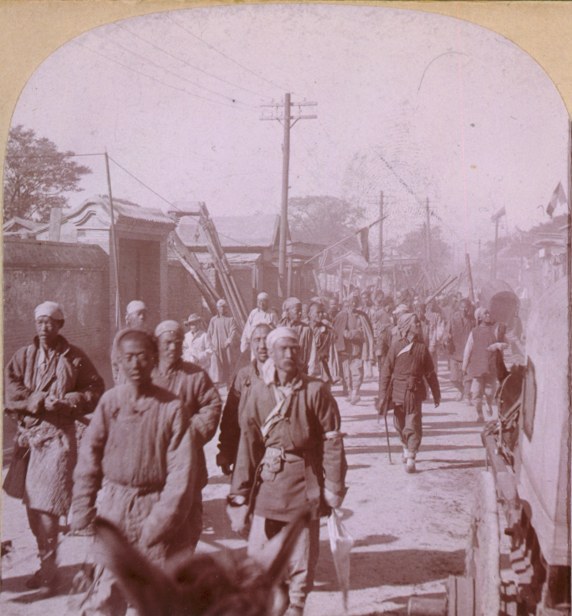
Of course, Jane's talk sent me back to look at other images I've come across – the old photos of the "Boxers" of the Yihetuan (Righteous Harmony Society) that shocked the West at the very start of the twentieth century.


(images of the Boxer Rebellion, from Wikipedia)


Or the attempts in kung fu cinema to imagine the anti-Qing "Shaolin" rebels in the Shaolin cycle.
(lay students survive the burning of the Shaolin Temple, and prepare to spread out to start anti-Qing rebellion across China in Chang Cheh's Shaolin Temple, 1976.)


How do such films attempt to (re)imagine a past of revolution through costume, and how does this relate to the actual attempts of past radicals to figure themselves through dress? There could be a whole research project here...

Monday, 7 May 2012

Hong Kong Riots and Unrest 1966 and 1967 - continued

The following has some colourful first hand accounts and photos of the riots in Hong Kong in the late 1960s.

http://www.britains-smallwars.com/RRGP/HongKong.htm

I found the reference in an article on the history of Shaw Brothers films, which claims that:

"Shaw Brothers and Chang Cheh specifically tried to cater for the audience of 1960s Hong Kong by creating heroes and plots reflective of the times and mood of the 60s [...] This can be pinpointed to 1967 with the Hong Kong Star Ferry riots. Hong Kong became [sic] a state of chaos and rebellion where violence and unrest went on for seven months. Young people in particular were challenging dominant patriarchs and rebelling against the system and the turbulence led to changes in entertainment. The audience needed escapism from the anarchy in reality but the current trends in romantic musicals could not possibly satisfy this new rebellious audience that needed a hero to represent these uncertain times."
http://brns.com/shawbros/pages/shaw3.html


Tuesday, 1 May 2012

"Man of Tai Chi" / Huairou

An interesting news article on developments in the Chinese film industry, and on Keanu Reeves' current tai chi project, from the Independent newspaper:

http://www.independent.co.uk/news/world/asia/hooray-for-huairou-chinese-film-comes-of-age-7624776.html


Friday, 6 April 2012

A Poem: Jia Doa's "The Swordsman"

David Chiang, righting wrongs in Chang Cheh's Have Sword Will Travel (1969).

For Ten Years I have been polishing this sword,
Its frosty edge has never been put to the test.
Now I am holding it and showing it to you, sir:
Is there anyone suffering from injustice?

(Jia Doa, 779-843 AD, translation from James Liu's The Chinese Knight Errant [London: Routledge, 1967].)

Saturday, 18 February 2012

McKenzie Wark on Viénet

In The Beach Beneath the Street: The Everyday Life and glorious Times of the Situationist International (London: Verso, 2011), Wark writes:

"With the failure of the revolution [in 1968], Viénet turned away fromn the critique of urbanism and towards the other pole of Situationist action – détournement. Can Dialectics Break Bricks? (1972) takes a kung fu action film, reorders some scenes, and replaces the subtitles with Viénet's own, making its narrative a rather pointed allegory for the co-option of radical desires by the supposedly left wing of spectacular power. In one scene two Stalinist bureaucrats lounge in a hot tub. One says: 'it seems their latest discovery is to détourn the mass media.' The other replies, 'That, old man, is the beginning of the end.' And the first concludes: 'They are capable of turning our own wooden language to sawdust.' In Viénet's hands, détournement is a Marxist chainsaw. It becomes a tool for remembering what was and forever could be." (153)

Sunday, 15 January 2012

Resistance

"Resistance is on its way to becoming a word of power, emerging alongside the terms 'revolution' and 'reform' that Hegel saw defining the range of modern politics."
Howard Caygill, "Also Sprach Zapata," Radical Philosophy 171 (Jan/Feb 2011):19.
In this sense, resistance is a third term that seems to problematise some of the binary oppositions characterised in earlier posts here (1 May 2011, 29 May 2011). What does 'resistance' do as a term in a project like mine? Does it serve as a term which opens us a productive thinking both of contemporary political practices, and the kinds of popular cultural resources that might include the kung fu film, and which might be considered, in this context, as resources for resistance? Does 'resistance' serve to elucidate a value for these? Or does it serve to mark their limit?

Most of Caygill's article explores Clausewitz (a rather occidental alternative to Sun Tzu et al!). He explores the way that a certain reading of Clausewitz allows us to think him as a philosopher of "the people's war of resistance" (22). Caygill notes that Clausewitz was setting out in his military theory to understand Napoleon's success, and also to understand how Napoleon could be fought – including the emergence of the guerrilla.
"To account for this change in the character of warfare, Clausewitz proposed a redefinition of war. In section 2 of book 1 of, 'Definition,' he defines the end or Zweck of war as to 'render the enemy incapable of further resistance.' So resistance is absolutely central to war – war addresses the enemy's capacity to resist." (22)
Such a foregrounding of "resistance" seems to speak to the kinds of narratives offered in kung fu films. Though the heroes – members of secret societies, loyalists of defeated dynasties, anti-tyrannical monks – are sometimes referred to in the subtitles or dubs as "revolutionaries," that term is perhaps a little misleading. They usually don't have a clear revolutionary agenda, certainly at least in the terms in which Thomas Taylor Meadows set up the term (i.e. in opposition to mere rebellion).

The plots, furthermore, rarely celebrate victorious uprising, the expulsion of the oppressor. What the heroes of the films succeed in, rather than dealing a final blow to their enemies, is precisely becoming heroes; they often die to do so; but their victory can be understood in the way that their inspirational example, even in personal defeat, keeps alive a larger possibility of resistance. The films are set in the darkest hours of defeat and occupation: either in the deepest depths of Qing rule, or, perhaps (as in the case of a film such as Lau Kar-Leung's Eight-Diagram Pole Fighter), at the moment of the slow defeat of the Song state by the Mongolians back in the thirteenth century. Chinese history is seen, in these tales, as a long struggle, and the films express a hope that if the spirit of resistance and the corporeal capacity to fight (as preserved in the martial arts) remain alive, then the war will not be over and the enemy will not be victorious. It is a vision, of course, that is sustained in a vision of the vast sweep of Chinese history, which has been marked not only between recurrent and lengthy "barbarian" occupation, but also each time by the final reversion to Han rule.

Such narratives, and such an account of the essential nature of resistance, might also offer an alternative template through which to valorise or to speculate on the longue durée (Braudel again!) of popular struggle, and the forms of "resistance" of peasants and the like – whether conceived in terms of medieval European uprisings and practices of cussed daily non-cooperation, Hobsbawm's "social banditry," or the sort of Qing-era protest described in Hung Ho-Fung's Protest with Chinese Characteristics (see image of salt riot recently posted!). Such, once again, are hardly "revolutionary" – and are often dismissed for their failure to be such – but nonetheless they perhaps remain essential in terms of keeping alive an "other" culture in the face of the official discourses of power.

In this regard, another of Caygill's remarks, drawing on the implications of applying a Clausewitzian notion of "resistance" to peoples' struggles against the State, is also very descriptive of the kung-fu scenario, and the "longue durée" of poular stuggle alike:
This ... involves the temporality of resistance. The strategy of the weaker – whether [Maoist] guerrilla or [Ghandian] satyagraha – is a strategy of time; the preservation of the capacity to resist involves a refusal to enter the augmenting cycle of violence that is escalation. This refusal means declining the invitation of the state to escalate violence in its pursuit of what Clausewitz called the 'decisive blow' and instead to threaten the State's capacity to resist by temporal distension, by what Mao in 1937 theorized as the 'prolonged war of resistance'. The war of resistance is above all a war for time – with one enemy proposing escalation and the concentration of struggle in a moment, the other responding by prolonging resistance indefinitely" (23-4).
Caygill's essay ends with a rather upbeat account of such resistance, looking in particular at the reminiscences of members of the early stages of the French Resistance movement against the second world war, who found a special aliveness in acts of resistance, and at the sayings of Subcommmandante Marcos of the more recent Zapatista movement, where resistance – as the preservation of resistance – again becomes a kind of an end and a joy in itself. (As in many ways a martial art is – certainly as depicted in martial arts cinema – in the creation and reproduction of the body's autonomy and power.)

However, is this the point where we have to ask questions about Caygill's argument – and perhaps about the politics of the narratives of martial arts films? Is it enough to be able to continue to resist, in the face of a more powerful enemy? Is this an end in itself? Is it enough to think that whilst we still resist an order we despise this keeps alive the possibility that one day, ground down by the slow pressures of non-conformity, or overcome by some external threat, current arrays of power will die away? Does such a conception of resistance in some ways end up complicit with the power one resists, allowing its continuation? In the end is "resistance" necessary (and important to nurture in a way that some revolutionary or reformist movements run the danger of forgetting) but nonetheless not sufficient?

A last question might rotate around the relationship of Caygill's article to its (and our own) historical context. Such an argument for the importance of "resistance" (rather than revolution) seems profoundly conditioned by a certain pessimism with regard to the kinds of possibility for change alive in the present. What does it say of our times to find "resistance" as the most we can hope for?

There are two ways in which this seeming pessimism might be valenced. The first is to judge it negatively: to find in it a failure of the "optimism of the will" and of the utopian imagination necessary to produce a better world. The second would be to recognise that at moments in history where the progressive or radical left is an "afflicted power" somewhat on the fringe of a field of politics (of "war continued by other means") dominated by the capitalist right, then a tactics of resistance – building its networks and its cultures – is highly appropriate, with more directly "revolutionary" strategies basically non-viable. Today's situation may be such a moment; and so, too, might be the context of the growth of the kung-fu genre in the early 70s in Hong Kong, in the wake of the clampdown on labour, radical and democratic groups at the end of the 1960s. Perhaps in some ways, this commonality is why I believe that the political imaginary of the kung-fu genre resonates so strongly with the present.