Friday, 15 January 2016

RIP David Bowie ... Martial Artist?

Introducing an Implausible (But Compelling) Conjunction – Bowie and the Martial Arts 


As I write, it is the week in which David Bowie died, and the media has gone into paroxysms of mourning for him – and quite rightly so, in my humble opinion. I'm quite happy to add to the mountain of obituaries – as a popular cultural figure he's one of the few, perhaps, about whom it would be impossible to write too much. Given the subject of this blog – martial arts cinema – I can perhaps only, however, hymn him as a figure in relation to the martial arts, rather than as a pop star.

But – David Bowie as a martial artist??????? Isn't that – well – rather preposterous?

What's this? Bowie-style high-kicking action? Can it be?

On the one hand, yes, it is a completely preposterous idea. But on the other, I have a certain faith that pursuing impossible conjunctions probably ought to be an important intellectual or academic method, certainly when it comes to the analysis of culture. Some impossible conjunctions (like the one that started me on the body of research of which this blog is just the occasional offshoot) have a power of compulsion behind them and in this case they surely take on the nature of the 'symptom' – the thing which in psychoanalysis calls for explanation and for some form of therapeutic 'working through'. The symptom marks the locus of a desire and a fantasy – and the very constitution of the subject itself. When we leave the analysts couch behind and start to look at culture, the questions might remain, of course: 'whose symptom?' ; 'which subject?' ; 'the symptom of what?' Perhaps the symptoms that I describe here are only mine and they are irrelevant to anyone except for me; but my wager is that they have a wider meaning than that. Perhaps if the paradoxical idea of David Bowie as Martial Artist has already drawn you thus far, through some rather dense academic prose, it suggests that it's your symptom too...

The idea of posing a relation between David Bowie and the martial arts (and in particular Hong Kong martial arts cinema) was, in any case, the subject of a short academic presentation that I gave a couple of years back, in order to give a flavour of my research to colleagues. That paper was called (rather mischievously) 'Panic in Hong Kong, or, David Bowie's Karate Lesson', and it sought to sketch a suggestive network of associations between a European countercultural milieu, in the thrall of a cosmopolitan vision of the global village, which might provide a figure for the valence of Hong Kong cinema as it was taken up in the West in the early 1970s. If it doesn't tell us 'what such films meant' as such, it certainly gives us an image of a set of relations and associations that we can interpret them as having entered into.

In the last few days, as Bowie songs have been going around and around my head, I've found myself thinking about this presentation again. But after all, the figure of return is also another marker of the symptom. So here goes a kind of self-analysis, which will start with me and open out to propose a set of wider cultural significances.

Panic in West Hampstead

Image result for Panic in detroitPerhaps the origin of this presentation – and of the strange conjunction of Bowie and the martial arts as a compelling (if implausible) one for me – lies in my own martial arts training, and in some things that might, if you want to dismiss my association of the two, be put down to accident. (But as Freud notes – there are no accidents in the unconscious.)

My own martial arts teacher is clearly a fan of Bowie, and he will frequently play Bowie songs during our classes. I remember in particular one class – one of the best classes I attended – in which, as we strove as students to draw martial spirit and martial awareness into our tai chi practice, he repeatedly played Bowie's 'Panic in Detroit' (again and again and again), stopping at one point to ask us about whether we knew what the song was about and to ask us why he might think it has something to do with the practice of martial arts. (Although, always enigmatic, he never directly answered that question himself, and left us to figure these things out). In any case, the thundering rhythm section of this song, for us in the lesson, stood the part of the war drums which I always imagine having accompanied military training in historical China. Some of Bowie's songs are simply great to do martial arts to – though that's far from a meaningful answer to the conundrum I'm setting. I think in many ways I 'found' David Bowie through my martial arts practice – as I've actually 'found' a lot of other music that I probably never would have become invested in had I not encountered it through this route. But my finding it is far from accidental. In some respects, I'd suggest, the music found me – there is an element of predestination in my seemingly random experience.


In one respect, well, I like Bowie – but so what? And my teacher's interest in Bowie, a skeptic will argue, may just say a lot about him, and about his particular tastes. There is no significance beyond that. But it also, to begin with, signals something about how old he is, having come into adulthood around the time that Bowie would have rose to fame. Here we are already edging beyond the accidental and the specific. This generational moment, which Bowie must surely signify for him, and from which his interest in Bowie (alongside many other musicians of the same era) must emerge already perhaps marks the conjunction as a significant one. And it is significant, too, in that my teacher belongs to a generation whose coming of age also coincided with the moment when Asian martial arts, too, were emerging (like rock) as a pursuit for disenfranchised youths, looking for meaning in their life. As well as Bowie, the transition from the sixties to the seventies was the moment of the rise of the kung fu film – alongside Bowie arrived 'Grasshopper' and Bruce Lee.

Bowie's first (eponymous) album was released in 1967, the same year as Chang Cheh's breakthrough film, The One-Armed Swordsman, revolutionised Chinese swordplay films. In 1969, as Bowie was recording Space Oddity, King Hu would already have been in the midst of filming A Touch of Zen, which ultimately came to be the first Chinese-language film to win a Grand Prize at Cannes. In 1971, when Bowie released his next album, Hunky Dory (his first album to reach the top 10, climbing to no. 3), Bruce Lee also performed in his first starring kung fu role in The Big Boss. The 'kung fu' film proper had been born. In 1972, the first kung fu films reached the major distribution in America (5 Fingers of Death/King Boxer being the first to receive a screening), and Bowie released The Rise and Fall of Ziggy Stardust and the Spiders from Mars. In 1973, when Aladdin Sane and Pin Ups were released, Lee starred in Enter the Dragon, the first 'Hollywood' kung fu film, and the genre's great global blockbuster. This was the year that 'Panic in Detroit', the song from which we drew so much in our lesson some time in the 2010s in a church hall in West Hampstead, was recorded.

Bowie and martial arts, then, were contemporaneous, synchronous even, I would argue. However, what we might still need to start to think about is whether they were in any sense bound together; and if so, what on earth this unlikely juxtaposition might mean, beyond their simultaneous existence for an audience of young consumers of popular culture.

David Bowie's Karate Lesson

Let's jump then to a particular moment in the media, back in those glory days. David Bowie's Karate Lesson. Perhaps this gives us a snapshot of a kind of significance that Asian martial arts had within a particular nexus, and the way that they entered into a particular world of pop-cultural, subcultural and even countercultural meaning-making.

The date is January 3rd, 1976, and David Bowie is appearing on the Dinah Shore show. Bowie is thin, suave, androgynous, debonair, seemingly shy, but nonetheless exudes a powerful charisma, a gentle grace and his hesitancy or shyness itself functions as a disarming charm. And – to join David, Dinah, the 'Fonz' and Nancy Walker – Bowie has brought on to the show his karate instructor, Dwayne Vaughn. Vaughn is super-fly, fast as lightening, proudly sporting an Afro, looking for all the world like the star of a blaxploitation film, though dressed in his karate gi – a real life 'Black Belt Jones'; or a carbon copy of Jim Kelly's character Williams in Enter the Dragon. (As Williams says of another character: 'Man, you come right out of a comic book!')

No, it's not my fantasy, it really happened.

As the interview unfolds, Bowie talks to Dinah Shore about his motivation for starting karate. It was because a number of friends and band-members were doing so. It was, it seems, in the air in rock'n'roll circles – even (especially?) the circles which must have surrounded as un-macho a form of music as Bowie's gender-bending performances. Bowie talks about the similarities between the discipline of mime he learned at theatre school and those of the martial arts. Karate, it turns out, is, for him, a kind of fast-motion mime. Bowie and Shore, echoing each other's movements, turn a karate block ('wax off'?), which Bowie points out resembles a mime artist running his hands against a pane of glass, into a sort of dance. Dinah adds in a wiggle of the hips, and then bumps hers against the Fonz's, karate providing an alibi for something that floats between an aggressive and a sexually provocative action (both perhaps somewhat taboo behaviours for a 'nice' lady, even in 1976). There's something complex going on here in terms not just of the layers of movement imagery that lie one on the other (dance-mime-martial art), but also of the pastiches of gender performance that aggression-as-flirtation-as-dance-as-karate-as-mime seems to involve. Bowie giggles a little, perhaps like the women professors discussed by Joan Riviere in her famous 1929 psychoanalytic paper on 'Womanliness as Masquerade', who were worried about having asserted themselves too 'masculinely' by being clever, and so feel a need to compensate with an extra, exaggerated show of the 'feminine'. To put it in another, more 'oriental', way, yang and yin need to be balanced in Bowie's complex play of personae.

Next, Vaughan leaps onto the set, appearing on screen mid-way through a flying kick to tumultuous audience applause. Bowie is, he says one of his 'best' students. Vaughn and Bowie perform a miniature 'street defence' lesson, showing off the practicality of karate, where Bowie learns about being attacked by someone bigger than himself. Vaughn iterates the 'oriental' wisdom that the movement and force of the aggressor can be used against them even as they attack. Passivity, or non-aggression is a kind of advantage. When Vaughn opens a sentence, "If I was going to choke you like so..." Bowie cuts in, joking: "I would scream very loudly". The capacity for violence is performed and disavowed at the same time. Vaughn talks of distracting the opponent and then hitting them in the groin (Bowie laughs, and so do the audience at the suggestion of genetalia). Vaughn shows (with Bowie his training partner) a series of strikes – to the groin, kneck, eyes, shins, back – causing Dinah Shore to recoil in camped up mock horror, and the audience to laugh uncomfortably again at this spectacle of rather mild, choreographed violence that's been conjured into prime time television – the acted-out image of a killer art. To a contemporary eye, there's something of Master Ken in all this. (Watching it again today, I expect him to advise restomping the groin).

Vaughn discusses the importance of relaxation in developing speed, discussing the wasted force of tensed muscles, and goes on to perform a lightning-quick, devastating-looking kata, full of power and explosive motion, to rapturous applause.

David Bowie's karate lesson, within the space of prime-time chat-show television, has been a complex affair in which race is performed and negotiated, with Vaughn both expressing and in many ways transcending his 'blackness' through his mimesis of the gnomic and powerful Asian (rather than African) master. Masculinities, too (also in turn raced, and classed) are performed and transcended – the 'thin white duke' (as he was about to become) leaving aside his 'thinness' and 'whiteness' (and suburban Britishness) through the appropriation of the imagery of violence, through his play with pupillage in relation to an African-American karate instructor, and their shared process of 'turning Japanese'. The relation to violence and masculinity (and to a racialised image of the violence or militancy of black masculinity) are conjured onto the screen to be repeatedly disavowed or held within the safe confines of a giggly humour that holds it under erasure. Shore and Nancy Walker both mime out at once a fascination with a form of male potency and also an always-already erased female appropriation of this system of fighting, which no longer requires strength but skill, and so evades the brawn with which more typical forms of Western masculinity are associated.


Panic in Hong Kong

He looked a lot like Che Guevara
Drove a Diesel Van
Kept his gun in quiet seclusion
A very modest Man 
He was the only survivor,
Of the National People's Gang...
(opening lines of Bowie's 'Panic in Detroit' (1973)) 

Bowie's 'Panic in Detroit' was written in 1973, and draws on Iggy Pop's memories, which he had recounted to Bowie, of the radical scene around Motor City in the era of the riots of 1967. The images are dark and despairing, looking back at a madly idealistic moment, in which people who 'looked a lot like Che Guevara' drove Diesel vans, were members of organisations (now stamped out by the violent reprisals of an authoritarian state) called things like the 'National People's Gang', and carried hidden weapons, dreaming of the violent overthrow of capitalism and the liberation of racially oppressed minorities, pot-smokers and the urban poor alike. The character described at the start of Bowie's song is often discussed as having been partially modelled on John Sinclair, manager of the MC5 and founder of the White Panther Party, an organisation that took literally Heuey Newton's suggestion that any white people who wanted to support the Black Panthers' cause should go and found their own version of his party. The White Panthers' ten-point manifesto propounded the 'total assault on the culture by any means necessary, including rock and roll, dope, and fucking in the streets'. The imagery of the song fluctuates between a sort of utopian wish expressed existentially in violence, a melancholic nostalgia for such a lost moment of revolutionary explosion, and the threat of closure of the possibility of such a desire within the already post-modern moment that the transition from the sixties to the seventies seems to mark. The swirling, entropic guitar lines seem to speak of both the darker aspects of violent revolt, but also a pervasive nihilism that seemed to follow in their wake.
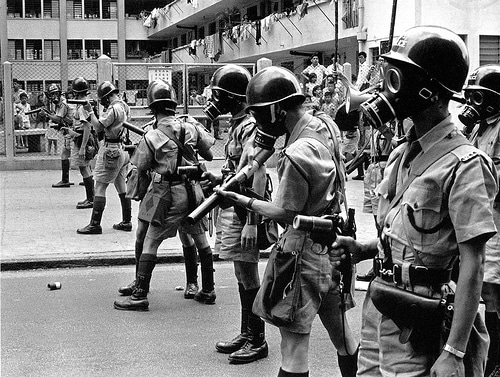
Police in riot gear in Hong Kong, 1967.

In 1967 Hong Kong, where the kung fu film would soon develop, saw its own riots, as pro-Maoist groups sought to capitalise on discontent with injurious labour conditions, inadequate social care and  the (racialised) colonial hierarchies of the era. The Hong Kong riots, like those in Detroit, perhaps did not lead to the kind of radical utopia that some of their promulgators hoped for. In many ways, with Cultural-Revolution China as the alternative to colonial rule, the people of Hong Kong were lucky that the rioters failed to overthrow the Hong Kong state. In both cases, however, perhaps, the violence of the uprisings sent a shock into the system of colonial and capitalist cultures, and contributed to a loosening of a series of forms of repression that typified the world of that era – especially for those not privileged to be white, male, heterosexual, middle class and living in the global 'centre' rather than its peripheries. If they didn't trigger revolution, reform may well have been one of their longer-term consequences.

Both elsewhere in this blog, and also in a longer article (published last summer in Asian Cinema 26.1) about Chang Cheh's film The Assassin, which was made in their wake, I have argued in much greater length for the importance of the Hong Kong riots as a determining factor in the development of Hong Kong's martial arts cinema and the invention of the 'kung fu' film. Their images of violence, I argue run to the logic of the revenge fantasies of the colonial subject described by Frantz Fanon. Fanon's description of the role of violence within the psyche of the colonised subject might be useful in thinking about the nature of the Detroit riots too – and perhaps the need to appropriate and manage a violence which is normally aimed at one, from the outside, in African American appropriations of karate and the martial arts (as discussed, for example, in Vijay Prashad's fantastic book, Everybody Was Kung Fu Fighting).

In that article, I make much of a resonance between Fanon's description of the dreams and fantasies of fantastical physical strength and power that he found common amongst colonised peoples, as a symptom of the desire for metaphorical as well as corporeal liberation, and the kind of imagery so around which kung fu films are structured. Fanon describes dream imagery of being able to outpace lines of traffic in great leaps, and this is curiously echoed in American film critic David Bordwell's much-quoted description of his response to kung fu cinema, which often left him (though a portly academic) with the thrilling illusion as he left the cinema that he, too, could vault parked cars in the parking lot outside. Such car-jumping imagery is echoed once again in Bowie's vision of what's at stake Detroit. My favourite passage in the song runs:

Putting on some clothes I made my way to school
And I found my teacher
crouching in his overalls
I screamed and ran to smash my favorite slot machine
And jumped the silent cars that slept at traffic lights
The 1967 riots of Hong Kong and Detroit were both, perhaps, fore-echoes of the phenomenon that came to be the global unrest of '1968' and Bowie's songs and performances, too – with their audacious renegotiations of sexual, gender and even racial identity – are also a part and parcel of the era of rebellion that has come to be marked by that symbolic year.

And kung fu, too, would fit into this picture if we read it through Bowie. That such a reading is plausible is supported by another, triangulating, narrative (which on its own, again, might be only anecdotal): when Felix Dennis turned away from the vanguard counterculture of OZ magazine (founded again in the magic year of 1967), to become a capitalist, the venture (in that other magically recurring year within my account here, 1973) that spanned his transformation of role from radical activist to publishing magnate was Kung Fu magazine. The craze for kung fu (and Kung Fu) seems to mark both the last glowing ashes of a radical project of anger, hope and emancipation, and its subsumption into a world of commercialised popular culture (rather like Bowie on the Dinah Shore show). The massive success of Kung Fu – largely a vehicle for Bruce Lee fandom – formed the economic ground of what would become a massive publishing empire.

Kung Fu Monthly, covers, with Bruce Lee.

China Girl / Japanese Boy

Bowie's lesson in kung fu also, perhaps, exists within a wider fascination with the Orient in his work. This in turn takes its significance within the context a wider interest of the countercultures – and the longer Western avant-garde with which the counter-cultures allied themselves – with images of the Far East. Bowie developed a complex, rich and rather nuanced (even, at its best, I think, self-critical, parodic) form of this orientalism, particularly focused around Japan – a form which allowed and opened up a space for the renegotiation of a series of traditional 'Western' cultural values and identities.

Bowie in a 'Space Samurai' costume, designed by Kansai Yamamoto,  (I believe 1973).

Fashion historian Helene Thian, for example, has discussed at length Bowie's Ziggy Stardust and Aladdin Sane costumes. These were designed by Kansai Yamamoto. Some were given trimmings of chinoiserie; others formed kimonos covered in Japanese characters; others still were formed into full-blown 'Space Samurai' costumes, echoing in form the hakama still worn by Aikido students today. His performance style was influenced by an early interest in kabuki theatre and especially its onnagata (female impersonation) roles, which were fostered during his years as a drama student under Lindsay Kemp – an added depth of allusion, perhaps, buried in Bowie's recognition of mime in karate movements expressed on the Dinah Shore show. Kemp's version of mime – and his interest in play with gender – were strongly inflected by this fascination with the orient, and both Kemp's and Bowie's acts of redefinition of masculinity were surely both inspired by (their misreadings of) the differences between 'Western' and 'Asian' forms of masculinity – however layered these were by orientalist stereotypes going back to the nineteenth century. Even the famous lightening stripe on Ziggy's face (seen so many times in the press recently) riffed on the make-up techniques of the onnagata which Bowie studied in Kemp's school under Tamasaburo Bando; and Ziggy's quick changes within a performance might also be linked back to the lightening-change techniques of kabuki.

Ch-Ch-Ch-Ch-Changes


Asia offered Bowie (and the hippies more generally) a form of 'becoming-other' within which the self could be reformed. Even if the idealisations of Bowie's 'becoming-Japanese' did not end in Japaneseness as such, and often at the very least ran very close to reiterating dangerous and invidious stereotypes that others have to live with, they nonetheless offered forms of very real self-transformation that empowered young working class people (especially, perhaps, men) and allowed them to resist the forms of interpellation that British (and American) society had hitherto imposed. A very generous reading might suggest that such forms of renegotiation, in deconstructing or undermining the supposedly solid binaries on which the relations between East and West relied, set these relations back into play, opening them up into transformation. Bowie was a key figure in the popular renegotiation of the ideas of East and West – just as Paul Bowman has argued Bruce Lee was.

Something of all this is, I would argue, at play in Bowie's karate lesson, in which, acted out on mainstream TV, a series of complex layers of racial, sexual and gendered identities are performed and renegotiated.

What this might suggest, I hope (though I'm not sure that I can do more than offer a 'suggestive' reading) is a network of countercultural projects in the wake of the 1960s into which the Asian martial arts entered as they became absorbed within Western culture. These contexts were (I am proposing) instrumental in forming at the very least one kind of socio-political significance which martial arts took on in the identity politics of the 1970s (and beyond), and one kind of appeal that may have taken many people – David Bowie himself, but also perhaps a generation of young people across Europe and America – into movie houses and training dojos with the hope of self-transformation. Self-transformation, of course, is, above all, what Bowie has always been about; and it's also been at the root of the appeal of martial arts.

As this is a kind of a tribute, the final words here should go to Bowie himself, along with a kind of toast to see him off. Here's to the hope that even in these difficult times, his project for countercultural change and challenge continues – and that images and practices of the martial arts continue to play a role in its unfolding...
I watch the ripples change their size
But never leave the stream
Of warm impermanence and
So the days float through my eyes
But still the days seem the same
And these children that you spit on
As they try to change their worlds
Are immune to your consultations
They're quite aware of what they're going through...  

Wednesday, 1 July 2015

Wing Chun as Woman Warrior

Michelle Yeoh as Yim Wing Chun in Wing Chun (dir. Yuen Woo Ping, 1994).

Last month I had the great pleasure of attending the first Martial Arts Studies conference, run by Paul Bowman at Cardiff University. It was a fascinating event, bringing together a range of speakers approaching the martial arts from a dazzling array of disciplinary perspectives, including film and media studies, anthropology and ethnography, sociology, medicine, sports science and hoplology. Paul’s project – interrogated at length in his recent (and excellent) book Martial Arts Studies: Disrupting Disciplinary Boundaries (London: Rowman and Littlefield, 2015) – is to start to investigate what’s at stake in such a trans-disciplinary object or field of study, and to set up a dialogue between the very different – often seemingly clashing – approaches to the martial arts. (Some of the keynotes are available online here.)

At the conference, I gave a joint paper along with my colleague susan puisan lok, a fascinating contemporary artist and an insightful theorist of visual culture in general and Asian diasporic experiences in particular. (Susan’s current artistic project, RoCH Fans and Legends, exploring Jin Yong’s Condor trilogy, its many cinematic/televisual adaptations and their global cult following, is of particular interest to me…)

In our paper we looked at representations of gender and the figure of the woman warrior (the nüxia) in the film Wing Chun (dir. Yuen Woo-ping, 1994). It’s a great film, and stars the magnificent Michelle Yeoh at her best.

Our starting point was a quote from actress Cheng Pei-pei, who recounted in an interview clashing with director Chang Cheh during the filming of Golden Swallow (1968) when he directed his male actors to leave a scene leaping through an open window, whilst he expected Cheng to walk through the door. Cheng refused, insisting that her character – a swordswoman – would leave through the window too.

Cheng Pei-pei playing a cameo as Wing Chun's teacher, the Abess Ng Mui in Wing Chun.  

Entrances, exits and other interactions across windows also seemed to us to be an insistent and structuring conceit in the construction of Wing Chun, with Yeoh’s character, Wing Chun herself, for example, leaping through a window to do battle with villains in the very first scene. Our concern was not just with how Wing Chun moves through these spaces, though, but also its other characters: its array of clownish and inadequate men, who sketch out a patriarchal system of authority in crisis, and the three sympathetic women who provide the core of identification and moral value within its narrative. Wing Chun lives with her Aunt Feng, a shrewd and entrepreneurial businesswoman, and they run a Tofu shop together. They take in a third woman, Yim Neung, who has been widowed and reduced to the point of selling herself for her husband’s funeral. Between them, they seem to sketch out three potential strategies for women (in its fictive world – and perhaps also in ours?) to make a living/life for themselves, in Wing Chun’s martial skill and heroism, Aunt Feng’s economic acumen, and Yim Neung’s “feminine” attractiveness.

Wing Chun, Aunt Feng and Yim Neung discuss their negotiation of gender expectations.

Our visuals for the paper, as we presented it, re-edited and slowed down all the scenes from the film where characters interact with windows and doors, revealing another kind of cinematic “choreography” to the work than fight choreography (though sometimes the two choreographies overlap).

These thresholds structure the space of the film (organised concentrically around the inner sanctum of the home – gendered female – out through the courtyard of Wing Chun’s house, through the shop-window which interfaces with the male and public realm of the street and the market, and out beyond the town into the wilderness in which bandits live. Windows, in particular, seem to mark liminal zones through which one may pass illegitimately with the athleticism of the warrior (xia/nüxia). They are also implicated, as “framing” devices, in the films scopic regimes, which are often phallocentric and voyeuristic, embodying a male gaze that often seems to belie the extent to which the film askes us to identify primarily with its female protagonists. But Wing Chun’s ability to pass through the window perhaps also marks a degree to which she is able to subvert and escape the framing power of such a gaze, and the normative social roles that it imposes on women. The ability to leap through the window, we argued, was related to Wing Chun’s propensity throughout the film towards cross dressing – another passage from one gendered social “frame” to another: her ability to step beyond the sanctioned social roles of femininity and embrace the conventionally “masculine” powers of the warrior.

Using some of the now growing literature on this film (esp. Sasha Vojkovic), some of the wider discourses on the figure of the woman warrior in Hong Kong/Chinese cinema (e.g. Lisa Funnell), and on Chinese masculinity/femininity in the wider sense (Kam Louie, Kwai-Cheung Lo) – combined with discussions of “queer theory” insights into cross dressing (Halberstam, Butler), we examined Wing Chun’s ability (and that of the film’s other characters) to cross gendered roles and spaces.

The next step will be to turn this into a paper for publication – but in the meantime, please feely free to contact me for further information on the paper as it stands!


In the meantime, here's the trailer for the film!


Wednesday, 1 October 2014

Hong Kong Mega-protests: From the Leftist Riots of 1967 to Occupy Central, 2014

Police leap into action during the Hong Kong riots, 1967.


Over the Summer I have been working on article on the relation between Chang Cheh's The Assasin (Da Ci Ke, 1967), and the Hong Kong Riots of 1967 - a connection which Chang himself has made repeatedly in articles and in his memoirs.  (The 1967 riots are a theme I've mentioned a couple of times here already.) However, just as I have been finishing my article with a view to sending it for publication, it's suddenly developed a new degree of topicality, what with the recent mass-scale protests in Hong Kong, and so I feel I need to do a little more untangling what and whether there is a relationship here. Cue the blog – whose immediacy might help me get together a few first thoughts about 1967 and 2104. Does it make sense to mention both in the same breath?

Of course, the two events were very different – the Hong Kong Leftist Riots of 1967 were, to start with, distinctly violent, and extremist, in contradistinction to the Ghandiist non-violence espoused by the leaders of the current demonstrations, who, in spite of the name "Occupy" which in the West is associated with a rather minority position at the leftmost edge of the political spectrum, are generally clearly very much political liberals. 

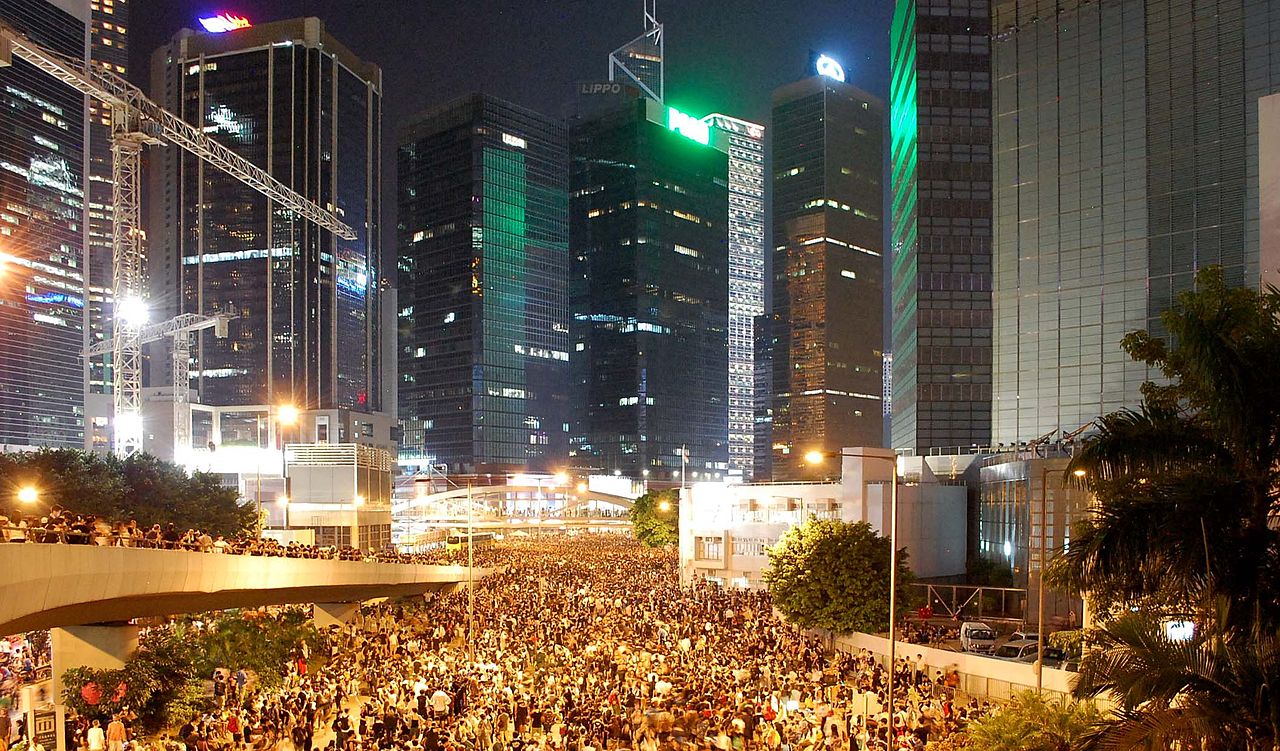
Occupation in Causeway Bay, 2014, photo by Citobun, from Wikimedia. CC BY-SA 4.0 license. 


Sit-in in Harcourt Road, Admiralty, 29/09/14, photo by Citobun, from Wikimedia. CC BY-SA 4.0 license 
The Hong Kong Leftist Riots also developed in a very different context: that of colonial occupation, a systematically racist government, and startling inequality at a time when hundreds of thousands lived in Hong Kong's slums, some 45% were below the poverty line, with little healthcare or educational provision for the poor, and ultimately little protection offered to them by the forces of law and order. And definitely no democracy. [1] Triggered by a series of strikes over labour conditions and pay in Hong Kong's factories, the conflict of workers with the factory-owners and the Hong Kong authorities were escalated by Leftist groups who felt, in the shadow of the Cultural Revolution, that they would be remiss if they did not militate for revolution in the heart of a capitalist, colonial Chinese enclave, and it is clear that their final hope was that the Red Army would step over the border to give them aid, returning Hong Kong to the mainland. The '67 riots were a significant breach of order, and caused a draconian crackdown from the British authorities on Leftist and militant groups – a crackdown that makes the teargas and pepper spray used so far by the police in the current disturbances look decidedly mild. (I very much hope that the state violence against the current protesters does not escalate, though such hopes seem rather unrealistic. We can only cross our fingers.) As cited by Gary Ka-wai Cheung, the author of a book-length study of the 1967 Leftist Riots (Hong Kong's Watershed: The Leftist Riots), the official figures are a staggering 51 dead at the end of the disturbances, and 4,979 arrested. [2] Most of the dead here seem to have been Leftists killed in the police crackdown and in police responses to the riots; however, the movement was a distinctly violent one, turning (in response to brutality from the authorities) increasingly to terroristic means, with a series of bombings bringing the city to a halt and losing the campaign what legitimacy it had with the wide public.

I am generally unclear as to the extent of support for the 1967 campaign. As Cheung draws a picture of it, there was certainly some widespread enthusiasm and sympathy at the start, with regards to the demands of the striking workers, and also fuelled by an unrest at continuing colonial conditions. However, the general Hong Kong populace was suspicious of the extremism of the movement – and increasingly so as it unfolded. However, the scale of the riots seems to have been larger than the support base the Cheung seems to imagine for them, and the testimony he cites of the time suggests a certain amount of (sub-)proletarian rage being vented at the police during the disturbances, suggesting to me that we are not just dealing with a politically isolated pre-Beijing clique of  militants, however much these groups may have attempted to steer the events. I find myself wondering whether there may be a kind of split between the polite opinion of the public sphere, to which Cheung seems keyed, and a lower sphere of "mass" response – and I am thinking here of the distinction that Chen Kuan-hsing makes between "civil society" (minjian shehui) and "popular democracy" (renmin minzhu). [3] This popular political sphere may be largely invisible in Cheung's account – but I am not a primary historian of the times and can only speculate on this…

In many ways, then the 1967 riots offer few clear parallels for the present situation, though it's perhaps worth noting that – certainly according to Cheung, who dubs them the "watershed" of modern Hong Kong history – they are the event above any other that established the (limited) freedoms and happinesses that Hong Kong citizens seem to be protesting to protect today. The initial political response to the 1967 riots was strong, with tight censorship over the press and the arts, but in order to forestall more thoroughgoing change, the British administration set about wide-reaching reforms of housing,  healthcare and welfare. They established anti-corruption campaigns, started the negotiations with China for the return of Hong Kong, and, with  a generally moderate response from the citizens of the island to the Leftists' call to arms noted, they started to introduce forms of public consultation, bringing the Chinese population more squarely into the civic processes of the colony, and fostering the development of institutions of the public sphere. The longer results, then were paradoxical – a society in which politics became something of a taboo, but where new political freedoms and participation were nurtured; the parallel growth of an identity of HK as a separate people to those in the mainland; increased cultural confidence; and the inclusion of poorer people within the economic part of the social contract.

However, one of the things that seems fascinating to me is that within the debates on the current protests, 1967 is so rarely mentioned. Newspapers (and, of course, my main source of information is Western newspapers) will often mention that political disturbances in Hong Kong of the scale of the current one are rare in the island's history, and some even paint them as unprecedented. In this regard – however qualitatively different the two events were – it seems striking that the last political disturbance that rivals (and even outstrips) the current events in scale is so very rarely brought up.

Of course, there are different reasons for this. Within a Western media, "1967" doesn't mean much to readers who have never heard of it. And it's much more convenient to trot out stereotypes of the Hong-Kong Chinese as an orderly, peace-loving and business-minded people, generally not interested in politics. As much as some of this has factual basis, of course, it is also deeply in line with a set of orientalising stereotypes. The idea of these protests as "unprecedented" also plays well into discourses that would like to play up the exceptionalism of this as a moment. Such amnesia would also highlight what is new in the situation – Chinese Communist Party rule rather than the British – and serves to sever links between the present events and continuing traditions of unrest in colonial-era Hong Kong. This allows the Western press to paint a picture of British rule as implicitly benign and free – when in fact, as the 1967 riots highlight, there was certainly no democracy at all for most of the 150 years of colonial occupation, and only minor reforms offered in the final years before hand-over, and it was only serious rioting that forced the British colonial powers to give the mass of ordinary people of Hong Kong any kind of piece of the economic pie.

However, there may also be Chinese reasons why 1967 is rarely mentioned in the discourses around 2014. The historical amnesia about these events has in fact been more generally systematic. Cheung opens his book noting that in the Hong Kong Museum of History there is not a single exhibit or panel mentioning the Leftist Riots. The British government wanted to forget them for obvious reasons. The Communist Party in the mainland was never really behind the riots, and it is far from a glorious episode in revolutionary history for them, either. Plus which, the Party often does not want to foster modern forces of protest and revolt that it may not be able easily to manage. 

In the present context, the demonstrators, too, may not want to look back at the Leftists of the sixties as their political ancestors, either: this would involve a certain paradoxical identification with the enemy (with Communists). Such an identification with a violent, and to large extent proletarian moment would also sit extremely uncomfortably with the moderate, liberal values which the current protest seems to embody. For spokespeople or supporters to make these comparisons may well seem like stirring up illegal revolt in a way that they would not like.

An interesting example of 1967-amnesia is a recent quote from Hung Ho-fung offered by a British newspaper, which I found very surprising because Hung is a scholar I respect very deeply, and who has looked into histories of Chinese protest going as far back as the seventeenth and eighteenth centuries, and who has written specifically about the histories of the left in Hong Kong in the New Left Review. [4]  From evidence of that article, Hung certainly knows quite a bit about 1967, and has been one of my own key sources in finding out about it. However, here he is in The Guardian

“This is a watershed,” said Hung Ho-fung, of Johns Hopkins University. “This time people are using civil disobedience and setting up barricades. There’s also the disruptive aspect; in the past, they emphasised that demonstrations would not affect everyday life. This time they really don’t care. I really haven’t seen anything like this in Hong Kong history.” [5]
It's interesting that Hung uses precisely the terms of the title of Cheung's book on 1967 – a "watershed" –  to describe the current events. i would be very surprised if Hung does not know of this book, and wonder if it is an unconscious referent in his statement. The idea that disruption is a new thing would seem a striking idea here – certainly it seems new within recent demonstrations, but to then claim that such is a total novelty "In Hong Kong history" seems surprisingly to repress the memory of 1967. Of course, I may be reading far too much into an offhand media interview, and there may be an editor's or journalist's compression creeping in to distort what Hung actually said. He may mean, in his last sentence, simply that the event, as a whole, is a very new thing in Hong Kong – and with some of the major differences between it and 1967 which I've noted above, it certainly is that…. 

Notes

[1] For more on the situation in Hong Kong, in the sixty , see for example Poshek Fu, “The 1960s: Modernity, Youth Culture and Hong Kong Cantonese Cinema", in David Desser and Poshek Fu (eds), The Cinema of Hong Kong: History, Arts, Identity (Cambridge: Cambridge University Press, 2000), pp. 73-4; Verina Glaessner, Kung Fu: Cinema of Vengeance (London: Lorimer, 1974), p. 15; Hung Ho-Fung, “Uncertainty in the Enclave,” New Left Review, no. 66 (Nov/Dec 2010), p. 57; and of course Gary Ka-wai Cheung, Hong Kong’s Watershed: The 1967 Riots (Hong Kong: Hong Kong University Press, 2009.

[2] Most of the material in this paragraph is drawn from Cheung's account. For the figures in question, see p. 123.

[3] Chen Kuan-hsing, Asia as Method: Toward Deimperialization (Durham: Duke UP, 2010), p. 230. 

[4] The article is cited in my note above!

[5] "Hong Kong: More Join Protests as Crowds Are Urged to Keep Going" The Guardian, 29 Sept, 2014, online ed: http://www.theguardian.com/world/2014/sep/29/-sp-hong-kong-protests-more-join-crowds-urged-keep-going-national-holiday (accessed 1 Oct 2014).

Saturday, 27 September 2014

Hito Steyerl - November

Hito Steyerl, November (2004)

Amongst many other things, Hito Steyerl's film November (2004) provides – within the realm of contemporary art practice – a startling reflection on some of the themes that I have been starting to explore on this blog.

The film traces the enigmatic figure of Andrea Wolf through a series of circulating media representations. Wolf - the film tells us - was a teenage friend of Steyerl, and the star of Steyerl's first movie, a home-made teenage feminist appropriation of martial art and exploitation tropes, shot on super-8 back in the 1970s. Only the action scenes were ever made, and the film involves a group of girls seeking out and beating up men for reasons that no longer seem clear to Steyerl herself, reprising imagery from Russ Mayer's Faster Pussycat, Kill, Kill!, a film that Steyerl notes is "tacky," and which is ideologically dubious to say the least, but which nonetheless seems here to have provided a model of identification within which feminist (or at least proto-feminist) desires could be negotiated by the young, somewhat radical, women who took part in Steyerl's shoot.

A still from Steyerl's early movie, reproduced in November shows Andrea Wolf,  age of 18. 
Wolf, however, also went on to lead a life involved in rather more actual radical politics, becoming involved in far-left groups in the orbit of the Red Army Faction, and ending her days in Turkey as a guerrilla with the Kurdish PKK. It was there that she met a tragic death, executed by the Turkish authorities. The fantasy violence of teenage identifications with media images are transformed into the messy real life violence of war. Wolf, however, was turned once again into a media image, in the guise of a political martyr, and made to circulate once more in the realm of imaginary identifications and kitsch fantasies.

Kurdish propaganda poster celebrating Andrea Wolf (with her assumed Kurdish name of Sehit Ronahi) after her death as a revolutionary martyr. These images were used on marches by PKK-sympathetic groups. 

Within her exploration of the power of images – in their continual circulation and with their continual transformations of meaning, to feed into reality, producing myths that are then performed – Steyerl's film includes a meditation on the martial arts cinema with which she and Andrea Wolf alike were obviously so fascinated as youths – Steyerl making a home-made B-Movie homage to the genre as her first directorial experiment, and Wolf taking up karate as a part of her self-creation as a militant, as an act, if you like, of self-empowerment. In November, Steyerl also recounts the myth of Bodhidharma travelling from India to China and founding the Shaolin Temple, creating the archetype of the lone, wandering warrior, dedicated to truth and justice and fighting the strong and the tyrranical with bare hands alone. It was a myth spread globally by the martial arts movies that boomed in the seventies, even finding its way into avant-garde texts such as René Viénet's Situationist classic Can Dialectics Break Bricks? – a film I've started to discuss elsewhere on this blog, and which Steyerl quotes at a number of points in her own twenty-first century revisitation of the "kung fu" moment.

Still from Steyerl's early film, as reproduced in November.
Of course, as much contemporary scholarship has set out to show, the story of Bodhidharma and the story of a Shaolin rebellion is so much myth, constructed largely only in the twentieth century, under the radical modernising programmes of the Nationalists and Communists, which sought to co-opt the physical cultures of martial arts into a nationalist revival of the body politic. Much of the discourse around the martial arts (and out of which martial arts cinema emerges) seems to hinge on the obsessive and contrary acts of making and unmasking myth. It has recently become something of an industry to debunk the Chinese martial arts' claims to older and more subversive histories, with writers in particular such as Peter Lorge and Stanley Henning in the forefront.

But this, for me, is where Steyerl's complex negotiation of the territory trumps the demythologisers. Her film at once criticises and lays bare the treachery of images and myths, their mutability, their seductive but dangerous power, and their ability to never quite mean what you want them to mean, even in your own acts of appropriation; but it also seems to embrace the productive power of myth, and of popular culture as a site of its circulation. Myth is the very power (the puissance, as Lacoue-Labarthe put it)[1] to produce a self and a position in the world, however compromised such a position may become by the instability of representation, and the powers that already colonise the image. The grasping and active, critical renegotiation of myth, rather than its simple rejection, becomes an important emancipatory activity.

In marking this complexity and ambivalence, Steyerl manages to avoid the trap into which the martial arts mythbusters fall. Such mythbusters fail to grasp the mythological power of their own acts of demythologisation. Thus when the Jingwu academy, back in the early twentieth century, broke the image of the Shaolin Temple as the fount of martial arts (a myth at that point not actually that old), it was only to replace it with the myth of the patriotic Huo Juanjia and his death at the hands of Japanese oppressors. And similarly it seems hardly co-incidental that at the moment when there is a rage for Western Scholars such as Lorge and Henning who (to put it a little crudely and to exaggerate just a little) deracinate the cultural aspects of Chinese martial arts in order to turn them into objects of comparative study, this is actually also the moment of the rise of Mixed Martial Arts (MMA), perhaps one of the most reactionary forms of martial artistry since the kung fu craze, in its gender politics as well as its spectacularisation of violence as pay-per-view spectacle, and one that also pretends to a "scientific" and trans-cultural neutrality in order to assert its suppose superiority over backwards forms of ("foreign") traditional practice. Such a scientism is in its own way an ultimate form of magical and mythologising gesture, set now under capitalist imperatives for making money.

(Some interesting analysis of the mythical nature of MMA and the like has recently been given in the "Martial Arts Studies" edition of JOMEC, to which I also contributed – see in particular Paul Bowman's reflection on "realism" in contemporary martial arts, and Daniele Bolelli's analysis of the role of "Gladiator" movies in the forming the nature of the visual spectacle of MMA. But I digress...)

Steyerl's film is called November. Within the film, the title is explained through the contrast to the revolutionary moment of October, a moment where things appear simple and true, and revolutionary action can be grasped confidently. By November, things are looking much more tangled and messy, the revolutionary enthusiasm shown as always already compromised by – and fallen into – the false images on which it depended. Steyerl doesn't retreat from problematising a radical legacy in her self-construction as a critical leftist, noting the ways in which in real history the "good guys" (even Andrea Wolf) are often not nearly as innocent or lilly-white as their mediatised images. November is a time of distrust and scepticism. It's a time when identifications need to be rebuilt, but also when they need to be guarded against.

It seems to me that martial arts cinema as a global phenomenon was always a cinema of "November" - a cinema of the aftermath – springing up in the wake of the global wave of decolonisation and the protests of "1968." It was always a cinema where the real had passed into its simulations and its uncanny (and untrustworthy) imagistic doubles. The question might remain, however, of the "truth" that such images nonetheless might carry into the present.

November, then is a time of haunting. A time, as Derrida might suggest, quoting Hamlet "out of joint." (See his Spectres of Marx.) Steyerl seems to capture this haunted and haunting quality of media images very well, neither there nor not-there. To live in the realm of media images is to live a haunted existence.

Perhaps this is the point, more generally, with the martial arts film, too. Even if the myths they recount don't simply tie us to a simple continuity with the past, in the way that official Chinese Communist Party histories sought to imagine the Boxers Rebellion, the Taiping Rebellion, the uprisings of the Hongmen (Tiandihui), or further back peasant revolts such as that of Li Zicheng, in their own image, there seems to me to remain the question of what it is that returns in them, what haunts them, from elsewhere, as it were.

Steyerl's film can be seen here:
http://vimeo.com/88484604

Note
[1] According to Lacoue-labarthe, myth "is a 'power' [puissance], the power that is in the gathering together of the fundamental forces and orientations of an individual or a people, that is to say the power of deep, concrete, embodied identity." See his Heidegger, Art and Politics, p.93.