Showing posts with label Mao. Show all posts

Thursday, 7 February 2013

Fashioning the Kung Fu Revolution? Flowing Robes, Zhongshan Suits and the "Army in Black Pyjamas"

This evening I attended a very interesting talk at Middlesex University (where I work), by Fashion Theorist / Design Historian Jane Tynan, whose research has mainly investigated military dress. Her talk was about the ways that the Irish revolutionaries of the abortive 1916 Easter Rising set out to create an identity for themselves through uniform. Though many of the leaders of the movement clearly had quite grand ambitions for fashioning their troops as a modern, disciplined force, in practice for activists on the ground uniform was necessarily a matter of sporadic, bricolaged elements, and the images that ended coming out of the rising were of a rather ragtag, motley, anarchic anti-colonial force.

The talk made me think of a paragraph that ended up on the "cutting room floor" of an article I've recently submitted to a journal. The paragraph was about the ways that dress in Hong Kong kung fu films, in the late 60s and early 70s, increasingly moved away from the flowing, aristocratic robes of the earlier wuxia films towards the peasant "black pyjamas" of Bruce Lee.  Vijay Prashad has suggested in his fascinating book Everybody Was Kung Fu Fighting, that in the context of the anti-colonial unrest of the era, Lee's outfit was powerfully loaded in terms of class and anti-colonial identity – for Prashad (who was himself at the time of the release of Lee's films a teenager starting to become involved in an Indian Marxism profoundly influenced by Maoism), Lee's attire could hardly but remind a viewer of the Vietnamese "army in black pyjamas" that also repeatedly graced the screens of the era with images of Asian underdogs kicking US imperialist butt...

(Bruce Lee in Fist of Fury, 1972 - kicking imperialist butt whilst wearing black pyjamas, the uniform of Asian anti-colonial resistance...)


This is also a kind of an imagining – or at least a re-imagining – of  the "fashioning" of early twentieth-century revolt...

A further sartorial figure within this 1970s Hong-Kong attempt to imagine – and re-enact – the style of revolution was, of course, the Zhongshan suit that was worn so stylishly by Bruce Lee in Fist of Fury (1972).  Lee's Zhongshan is white, which, of course, in China, is the colour of mourning. This, though, in the context of Lee's character's fury against the murder of his teacher by a foreign occupying power, is a peculiarly politicised, nationalist, anti-colonial kind of mourning.

(Bruce Lee's white Zhongshan in Fist of Fury)

The Zhongshan must have been  a profoundly loaded piece of clothing in the early 70s. The Zhongshan suit, in fact, is named after the nationalist revolutionary Sun Yat-sen, whose most popular name amongst Chinese is in fact Sun Zhongshan (zhong means centre, and shan means mountain). The Zhongshan was a suit designed by the nationalist revolutionaries to express their political values immediately after the revolution of 1912. (Sun himself is said to have had a hand in its design.) It was, first and most obviously, a rejection of the Manchurian styles of dress of the Qing Dynasty, which had been used very much as a form of social control. The style of the Zhongshan seemed to borrow much from the Western suit, but clearly gave it an oriental twist, both making a claim for modernity, but also marking a difference to the hated Western powers which had beset China over the preceding centuries. In fact, the suit made a clear reference to contemporary Japanese military cadet uniforms, which Sun would have seen during the years of his exile there, with Japan also serving as the model of a successfully modernising East Asian nation. (I can hardly but make a nod here to Jane Tynan's discussion this evening of the militarisation which must have pervaded Irish society at exactly this point in time, with the development of the militias who she discussed in her talk, and who went on to take part in the 1916 uprising. The zhongshan was also a means to bring a military iconography into the everyday.)

The Zhongshan, however, is better known in the West now as the "Mao suit" – the Chinese communists took up the style during their alliance with Sun Yat-sen's nationalist party, and the fashion stuck with them. One wonders quite how Bruce Lee's (super-sylish, minimal and perfectly tailored) Zhongshan would have been read at what was still the height of the Cultural Revolution, where the Maoist Zhongshan (rather less fashionable though this version may have been!) was very much the uniform of the day for mainland males, made to symbolise the unity of the Chinese proletariat. In the wake, still, of the 1967 disturbances, and in the shadow of a continuing student movement, how would this clothing have made sense in Hong Kong in 1972?

(Both Mao and Chang Kai Shek are pictured here wearing the Zhongshan.)

Interestingly, director Chang Cheh (discussed elsewhere on this blog, with regards to the ways that his work was intertwined with the 1967 Hong Kong riots, and the ways his films are haunted by this radical moment) has claimed that Lee took these suits from his own prior film, Vengeance! (1970)Indeed, in this, David Chiang also wears both black and white suits that Lee's own are very close to in style, and Chiang even perhaps outdoes Lee in looking dapper and stylish, the white Zhongshan, in Vengeance!, serving as a canvas for Chang's signature motif of a drenching in lurid red blood, the glamour of the garment gaining from Chang's tragic heroism.

(David Chiang's black Zhongshan in Vengeance!, 1970)


It's interesting that when Chang discusses the suit he (or at the very least his translator) calls it a "white student uniform (or Zhongshan suit)" [The Making of Martial Arts Films, p.22] - making a connection to student movements. In this regard (and in particular in the light of Chang's attempt earlier in the same essay to link his films to the student movements of the 60s), Vengeance! starts to become legible as a kind of a political allegory, with David Chiang's youthful hero figuring as a terrible force of retribution. His individual struggle against the corrupt system of power, wealth and authority that has murdered his brother and attempted to cover up the crime starts to signify a larger failure of established hierarchies, and a youthful, iconoclastic revolt against these.

(When David Chiang wears white, you know things are about to turn sour for all involved...)

(David, you'll never get the stains out of that!)

(Is anyone going to be left alive at the end of this film???)


Of course, Jane's talk sent me back to look at other images I've come across – the old photos of the "Boxers" of the Yihetuan (Righteous Harmony Society) that shocked the West at the very start of the twentieth century.

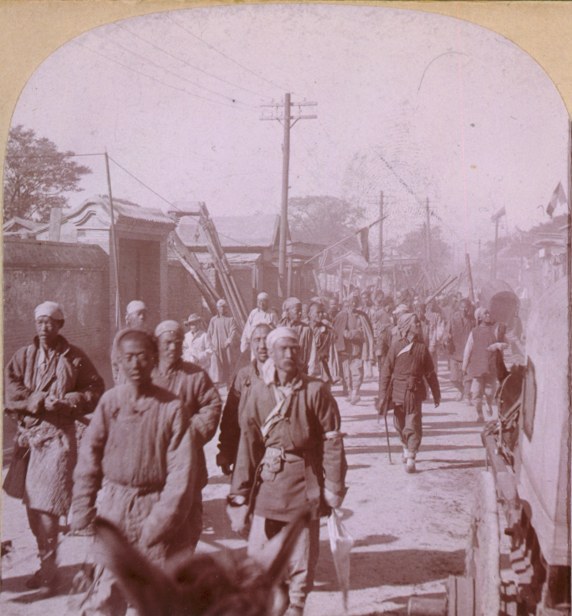
(images of the Boxer Rebellion, from Wikipedia)


Or the attempts in kung fu cinema to imagine the anti-Qing "Shaolin" rebels in the Shaolin cycle.
(lay students survive the burning of the Shaolin Temple, and prepare to spread out to start anti-Qing rebellion across China in Chang Cheh's Shaolin Temple, 1976.)


How do such films attempt to (re)imagine a past of revolution through costume, and how does this relate to the actual attempts of past radicals to figure themselves through dress? There could be a whole research project here...

Sunday, 15 January 2012

Resistance

"Resistance is on its way to becoming a word of power, emerging alongside the terms 'revolution' and 'reform' that Hegel saw defining the range of modern politics."
Howard Caygill, "Also Sprach Zapata," Radical Philosophy 171 (Jan/Feb 2011):19.
In this sense, resistance is a third term that seems to problematise some of the binary oppositions characterised in earlier posts here (1 May 2011, 29 May 2011). What does 'resistance' do as a term in a project like mine? Does it serve as a term which opens us a productive thinking both of contemporary political practices, and the kinds of popular cultural resources that might include the kung fu film, and which might be considered, in this context, as resources for resistance? Does 'resistance' serve to elucidate a value for these? Or does it serve to mark their limit?

Most of Caygill's article explores Clausewitz (a rather occidental alternative to Sun Tzu et al!). He explores the way that a certain reading of Clausewitz allows us to think him as a philosopher of "the people's war of resistance" (22). Caygill notes that Clausewitz was setting out in his military theory to understand Napoleon's success, and also to understand how Napoleon could be fought – including the emergence of the guerrilla.
"To account for this change in the character of warfare, Clausewitz proposed a redefinition of war. In section 2 of book 1 of, 'Definition,' he defines the end or Zweck of war as to 'render the enemy incapable of further resistance.' So resistance is absolutely central to war – war addresses the enemy's capacity to resist." (22)
Such a foregrounding of "resistance" seems to speak to the kinds of narratives offered in kung fu films. Though the heroes – members of secret societies, loyalists of defeated dynasties, anti-tyrannical monks – are sometimes referred to in the subtitles or dubs as "revolutionaries," that term is perhaps a little misleading. They usually don't have a clear revolutionary agenda, certainly at least in the terms in which Thomas Taylor Meadows set up the term (i.e. in opposition to mere rebellion).

The plots, furthermore, rarely celebrate victorious uprising, the expulsion of the oppressor. What the heroes of the films succeed in, rather than dealing a final blow to their enemies, is precisely becoming heroes; they often die to do so; but their victory can be understood in the way that their inspirational example, even in personal defeat, keeps alive a larger possibility of resistance. The films are set in the darkest hours of defeat and occupation: either in the deepest depths of Qing rule, or, perhaps (as in the case of a film such as Lau Kar-Leung's Eight-Diagram Pole Fighter), at the moment of the slow defeat of the Song state by the Mongolians back in the thirteenth century. Chinese history is seen, in these tales, as a long struggle, and the films express a hope that if the spirit of resistance and the corporeal capacity to fight (as preserved in the martial arts) remain alive, then the war will not be over and the enemy will not be victorious. It is a vision, of course, that is sustained in a vision of the vast sweep of Chinese history, which has been marked not only between recurrent and lengthy "barbarian" occupation, but also each time by the final reversion to Han rule.

Such narratives, and such an account of the essential nature of resistance, might also offer an alternative template through which to valorise or to speculate on the longue durée (Braudel again!) of popular struggle, and the forms of "resistance" of peasants and the like – whether conceived in terms of medieval European uprisings and practices of cussed daily non-cooperation, Hobsbawm's "social banditry," or the sort of Qing-era protest described in Hung Ho-Fung's Protest with Chinese Characteristics (see image of salt riot recently posted!). Such, once again, are hardly "revolutionary" – and are often dismissed for their failure to be such – but nonetheless they perhaps remain essential in terms of keeping alive an "other" culture in the face of the official discourses of power.

In this regard, another of Caygill's remarks, drawing on the implications of applying a Clausewitzian notion of "resistance" to peoples' struggles against the State, is also very descriptive of the kung-fu scenario, and the "longue durée" of poular stuggle alike:
This ... involves the temporality of resistance. The strategy of the weaker – whether [Maoist] guerrilla or [Ghandian] satyagraha – is a strategy of time; the preservation of the capacity to resist involves a refusal to enter the augmenting cycle of violence that is escalation. This refusal means declining the invitation of the state to escalate violence in its pursuit of what Clausewitz called the 'decisive blow' and instead to threaten the State's capacity to resist by temporal distension, by what Mao in 1937 theorized as the 'prolonged war of resistance'. The war of resistance is above all a war for time – with one enemy proposing escalation and the concentration of struggle in a moment, the other responding by prolonging resistance indefinitely" (23-4).
Caygill's essay ends with a rather upbeat account of such resistance, looking in particular at the reminiscences of members of the early stages of the French Resistance movement against the second world war, who found a special aliveness in acts of resistance, and at the sayings of Subcommmandante Marcos of the more recent Zapatista movement, where resistance – as the preservation of resistance – again becomes a kind of an end and a joy in itself. (As in many ways a martial art is – certainly as depicted in martial arts cinema – in the creation and reproduction of the body's autonomy and power.)

However, is this the point where we have to ask questions about Caygill's argument – and perhaps about the politics of the narratives of martial arts films? Is it enough to be able to continue to resist, in the face of a more powerful enemy? Is this an end in itself? Is it enough to think that whilst we still resist an order we despise this keeps alive the possibility that one day, ground down by the slow pressures of non-conformity, or overcome by some external threat, current arrays of power will die away? Does such a conception of resistance in some ways end up complicit with the power one resists, allowing its continuation? In the end is "resistance" necessary (and important to nurture in a way that some revolutionary or reformist movements run the danger of forgetting) but nonetheless not sufficient?

A last question might rotate around the relationship of Caygill's article to its (and our own) historical context. Such an argument for the importance of "resistance" (rather than revolution) seems profoundly conditioned by a certain pessimism with regard to the kinds of possibility for change alive in the present. What does it say of our times to find "resistance" as the most we can hope for?

There are two ways in which this seeming pessimism might be valenced. The first is to judge it negatively: to find in it a failure of the "optimism of the will" and of the utopian imagination necessary to produce a better world. The second would be to recognise that at moments in history where the progressive or radical left is an "afflicted power" somewhat on the fringe of a field of politics (of "war continued by other means") dominated by the capitalist right, then a tactics of resistance – building its networks and its cultures – is highly appropriate, with more directly "revolutionary" strategies basically non-viable. Today's situation may be such a moment; and so, too, might be the context of the growth of the kung-fu genre in the early 70s in Hong Kong, in the wake of the clampdown on labour, radical and democratic groups at the end of the 1960s. Perhaps in some ways, this commonality is why I believe that the political imaginary of the kung-fu genre resonates so strongly with the present.

Sunday, 1 May 2011

Revolution vs. rebellion?

Jet Li, Takeshi Kaneshiro and Andy Lau in Warlords (2007), set amidst the Taiping Rebellion.

"Of all the nations that have attained a degree of civilisation, the Chinese are the least revolutionary and the most rebellious."
Thomas Taylor Meadows, The Chinese and their Rebellions, Viewed in Connection with their National Philosophy, Ethics, Legislation and Administrations (London, 1855), 25.


Meadows had been British consul to China, and his strange book is largely a proposal that the Chinese imperial examinations should serve as a model for creating a meritocratic civil service for Britain. For Meadows the long stability of the form of the Chinese imperial state (in spite of changing dynasties) was due largely to the creation of the class of scholar-bureaucrats which the examinations fostered.


His statement above, however, is of interest to me since it might prompt some of the problems which would dog an understanding of kung fu cinema as a cinema with something to say to revolutionaries. Might we not say the same thing about these films as Meadows does about China: that they are the apotheosis of rebellion, but that they are not the least bit revolutionary?


But Meadows's book is brought up here as a place where contradictions and problems might gravitate to the point of hyperdensity at which they go supernova. Meadows's statement, after all, hits us with the historical equivalent of dramatic irony. How could one say such a thing about the land that gave us Mao, and exported Marxist guerilla insurgency not only across Asia but also the world? Since Meadows wrote, where has been more revolutionary than China, that great idol of the revolts of 1968? To make such a statement as Meadows nowadays would seem at the very least to require a rather complex redefinition of what counts as radical or revolutionary. (Mao as a kind of a latter-day Confucian…) But I would argue that the question of what counts as properly radical is, in any case, something that needs to be made problematic.


For Meadows, the distinction is simple enough. He glosses his argument thus:

"Revolution is a change in the form of government and of the principles on which it rests: it does not necessarily imply a change of rulers. Rebellion is a rising against the rulers which, far from necessarily aiming at a change of governmental principles and forms, often originates in a desire of preserving them intact. Revolutionary movements are against principles; rebellions against men" (25).


In the light of such criteria, at first glance there is a lot of common sense in Meadows's assessment, even if China was, as he was writing, undergoing one of the biggest and most awful civil wars that history has given us: the Taiping Rebellion in which at least 20 million people lost their lives. From an English perspective, in 1855, and in contrast to the European upheavals of the previous decade, with all the radical theory that fuelled these – this is the decade, after all, in which the Communist Manifesto was written – China's turmoil might have seemed rather backward, and lacking in the genuine revolutionary impetus of the thoroughgoing critiques proposed by Marx and the like. Hong Xiquan (in spite of his millennial theology) could easily be imagined by Westerners as simply a man who intended to set himself up as an alternative Emperor in the stead of the Qing dynasty, and who would be expected to rule in just the same way that they, and the dynasties of the preceding two thousand years, had always done.


Marx himself would seem to concur in his articles on the Taiping uprising in Die Presse:

"Some time before the tables began to dance, China--this living fossil--started revolutionizing. By itself there was nothing extraordinary in this phenomenon, since the Oriental empires always show an unchanging social infra-structure coupled with unceasing change in the persons and tribes who manage to ascribe to themselves the political super-structure" (cited by Daniel Little, "Marx and the Taipings," Understanding Society, Blogger.com at Feb 13 2009 (accessed 8 April 2011).)


With the image of dancing tables – it also figures in a footnote to Chapter 1 of Capital – Marx is referring to the craze in the 1850s for seances, nicknamed at the time "table turning," an enthusiasm he suggested was a substitute for rebellion, emerging in the context of the blocked desires created by the defeat of the 1848 uprisings. Chiming with such spinning tables, the 'revolutionising' of China in the Taiping uprising becomes an empty rotational spectacle, rather than any meaningful turning of history's wheels, and the European fascination with the phenomenon is, like that of the occult, a mere pathological symptom of the impossibility of real rebellion at home.


But Marx's and Meadows's judgements alike are coloured by an orientalism which – as Daniel Little notes in an interesting blog post on Marx and the Taiping – imagines the East as eternal and the West as the locus solus of historical change. Little notes that Marx's usual acuity with regard to class is missing in his discussions of China, and any proper examination of the Taiping movement – its social programme, for example, or the reasons why a peasantry flocked to it – are foreclosed, and that recent scholarship has done much to complexify such a vision of the Taiping as merely aiming to replace one Emperor with another.


In this regard, and especially in the light of the nationalist and communist revolutions of the twentieth century, China's history might start to look much more revolutionary than merely rebellious. Were the peasant revolts that echoed through its histories, from the "yellow turbans" of 184-205 AD that ended the rule of the Han dynasty to the Boxer Rebellion at the dawn of the twentieth century, only about restoring and rejuvenating the order of the status quo, or can they be seen as involving radical social projects? The yellow turbans, famously, were a Taoist sect which espoused equal rights and equal distribution of land. (Terry Kleeman, in his book Great Perfection has documented a similar utopian and millennial Taoist sect which held out as a separate state across much of present-day Sichuan for over half a century in the tumultuous fourth century AD.) As Little notes, whilst Marx and Meadows saw nothing truly revolutionary in the Taipings, for Mao they figured as heroic forebears engaged in a proto-communist endeavour.


The historical ironies that surround Meadows's remarks, then, as they are visible from this end of the twentieth century, point to a certain problematic which was already in place at the time they were written. The attractive neatness of the formula has the hallmark of a simplification through which history is made malleable to ideological manipulation. The easy dichotomy between rebellion and revolution hides a surreptitious set of distinctions between what is or is not "essential" or "fundamental" in change (and what are merely superficial alterations); and, we might add, recent scholarship would suggest that the judgment about these things may well be much more culturally and historically relative than either Marx or Meadows imagined when they were writing.

Raising this, of course, at the current early stage in proceedings of this research, is more to lay out a question than provide an answer as to how we might deconstruct or dialecticise this pair of terms, how they might play out in Chinese history, and how the impetus for 'rebellion' and 'revolution' may be at stake in martial art films. This is all work to be done. The usual assumption (as I note above) would tend to be that martial arts movies are only "rebellious" (seen as a bad, watered-down, unproductive thing, mere table-turning, if you like, spectacle and not substance) rather than in any sense being truly "revolutionary" (in the sense of opening on to "real change"). There are, of course exceptions: Vijay Prashad and M.T. Kato both find in Bruce Lee an authentic revolutionary hero – Kato even talks about a kung fu "cultural revolution". But in these, just as in the case of those who think that martial arts films never amount more than pseudo-revolutionary posturing, there is the mobilisation of this pair of terms to come to a judgment about the political meaning of the kung fu genre or its particular films and stars.


Of course, there are wider stakes too. The discourses of or around "popular culture" and its value more generally have revolved around this point of whether it has seeds of revolutionary (real, fundamental, meaningful) change, or whether it only involves those surface novelties which allow capitalism to remain, under the surface, always the same. (If some might view martial arts films as all rebellion and no revolution, this is only because this is an attitude generally taken up towards popular culture more generally.) These issues, then, lay at the heart of the discipline of Cultural Studies (and its debates with its opponents on the left), and more generally around the New Left movement from which it emerged, as it tried to rethink a radical but more 'democratic' politics in the face of existing totalitarian socialisms. It also haunts the current returns (in Zizek and others, for example) to a position which sees in the New Left (and its investments in the popular) suspiciously liberal traits.