Showing posts with label violence. Show all posts

Monday, 8 September 2014

Lau Kar-leung and Walter Benjamin


An authentic and auratic performing body – Gordon Liu in Lau Kar-leung's 36th Chamber of Shaolin.

Having made two blog posts here recently, I realised that I should probably also add a link to my recent ("proper") article,  "Lau Kar-leung with Walter Benjamin: Storytelling, Authenticity, Film Performance and Martial Arts Pedagogy," published in am exciting special edition of the journal JOMEC (JOurnalism, MEdia and Cultural studies) on the expanding new field of "Martial Arts Studies," edited by Paul Bowman.

The article is here:
http://www.cardiff.ac.uk/jomec/jomecjournal/5-june2014/White_Authenticity.pdf

and the table of contents for the journal is here:
http://www.cardiff.ac.uk/jomec/research/journalsandpublications/jomecjournal/5-june2014/index.html

There's some really fascinating material in the journal besides my own contribution!


Monday, 7 May 2012

Hong Kong Riots and Unrest 1966 and 1967 - continued

The following has some colourful first hand accounts and photos of the riots in Hong Kong in the late 1960s.

http://www.britains-smallwars.com/RRGP/HongKong.htm

I found the reference in an article on the history of Shaw Brothers films, which claims that:

"Shaw Brothers and Chang Cheh specifically tried to cater for the audience of 1960s Hong Kong by creating heroes and plots reflective of the times and mood of the 60s [...] This can be pinpointed to 1967 with the Hong Kong Star Ferry riots. Hong Kong became [sic] a state of chaos and rebellion where violence and unrest went on for seven months. Young people in particular were challenging dominant patriarchs and rebelling against the system and the turbulence led to changes in entertainment. The audience needed escapism from the anarchy in reality but the current trends in romantic musicals could not possibly satisfy this new rebellious audience that needed a hero to represent these uncertain times."
http://brns.com/shawbros/pages/shaw3.html


Sunday, 15 January 2012

Resistance

"Resistance is on its way to becoming a word of power, emerging alongside the terms 'revolution' and 'reform' that Hegel saw defining the range of modern politics."
Howard Caygill, "Also Sprach Zapata," Radical Philosophy 171 (Jan/Feb 2011):19.
In this sense, resistance is a third term that seems to problematise some of the binary oppositions characterised in earlier posts here (1 May 2011, 29 May 2011). What does 'resistance' do as a term in a project like mine? Does it serve as a term which opens us a productive thinking both of contemporary political practices, and the kinds of popular cultural resources that might include the kung fu film, and which might be considered, in this context, as resources for resistance? Does 'resistance' serve to elucidate a value for these? Or does it serve to mark their limit?

Most of Caygill's article explores Clausewitz (a rather occidental alternative to Sun Tzu et al!). He explores the way that a certain reading of Clausewitz allows us to think him as a philosopher of "the people's war of resistance" (22). Caygill notes that Clausewitz was setting out in his military theory to understand Napoleon's success, and also to understand how Napoleon could be fought – including the emergence of the guerrilla.
"To account for this change in the character of warfare, Clausewitz proposed a redefinition of war. In section 2 of book 1 of, 'Definition,' he defines the end or Zweck of war as to 'render the enemy incapable of further resistance.' So resistance is absolutely central to war – war addresses the enemy's capacity to resist." (22)
Such a foregrounding of "resistance" seems to speak to the kinds of narratives offered in kung fu films. Though the heroes – members of secret societies, loyalists of defeated dynasties, anti-tyrannical monks – are sometimes referred to in the subtitles or dubs as "revolutionaries," that term is perhaps a little misleading. They usually don't have a clear revolutionary agenda, certainly at least in the terms in which Thomas Taylor Meadows set up the term (i.e. in opposition to mere rebellion).

The plots, furthermore, rarely celebrate victorious uprising, the expulsion of the oppressor. What the heroes of the films succeed in, rather than dealing a final blow to their enemies, is precisely becoming heroes; they often die to do so; but their victory can be understood in the way that their inspirational example, even in personal defeat, keeps alive a larger possibility of resistance. The films are set in the darkest hours of defeat and occupation: either in the deepest depths of Qing rule, or, perhaps (as in the case of a film such as Lau Kar-Leung's Eight-Diagram Pole Fighter), at the moment of the slow defeat of the Song state by the Mongolians back in the thirteenth century. Chinese history is seen, in these tales, as a long struggle, and the films express a hope that if the spirit of resistance and the corporeal capacity to fight (as preserved in the martial arts) remain alive, then the war will not be over and the enemy will not be victorious. It is a vision, of course, that is sustained in a vision of the vast sweep of Chinese history, which has been marked not only between recurrent and lengthy "barbarian" occupation, but also each time by the final reversion to Han rule.

Such narratives, and such an account of the essential nature of resistance, might also offer an alternative template through which to valorise or to speculate on the longue durée (Braudel again!) of popular struggle, and the forms of "resistance" of peasants and the like – whether conceived in terms of medieval European uprisings and practices of cussed daily non-cooperation, Hobsbawm's "social banditry," or the sort of Qing-era protest described in Hung Ho-Fung's Protest with Chinese Characteristics (see image of salt riot recently posted!). Such, once again, are hardly "revolutionary" – and are often dismissed for their failure to be such – but nonetheless they perhaps remain essential in terms of keeping alive an "other" culture in the face of the official discourses of power.

In this regard, another of Caygill's remarks, drawing on the implications of applying a Clausewitzian notion of "resistance" to peoples' struggles against the State, is also very descriptive of the kung-fu scenario, and the "longue durée" of poular stuggle alike:
This ... involves the temporality of resistance. The strategy of the weaker – whether [Maoist] guerrilla or [Ghandian] satyagraha – is a strategy of time; the preservation of the capacity to resist involves a refusal to enter the augmenting cycle of violence that is escalation. This refusal means declining the invitation of the state to escalate violence in its pursuit of what Clausewitz called the 'decisive blow' and instead to threaten the State's capacity to resist by temporal distension, by what Mao in 1937 theorized as the 'prolonged war of resistance'. The war of resistance is above all a war for time – with one enemy proposing escalation and the concentration of struggle in a moment, the other responding by prolonging resistance indefinitely" (23-4).
Caygill's essay ends with a rather upbeat account of such resistance, looking in particular at the reminiscences of members of the early stages of the French Resistance movement against the second world war, who found a special aliveness in acts of resistance, and at the sayings of Subcommmandante Marcos of the more recent Zapatista movement, where resistance – as the preservation of resistance – again becomes a kind of an end and a joy in itself. (As in many ways a martial art is – certainly as depicted in martial arts cinema – in the creation and reproduction of the body's autonomy and power.)

However, is this the point where we have to ask questions about Caygill's argument – and perhaps about the politics of the narratives of martial arts films? Is it enough to be able to continue to resist, in the face of a more powerful enemy? Is this an end in itself? Is it enough to think that whilst we still resist an order we despise this keeps alive the possibility that one day, ground down by the slow pressures of non-conformity, or overcome by some external threat, current arrays of power will die away? Does such a conception of resistance in some ways end up complicit with the power one resists, allowing its continuation? In the end is "resistance" necessary (and important to nurture in a way that some revolutionary or reformist movements run the danger of forgetting) but nonetheless not sufficient?

A last question might rotate around the relationship of Caygill's article to its (and our own) historical context. Such an argument for the importance of "resistance" (rather than revolution) seems profoundly conditioned by a certain pessimism with regard to the kinds of possibility for change alive in the present. What does it say of our times to find "resistance" as the most we can hope for?

There are two ways in which this seeming pessimism might be valenced. The first is to judge it negatively: to find in it a failure of the "optimism of the will" and of the utopian imagination necessary to produce a better world. The second would be to recognise that at moments in history where the progressive or radical left is an "afflicted power" somewhat on the fringe of a field of politics (of "war continued by other means") dominated by the capitalist right, then a tactics of resistance – building its networks and its cultures – is highly appropriate, with more directly "revolutionary" strategies basically non-viable. Today's situation may be such a moment; and so, too, might be the context of the growth of the kung-fu genre in the early 70s in Hong Kong, in the wake of the clampdown on labour, radical and democratic groups at the end of the 1960s. Perhaps in some ways, this commonality is why I believe that the political imaginary of the kung-fu genre resonates so strongly with the present.

Monday, 2 January 2012

Qing-era Salt Riot

"Illegal private salt makers, mostly women, in Yangzhou demolished the official salt-selling station in reaction to the government's intensifying effort to eradicate private salt sales. Source: Dianshizai Hubao, 1897."
From Ho-Fung Hung's Protest with Chinese Characteristics: Demonstrations, Riots, and Petitions in the Mid-Qing Dynasty (New York: Columbia UP, 2011).

Interesting to compare with the European image I took from Braudel in my introduction to this blog...

Saturday, 19 November 2011

Four Riders – Chang Cheh's apocalyptic vision


In January, I am giving a talk at Tate Britain as part of a symposium on the theme of apocalypse, which will be in conjunction with the John Martin exhibition currently on there. The talk will focus on depictions of London, on the apocalyptic city and it will draw on the research on the "sublime" which I've developed over the last few years.

It thus feels part of a rather different body of work from the kung fu research that this blog deals with. However, with the conference only just lined up, I stumbled across a Chang Cheh film the other day that I had not seen before: Four Riders (1972). Oddly enough, it is a film which makes clear reference to the apocalypse, for indeed the riders of Chang's title are the Four Horsemen of the Book of Revelations. Given this synchronicity (and since I'm thinking about apocalypses in any case), I thought I might jot down a few notes on this film.

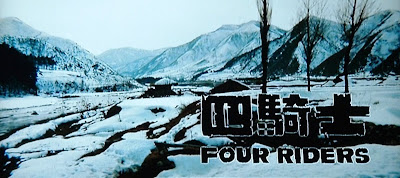
The reference to the apocalypse occurs most clearly in one particular scene where one character, a hospitalised soldier reads the passage from the Bible in which the horsemen are described. As he reads, Chang envisions these riders cinematically as ancient Chinese warriors in generals' armour, riding in slow motion. The opening credits of the film (to which Chang returns in his final shots) also, however, make the reference. They show a desolate – but hauntingly beautiful, sublime even – snow-clad landscape, across which four tiny figures – hardly more than black spots on the screen – are making their way.


Four figures make their way across the snow-covered landscape of Four Riders's opening sequence.

Such apocalyptic images, however, are primarily allegorical. The apocalypse which Chang seems to be alluding to through the film is that of twentieth century history, with its seemingly perpetual unleashing of war, famine, death, and conquest. The film, made in the midst of the Vietnam War, is set at the moment of the ending of the most famous of the preceding explosions of Cold War tension into prolonged, violent conflict in the far East: the Korean hostilities of the 1950-53. As if to highlight the allegorical, rather than historical, nature of his depiction of post-armistice Korea, Chang makes little concession to period detail, with the interiors, costumes and haircuts seeming to locate the film much more squarely in Chang's own 1970s. With many of the outdoor scenes shot on location in Seoul, we have a bleak landscape of neon lights that speak more of a globalising order of capitalism than of the authentic look of the 1950s. This environment, too, it seems, is for Chang a part of the apocalypse of modernity. The film, in fact, in spite of its Korean setting and in spite of its heroes playing the role of soldiers, is a gangster film: a film not so much about war as about the corruption, moral decay and violence of the (post-)colonial city. The tale revolves around a group of demobbed Chinese heroes turning to the city in search of fun and relief from the tensions of war. One of the protagonists comments near the start – with a certain situational irony given the unfolding of events in the film – that any big city is a paradise for those who have money to spend. They find the city, instead, to be a hellish zone of conflict, violence, exploitation, danger and horror. The setting of the film in armistice-moment South Korea seems to function primarily to add a background of totalitarian control and military government to the urban setting so familiar from kung fu films.


Seoul: the capitalist city as apocalypse

After the icy wastelands of the credits, the film opens with one of the four main protagonists, played by Ti Lung, at the moment of the end of the war and the end of his military service, in his army unit, tearing the rank insignia off his lapel and throwing them at the feet of his commanding officer: "Colonel," he says, "As of today I'm no longer in the army any more, and this means you're not my boss now!" He then assaults the shocked Colonel, and this results (for reasons not entirely explained) in a big punch up between the men of his unit, yelping in joy as they fight each other. Ti Lung extricates himself from the melée and when the MPs arrive, they ask him what the fight is about. He answers (lighting a cigarette): "I wouldn't know. But still, it's been a long war. They've got to fight somebody." As the MPs rush in to restrain the men, Ti Lung calmly steals and drives away in an army jeep, off to spend his severance pay (and anything he can get for the jeep) in the big city.


"I wouldn't know. But still, it's been a long war. They've got to fight somebody." Ti Lung – suave and macho as ever – is confronted by an MP.

The scene is significant in setting the tone for the film. It sets up something of the paradoxical politics which pervade the piece. We have in Ti Lung's character something of the archetypal hero of Chang's work of the early 70s: an anti-authoritarian rebel who, as with the xia of ancient Chinese martial tales, is more concerned with being true to himself than the structures of social hierarchy or order. In this regard, the character is a fine example which would bear out Chang's own discussion of his films (quoted in a recent post here) as aligned with the energies of the countercultural movements of the late 60s and early 70s. Authority in this film (as the Colonel in the first scene) is despised, seen as corrupt or at best draconian and incompetent. The military police, who arrive in numbers in this first scene are a constant presence throughout, and we are presented, as the opening scene already implies, with a bankrupt, paranoid order lapsed into the quasi-fascist police state that in fact literally held sway in South Korea for many years after the armistice. The heroes of the film – four Chinese mercenaries leaving the army and meeting up in the city after peace has broken out, played by Ti Lung, David Chiang, Chen Kuan-Tai and Wong Chung – serve as exemplars of an individualism and Romantic rebel integrity that Cheh poses as standing in its face. In the opening credits, as we move through the icy, windswept landscape, the camera lingers on one red flower poking up through the snow. The heroic and noble characters played by Ti, Chiang, Chen and Wong, then, are such flowers, in an apocalyptic modern landscape of authoritarian despotism, absurdly senseless war ("They've got to fight someone!"), and corrupt economic exploitation.


The heroes of Four Riders (Left to right, played by: Ti Lung, Chen Kuan-Tai, Wong Chung and David Chiang). Endangered flowers in a hostile landscape, or an elemental force of justice?

The four are brought together in combatting a group of gangsters who are smuggling drugs out of the country in the uniforms of demobilised American servicemen, a group clearly involved in a series of criminally exploitative businesses, and operating out of an American-themed bar (the "Hello John Club"). Ti's character stumbles across and attempts to intervene in the gang's killing of a GI, and, beaten by the gang and left unconscious, is framed for the murder. The other three – Wang (who he has given a lift to the city), Chen (playing a melancholy soldier, recovering in hospital after being wounded in action), and Chiang (who has become an alcoholic drifter in the city's bars) – join forces to free Ti and (as one would expect from the genre) wreak their bloody revenge on the gang.

The end of the film, a running battle that extends over a number of locations and ends in a gymnasium, stands out even within Chang Cheh's bloody oeuvre as an unrelenting and protracted slaughter, as the four heroes (slowly, of course, themselves being skewered or hacked to pieces in the process) work their way through the entire criminal gang. In this regard, they serve as one of the possible referents of the "four riders" of the title – as a cleaning scourge, if you like, of the evils and corruption of the modern world, a judgment passed on it. However, such a reading hardly seems to do justice to the grimness of Chang's apocalyptic vision in the film. As the remaining heroes, bloody and wounded themselves, finish off the gangsters, the Military Police arrive, surround the building and, believing the heroes to be a part of the gang, cut them down in a hail of bullets. It's an ending that echoes and outdoes that of George Roy Hill's Butch Cassidy and the Sundance Kid (a film which three years previous to Chang's film), but whereas the cowboys seem to go out in blaze of glory, in Chang's altogether more dystopian version the impression is of futility of heroism in the face of an all-powerful, deadly state machinery – one that in spite of its might is nonetheless irrational, absurd and incapable of (or just uninterested in) providing for human happiness or justice. The heroes, in spite of having secured the evidence of their innocence, are gunned down without the chance to present this. Rather than the cavalry rushing in to save the day at the last minute, this Military Police arrives at the end to finish off the massacre, leaving behind no shred of hope, only indiscriminate carnage.

Control triumphs over justice: the scene is sewn up by the Military Police.

What, then, to make of the politics of Chang's vision? (Is it even fair to ask it to have such? It often seems to me that popular cinema is better understood as having a "proto-politics" rather than a developed politics, per se; as being pregnant with a series of quite different political valences, rather than having a particular valence as such.)

Its pessimism, of course, hardly seems fertile for revolutionary endeavour (even if Gramsci contrasted a pessimism of the intellect with an optimism of the will). Furthermore the film's vision of fallen modernity all too easily feeds into conservative discourse, and perhaps makes a certain sense of the fact that Chang's films locate themselves in a fantasised past rather than a modern present, escaping into a zone where alternate moral values to those provided by money and power can be projected – values of heroism, brotherliness, the fight for justice and so on. Such a past (real or imaginary as it may be) nonetheless might well serve as a repository of "heterologies," asserting that the world has been and so potentially still might in the future be different from the way it is now.

However, as Cheh's own understanding of his work of the late 1960s and early 1970s suggests (see my recent post), there is a certain degree to which this film might align itself with a counterculture, setting its values against a post-colonial state which is literally here the South Korea of the 1950s, but is clearly also more generally the Cold War order of 1970s Asia. I believe that we should not only recognise in this grim landscape the totalitarianism which a Hong Kong inhabitant might have feared in the PRC, but also – through the implication of the commercial landscape of Seoul and the globalised links of the criminal gang, with their connections to the US and with an American Boss – that of Hong Kong itself, still a non-democratic state that had, at the end of the 1960s, come down hard on its rebels, revolutionaries and dissidents.

Perhaps for leftists, the political valence of the film might depend in large part on where one stands on questions of the counterculture of the late 1960s and early 1970s. Is this to be understood only as a retrenchment of capitalist values, with its insistence on individualism, hedonism and the like? Or are we to understand its pursuit of freedom and libertarianism as fundamental to any radical project, serving as a vital critique of the more repressive socialist regimes that grew up in the twentieth century as well as to the repressive nature of early-twentieth-century capitalism?


An image of revolutionary hope? Spring after the freeze?

Wednesday, 28 September 2011

Chang Cheh on 60s wuxia and their social context

"swordsmen, assassins, martyrs and death-defying fanatics ... tragic men who defy authority and the establishment": Jimmy Wang Yu as the eponymous hero of Chang Cheh's The Assassin (1967). An icon of anti-authoritarian revolt for the counterculture?
"The 60s and the 70s were the most energetic periods of Hong Kong – the period when young people exerted themselves. The age of love tales was past. The masses were striving ahead in a rebellious mood and the colonial administration was receiving a shock to the system ... The martial arts pictures represented this spirit of the times. After I made The One-Armed Swordsman (1967), riots broke out in Kowloon. Then, during the riots, I made The Assassin (1967). In an [sic] Ming Pao Monthly article published on May 1968, titled 'Hong Kong's Anti-Establishment Movies and the Mass Movement,' Law Kar wrote: 'Zhang Che's movie characters are young swordsmen, assassins, martyrs and death-defying fanatics. His heroes are tragic men who defy authority and the establishment.' At the time, people called my movies 'violent', and 'bloody'. I always thought this was a very shallow way of looking at my movies."
From Chang Cheh's essay, "Creating the Martial Arts Film and the Hong Kong Cinema Style," in The Making of Martial Arts Films: As Told by Filmmakers and Stars (Hong Kong: Hong Kong Film Archive, 1999).

Chang Cheh was one of the key directors who transformed the martial arts genre in Hong Kong cinema during the late 1960s, pioneering the "kung fu" film. It's interesting to see him contextualise his practice in this way, considering that he is often counted a cultural conservative, with politics far from the radical left.

Thursday, 14 April 2011

Some Quotes from Frantz Fanon


Bruce Lee with Nunchaku in Way of the Dragon (1972)

A while back at the University I gave a lecture on Bruce Lee and the Postcolonial. Here are some quotations from Frantz Fanon's Wretched of the Earth that chime with my theme:

"And it is clear that in the colonial countries the peasants alone are revolutionary, for they have nothing to lose and everything to gain. The starving peasant, outside the class system is the first among the exploited to discover that only violence pays. For him there is no compromise, no possible coming to terms; colonization and decolonization are simply a question of relative strength."

“[In the colonial situation,] the dreams of the native are always of muscular prowess; his dreams are of action and aggression. I dream I am jumping, swimming, running, climbing; […] that I span a river in one stride, or that I am followed by a flood of motor cars which never catch up with me. […] The native’s muscles are always tensed. You can't say that he is terrorized, or even apprehensive. He is in fact ready at a moment’s notice to exchange the role of the quarry for that of the hunter” (40).

“[In the colonial situation,] at the level of individuals, violence is a cleansing force. It frees the native from his inferiority complex, and from his despair and inaction; it makes him fearless and restores his self respect” (74).

“Violence […] is Man recreating himself.” Sartre, in his Preface to the book, p.18.

Friday, 25 March 2011

Braudel on revolt in the late European middle ages

The following passage is from Fernand Braudel's Civilization and Capitalism, vol. 2:

Yves-Marie Bercé has found evidence of five hundred revolts among the peasants of Aquitaine alone, between 1590 and 1715. Records relating to a hundred or so German towns from 1301 to 1550 reveal 200 clashes with authority, some accompanied by bloodshed. In Lyons, in the 357 years between 1173 and 1530, 126 were marked by disturbances (rather more than one year in three). We may call these incidents or disturbances – though some of them were so powerful and violent that only the word revolution really does justice to them. On a European scale, during the five centuries covered by this book, there were tens of thousands of incidents – not all of them classified properly and some still lying hidden in the archives. The research so far undertaken does however make it possible to draw some conclusions – some with confidence in the case of peasant revolts, but with much greater risk of error in the case of workers' risings, which were essentially an urban phenomenon.

A great deal of work has been done on peasant revolts in France, following Boris Porchenev's revolutionary book. But it is obvious that France was not alone in this respect, even if the attention it has attracted from historians makes the French case exemplary. From the material so far assembled at any rate, an unmistakeable picture emerges: the peasant community was in perpetual conflict with its oppressors: the state, the landlord, external circumstances, hard times, armed troops, and anything that threatened or even impeded the village community which was the condition of its liberty. And in peasant eyes, all these foes were combined. When in 1530, a local nobleman sent his pigs to root in the common woodland, a little village of the Neapolitan county of Nolise rose up in defence of its grazing rights with the cry 'Viva il popolo et mora il signore' ('Long live the people and death to the master!'). Hence the uninterrupted series of incidents revealing the traditional mentality and special conditions of peasant life, right down to the nineteenth century. If, as Ingmar Bog has remarked, one is looking for an illustration of 'the long term' with its repetitions, its revivals and monotonous patterns, the history of peasants provides any number of perfect examples.

A first reading of this massive literature leaves one with the impression that all this agitation, while never dying down, rarely achieved anything. To rebel was 'to spit in the sky': the jacquerie of 1358 in the Ile-de-France; the English Peasant's revolt of 1381; the Bauernkrieg of 1525; the salt-tax rebellion by the communes of Guyenne in 1584; the violent Bolotnikov rising in Russsia in 1614; the great peasant war that shook Naples in 1647 – all these furious outbursts regularly failed. So too did the minor rebellions which unwaryingly relayed each other. The established order could not tolerate peasant disorder which, in view of the predominance of agriculture, might undermine the very foundations of society and economy. State, nobles, bourgeois property owners, even the Church and certainly the towns were almost constantly in league against the peasant. Flames were nonetheless smouldering under the ashes.

The failures were not [...] as complete as they appeared. The peasant was always rudely brought to heel it is true, but more than once progress was made as a result of rebellion. The 'Jacques' of 1358 did after all secure the liberty of the peasantry in the Paris region. The desertion, then repopulation of this key region cannot entirely explain the process whereby this liberty was won, recaptured and maintained. Was the Bauernkrieg of 1525 a total failure? Not necessarily. The peasant rebels between the Elbe and the Rhine did not, like their brothers beyond the Elbe, become new serfs: they preserved their liberties and ancient rites.(494-6)

Sunday, 20 March 2011

In lieu of an introduction

I've tried to sit down and write an introduction to this blog a few times. However, each time, it becomes long and unweildy – and I can not imagine an internet reader ploughing their way through what I have written.

So this is written in lieu of an introduction. I'll have to carry out this full task elsewhere, probably in a series of posts, and I'll mark them as a "thread" – with a name like "starting points." The problem is that for me, there are just too many starting points for this project to get to grips with all at once. It's origins spread out like the root of a tree.

However, basically, the project perhaps starts with a kind of a problem, rather than an answer. it's a research project in search of a question, if you like.

It started for me with a collision of two things.

First, I was reading Fernand Braudel's trilogy of books Capitalism and Material Life 1400-1800. This is a magisterial reading of the early history of capitalism, before its modern-day industrial manifestations. Braudel charts capitalism's slow growth, and its transformation of everyday ways of life. One thing (amongst many) that struck me was Braudel's description of the countryside and towns of the European middle ages and early modernity as heaving with perpetual unrest harbouring uprisings at a rate that perhaps even puts the twentieth-century in the shade. This contrasted with a "common-sense" understanding that I had – one which is supported in such accounts as Thompson's famous Making of the Working Class – that it was only the with the industrial revolution and its experiences of labour that a "revolutionary" political consciousness of class, exploitation, and of ordinary people's abilities to change their fate and the composition of their society developed.

At the same time as reading Braudel, I was watching quite a few kung fu movies – these have become, for me, something of a passion! The motif of revolting peasants from Braudel seemed to resonate with what I saw on screen. Revolt is a key theme within the kung fu genre, as is the problem, generally, of resisting tyranny and exploitation. The settings of kung fu films often involve a (fantasised) past – like Westerns, they obsess on that moment of transition between the modern and a world before modernity has fully arrived. They are primarily rural in setting, and so what we see so often in them are peasants in revolt.

This juxtaposition is more beset with problems than with any immediate solution – so many problems that in this introduction I can hardly even start to sketch out their outline, so will save this for later posts, too.

However, around the meeting of a Braudellian history of the longue durée of capitalism and martial arts cinema a number of fascinating issues/questions seem to intersect:

1. Does this collision help think traditions of revolution and revolt as stretching back into the (pre-industrial) past, and stretching forward into our own (post-industrial) present and its future?

2. Might popular culture (in spite of its highly Spectacularised and ideological nature) harbour cultural memories of such traditions, and are there resources in it for (future) popular movements?

3. What would kung fu films have to add to our thinking of the questions of revolutionary – or for that matter imperialist/capitalist/authoritarian/etc. – violence? (such questions of the ethical and practical nature of violence in revolt have been very much in the air in left-wing circles of late, for example in the writings of Badiou or Zizek; such debates seem to me, intuitively, to have much to do with the strange and double-edged histories of martial arts as on the one had military technologies of domination, and on the other a matter of traditional forms of popular defence and struggle...)

4. I'm also interested in the theme of work/labour, which is, of course, at the heart of Marxist analyses of capitalism and of its forms of exploitation. It's also, I think, an important and little-discussed theme in kung fu films. This is, however, probably something – like much I've said here – that remains, necessarily at this stage, at the level of suggestion rather than argument: it is something that the unfolding research of which this blog is a part will have to persuade people...