Showing posts with label modernity. Show all posts

Monday, 8 September 2014

Lau Kar-leung and Walter Benjamin


An authentic and auratic performing body – Gordon Liu in Lau Kar-leung's 36th Chamber of Shaolin.

Having made two blog posts here recently, I realised that I should probably also add a link to my recent ("proper") article,  "Lau Kar-leung with Walter Benjamin: Storytelling, Authenticity, Film Performance and Martial Arts Pedagogy," published in am exciting special edition of the journal JOMEC (JOurnalism, MEdia and Cultural studies) on the expanding new field of "Martial Arts Studies," edited by Paul Bowman.

The article is here:
http://www.cardiff.ac.uk/jomec/jomecjournal/5-june2014/White_Authenticity.pdf

and the table of contents for the journal is here:
http://www.cardiff.ac.uk/jomec/research/journalsandpublications/jomecjournal/5-june2014/index.html

There's some really fascinating material in the journal besides my own contribution!


Wednesday, 17 April 2013

Kung fu, Vampire and Capital (Part 1)

Still from Mr Vampire (dir. Ricky Lau, HK, 1985)

I have of late been reading David McNally's book, Monsters of the Market, a fascinating - if not methodologically unproblematic - exploration of the figures of the zombie and the vampire since early modernity, read in the light of the growth of capital. In McNally's reading, under conditions of capitalism, labourers are treated (and thus imagined in capitalist culture) as objectified, living-dead bodies, placed into a mindless, zombie-like regime of wage-slavery (or, in more recent days, consumption). Rather than such a figure of the zombie, other literature (and the literary texture of Marx's work in particular) registers and displaces the vampire-like qualities of capital, as dead labour dominating and sucking the life out of its subjects.

The rather unstable figure of the monster runs throughout the book, uniting these two figures of the undead – the vampire and the zombie – each forming an opposing pole of a single cultural complex. For McNally (at least as far as I understand the drive of his book), the 'monstrous' is an ambivalent category in modern culture, signifying on the one hand the monstrous and disordering powers of capital itself, but also projecting these onto the labouring classes as a formless, dangerous mass that threatens the law and the metaphysical order of the Universe and the social fabric. The monstrous body of the modern poor is a disordered, disarticulated, chaotic body, decomposing into its constituent parts. It's the body, of course, of Frankenstein's monster in Mary Shelley's famous book. Shelley's creature is itself a body – McNally's book insists – composed from the grave-robbed, undead, reanimated bodies of the criminalised working classes, subject as they were in the eighteenth century to being dismembered after death and set to work as objects of knowledge (and moral examples) at the hands of dissectors. Working class bodies were, furthermore, of course, already bodies 'dissected' and 'decomposed' into their constituent parts, by the processes of disciplined labour (the worker as a 'hand'), and by the processes of abstraction which robbed them of any organic unity.  


In the last and most interesting chapter of McNally's book he turns away from European history to consider the contemporary phenomenon of an explosion of zombie myths in Sub-Saharan Africa. These, McNally insists, cannot be understood simply as some form of pre-modern throwback, a survival of old modes of superstition. In fact, McNally discusses the ways that contemporary narratives of witchcraft in Africa are radically discontinuous with older varieties of this, and whatever superficial similarities there may be between old and new iconographies, the meaning of such stories is now something quite different. McNally proposes that modern witchcraft and zombie stories should be read as an attempt to figure – in however a transformed guise – the horrors of globalised, neoliberal economics, as this reconfigures African cultures and societies. As such a figuration, there is a certain resistant value in vampire myth, as it makes uncanny that logic which capitalism would like to make normal, and which it has succeeded in the West as normalising to a far greater degree.

File:Slaves in chains (grayscale).png
Slaves in East Africa, c.1900
The zombie, in fact, he suggests is not an old figure in many of the cultures where it appears. Instead, it is a figure which arrives in the contemporary African vernacular primarily through Hollywood, and, in the longer run through histories of slavery in the West Indies (the slave as zombie - as a person without will or soul, reduced only to primary functions of work). What emeges in recent years in Africa are myths, urban rumours and popular literature or cinema about (poor) victims being resurrected by demonic (rich) sorcerers in order to be put to work, with the zombie-master accumulating all the wages earned by the possessed body. Other stories tell of enchanted bodies who open their mouths to vomit out coins, and are thus turned into "human cash machines" whose very material substance can be transformed into ready cash. For McNally, of course, these are to be read as allegories, metaphors or displaced expressions of fears about the exploitative nature of capitalism.

One of the questions that interests me is how McNally's schema might help us think about the rather different zombie/vampire bodies that became so popular in Hong Kong cinema during the late 1980s (and, I suppose, in the run-up to reunification with the mainland).

There are, of course, some small commonalities and some huge differences between Hong Kong in the 80s and twenty-first century Africa. The legacy of Western colonial and Imperial domination serving to form, to a certain degree, a baseline of shared experience, however different this historical trajectory has been in China and Africa. We might also note the 'belated' modernisation, industrialisation and urbanisation of both societies, with a significant load of cultural material being brought to Hong Kong in the 50s and 60s by its massive influx of immigrants, largely from still relatively 'traditional' rural societies. In both cases, and though at somewhat different moments, and with different effects, we are also dealing with the absorption of the culture in question with processes of globalisation and neoliberal accumulation. Hong Kong was an early 'globaliser', starting as it did as a colonial trading hub, and only then diversifying in the 60s and 70s as a manufacturing base. Hong Kong – even its poor inhabitants – also rapidly drew a large amount of wealth from its insertion into global markets, and by the 1980s was looking a quite different economic and social reality from the societies we would usually tend to imagine as 'Third World'... In this regard, the growth of cinematic stories of the supernatural in the eighties is interesting precisely with regard to this being a moment where a decisive distance is marked from 'traditional' culture, and (with a population largely born and raised on the island, quite probably for most people already at a generation's distance from mainland origins) in which Hong Kong's self-image is distictively 'urban', independent and autocthonous.

What to make, then of the films? Perhaps the place to start is with some more basic description of the genre in question - the 'hopping corpse' or 殭屍 (jiangshi in Mandarin / geongsi in Cantonese) movie. Jiangshi is usually translated into English as '(Chinese) vampire', or, somewhat less commonly, as '(Chinese) zombie'. The word, however, literally means 'stiff corpse' - and it is this stiffness (a rigor mortis that survives the reanimation of the dead) that determines the distinctive gait of the jiangshi, as it makes ungainly two-legged hops, hands rigidly outstretched in front of it - in pursuit of its victims.

Interestingly enough given McNally's typology, the jiangshi shares certain properties of both vampire and zombie, or exists within a continuum somewhere between the two poles of the figure of the monster. If the zombie is a will-less body controlled by another (or just rambling around without a master), and the vampire marks a kind of undead and absolute, demonic will, the jiangshi is both and neither. Uncontrolled, the jiangshi may be a kind of a terrible and monstrous demon; controlled it becomes a comic and ultimately pathetic tool, and the jiangshi switches easily from state to state (by applying or detaching a spell written on a sheet of paper to its forehead, for example). In this regard, it may at first sight seem to fit quite badly with a figure either of worker's body or the horrors of capital.

Jiangshi in Mr Vampire – the undead transformed into an army of docile, controlled bodies

In relation to the question of the particular moment in which the vampire films appeared, described above as one at which the relation to the past was being released, at which Hong Kong identity was being set up as modern and Western in opposition to an imagined 'backward' mainland, and at a moment of the dim rise of anxieties about reunification with Communist China, it's interesting that the hopping vampire – usually clothed in the archaic funeral clothes of a Qing-dynasty official – seems to mark a complex and ambivalent relation to a past that is at once desired and hated, owned and disavowed. In this much it's interesting that the Chinese title of the most popular and genre-defining of the Vampire films of the 80s, which is translated into English by its distributors as Mr Vampire, is in fact better translated literally as Uncle Vampire (僵屍先生). This is a genre of film, then, which is profoundly about a relation to patriarchy and tradition.

Indeed, the first of the Mr Vampire films (it was a film so popular it spawned a series of sequels as well as a flood of imitations) is clearly set around problems of descent and the relation to ancestors (not to mention land and money). The heroes of the film are a long-suffering Taoist priest, Master Kao (played by one of my favourite actors and martial arts performers, Lam Ching-ying), and his rather unruly apprentices. He is called by a client, a rich businessman who is having problems with his business, to examine the burial of his father. On examination of the grave, Kao comes to the conclusion that the businessman's father had been given very bad advice in laying out the feng shui for his chosen burial site and that this is causing a problem. When he probes the matter, Kao discovers that the land for the grave had been bought from the same fortune-teller who had advised on the burial – and that underhand financial means had been applied to force him to sell the land cheaply. The bad advice on burying the body was the fortune-teller's revenge, and it is this that causes the dead patriarch to return from the dead to pursue his own descendants - killing and making a vampire first of his son, and then pursuing his niece (who the film's heroes endeavour to rescue), hence becoming the 'Uncle Vampire' of the original Cantonese title. What we have, then is a relationship to the past, to ancestors, and to a legacy (one which is both financial and familial, magical and cultural) that has become unnatural and toxic through the intervention of the distorting powers of money. In this regard, we are very close to many of the metaphors which McNally values so much in Marx (and which Marx in turn seems to draw from Shalespeare and from a Gothic tradition of literature), whereby money makes live things into dead ones, and animates the inanimate; where traditions are destroyed; where hierarchies are inverted; and order made basely disorderly.

Lam Ching-ying strikes a pose as the Taoist priest in Mr Vampire

What perhaps complicates the picture here, however, is the relation to the 'mainland' and to traditional Chinese culture which seems to be set up. The Qing-dynasty costume of the undead seems to hint on the one hand at a history of colonial rule and foreign domination. The vampire in this sense is something 'alien'. However, it seems also to hint at an alienness which is intimately 'homely'. Might this remind us of  Freud's discussion of the odd collapse of the difference between the Heimlich and the Unheimlich – whereby what is most terrible and alien turns out to have at its core something repressed that comes from within, and from the most private, primal and forgotten parts of the self which have only become so emphatically foreign because we cannot, on the most terrible pain, admit them into consciousness as a core of the self and its formative history. The Qing-era costumes of the vampire – and all the evocation of even older ancient myth and superstition that surrounds the vampire – seem to evoke a more diffuse sense of Chinese tradition – a set of beliefs that have been left behind (certainly enough to make them an entertainingly comedic spectacle) but which still haunt to the degree that unease can amplify the power of laughter. What, I wonder is the relation of the mainland to this figure – I cannot also help reading in these films the presence of China itself (in the guise of the PRC) as a land of forefathers for the Hong Kong people that also threatens to swallow up and suck the life from the 'young' and 'modern' (and capitalistic) island-city. But how would this square with a reading of the unease figured in the film, too about what I take as capitalist values?

Wrestling with the Patriarch? Still from Mr Vampire

Any thoughts from anyone reading this would be gratefully received! Either pop them in the comments below or email me! Thanks!

(To be continued...)

Saturday, 19 November 2011

Four Riders – Chang Cheh's apocalyptic vision


In January, I am giving a talk at Tate Britain as part of a symposium on the theme of apocalypse, which will be in conjunction with the John Martin exhibition currently on there. The talk will focus on depictions of London, on the apocalyptic city and it will draw on the research on the "sublime" which I've developed over the last few years.

It thus feels part of a rather different body of work from the kung fu research that this blog deals with. However, with the conference only just lined up, I stumbled across a Chang Cheh film the other day that I had not seen before: Four Riders (1972). Oddly enough, it is a film which makes clear reference to the apocalypse, for indeed the riders of Chang's title are the Four Horsemen of the Book of Revelations. Given this synchronicity (and since I'm thinking about apocalypses in any case), I thought I might jot down a few notes on this film.

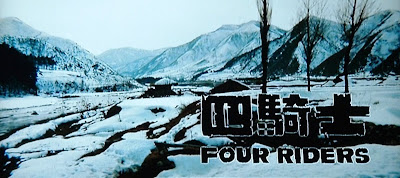
The reference to the apocalypse occurs most clearly in one particular scene where one character, a hospitalised soldier reads the passage from the Bible in which the horsemen are described. As he reads, Chang envisions these riders cinematically as ancient Chinese warriors in generals' armour, riding in slow motion. The opening credits of the film (to which Chang returns in his final shots) also, however, make the reference. They show a desolate – but hauntingly beautiful, sublime even – snow-clad landscape, across which four tiny figures – hardly more than black spots on the screen – are making their way.


Four figures make their way across the snow-covered landscape of Four Riders's opening sequence.

Such apocalyptic images, however, are primarily allegorical. The apocalypse which Chang seems to be alluding to through the film is that of twentieth century history, with its seemingly perpetual unleashing of war, famine, death, and conquest. The film, made in the midst of the Vietnam War, is set at the moment of the ending of the most famous of the preceding explosions of Cold War tension into prolonged, violent conflict in the far East: the Korean hostilities of the 1950-53. As if to highlight the allegorical, rather than historical, nature of his depiction of post-armistice Korea, Chang makes little concession to period detail, with the interiors, costumes and haircuts seeming to locate the film much more squarely in Chang's own 1970s. With many of the outdoor scenes shot on location in Seoul, we have a bleak landscape of neon lights that speak more of a globalising order of capitalism than of the authentic look of the 1950s. This environment, too, it seems, is for Chang a part of the apocalypse of modernity. The film, in fact, in spite of its Korean setting and in spite of its heroes playing the role of soldiers, is a gangster film: a film not so much about war as about the corruption, moral decay and violence of the (post-)colonial city. The tale revolves around a group of demobbed Chinese heroes turning to the city in search of fun and relief from the tensions of war. One of the protagonists comments near the start – with a certain situational irony given the unfolding of events in the film – that any big city is a paradise for those who have money to spend. They find the city, instead, to be a hellish zone of conflict, violence, exploitation, danger and horror. The setting of the film in armistice-moment South Korea seems to function primarily to add a background of totalitarian control and military government to the urban setting so familiar from kung fu films.


Seoul: the capitalist city as apocalypse

After the icy wastelands of the credits, the film opens with one of the four main protagonists, played by Ti Lung, at the moment of the end of the war and the end of his military service, in his army unit, tearing the rank insignia off his lapel and throwing them at the feet of his commanding officer: "Colonel," he says, "As of today I'm no longer in the army any more, and this means you're not my boss now!" He then assaults the shocked Colonel, and this results (for reasons not entirely explained) in a big punch up between the men of his unit, yelping in joy as they fight each other. Ti Lung extricates himself from the melée and when the MPs arrive, they ask him what the fight is about. He answers (lighting a cigarette): "I wouldn't know. But still, it's been a long war. They've got to fight somebody." As the MPs rush in to restrain the men, Ti Lung calmly steals and drives away in an army jeep, off to spend his severance pay (and anything he can get for the jeep) in the big city.


"I wouldn't know. But still, it's been a long war. They've got to fight somebody." Ti Lung – suave and macho as ever – is confronted by an MP.

The scene is significant in setting the tone for the film. It sets up something of the paradoxical politics which pervade the piece. We have in Ti Lung's character something of the archetypal hero of Chang's work of the early 70s: an anti-authoritarian rebel who, as with the xia of ancient Chinese martial tales, is more concerned with being true to himself than the structures of social hierarchy or order. In this regard, the character is a fine example which would bear out Chang's own discussion of his films (quoted in a recent post here) as aligned with the energies of the countercultural movements of the late 60s and early 70s. Authority in this film (as the Colonel in the first scene) is despised, seen as corrupt or at best draconian and incompetent. The military police, who arrive in numbers in this first scene are a constant presence throughout, and we are presented, as the opening scene already implies, with a bankrupt, paranoid order lapsed into the quasi-fascist police state that in fact literally held sway in South Korea for many years after the armistice. The heroes of the film – four Chinese mercenaries leaving the army and meeting up in the city after peace has broken out, played by Ti Lung, David Chiang, Chen Kuan-Tai and Wong Chung – serve as exemplars of an individualism and Romantic rebel integrity that Cheh poses as standing in its face. In the opening credits, as we move through the icy, windswept landscape, the camera lingers on one red flower poking up through the snow. The heroic and noble characters played by Ti, Chiang, Chen and Wong, then, are such flowers, in an apocalyptic modern landscape of authoritarian despotism, absurdly senseless war ("They've got to fight someone!"), and corrupt economic exploitation.


The heroes of Four Riders (Left to right, played by: Ti Lung, Chen Kuan-Tai, Wong Chung and David Chiang). Endangered flowers in a hostile landscape, or an elemental force of justice?

The four are brought together in combatting a group of gangsters who are smuggling drugs out of the country in the uniforms of demobilised American servicemen, a group clearly involved in a series of criminally exploitative businesses, and operating out of an American-themed bar (the "Hello John Club"). Ti's character stumbles across and attempts to intervene in the gang's killing of a GI, and, beaten by the gang and left unconscious, is framed for the murder. The other three – Wang (who he has given a lift to the city), Chen (playing a melancholy soldier, recovering in hospital after being wounded in action), and Chiang (who has become an alcoholic drifter in the city's bars) – join forces to free Ti and (as one would expect from the genre) wreak their bloody revenge on the gang.

The end of the film, a running battle that extends over a number of locations and ends in a gymnasium, stands out even within Chang Cheh's bloody oeuvre as an unrelenting and protracted slaughter, as the four heroes (slowly, of course, themselves being skewered or hacked to pieces in the process) work their way through the entire criminal gang. In this regard, they serve as one of the possible referents of the "four riders" of the title – as a cleaning scourge, if you like, of the evils and corruption of the modern world, a judgment passed on it. However, such a reading hardly seems to do justice to the grimness of Chang's apocalyptic vision in the film. As the remaining heroes, bloody and wounded themselves, finish off the gangsters, the Military Police arrive, surround the building and, believing the heroes to be a part of the gang, cut them down in a hail of bullets. It's an ending that echoes and outdoes that of George Roy Hill's Butch Cassidy and the Sundance Kid (a film which three years previous to Chang's film), but whereas the cowboys seem to go out in blaze of glory, in Chang's altogether more dystopian version the impression is of futility of heroism in the face of an all-powerful, deadly state machinery – one that in spite of its might is nonetheless irrational, absurd and incapable of (or just uninterested in) providing for human happiness or justice. The heroes, in spite of having secured the evidence of their innocence, are gunned down without the chance to present this. Rather than the cavalry rushing in to save the day at the last minute, this Military Police arrives at the end to finish off the massacre, leaving behind no shred of hope, only indiscriminate carnage.

Control triumphs over justice: the scene is sewn up by the Military Police.

What, then, to make of the politics of Chang's vision? (Is it even fair to ask it to have such? It often seems to me that popular cinema is better understood as having a "proto-politics" rather than a developed politics, per se; as being pregnant with a series of quite different political valences, rather than having a particular valence as such.)

Its pessimism, of course, hardly seems fertile for revolutionary endeavour (even if Gramsci contrasted a pessimism of the intellect with an optimism of the will). Furthermore the film's vision of fallen modernity all too easily feeds into conservative discourse, and perhaps makes a certain sense of the fact that Chang's films locate themselves in a fantasised past rather than a modern present, escaping into a zone where alternate moral values to those provided by money and power can be projected – values of heroism, brotherliness, the fight for justice and so on. Such a past (real or imaginary as it may be) nonetheless might well serve as a repository of "heterologies," asserting that the world has been and so potentially still might in the future be different from the way it is now.

However, as Cheh's own understanding of his work of the late 1960s and early 1970s suggests (see my recent post), there is a certain degree to which this film might align itself with a counterculture, setting its values against a post-colonial state which is literally here the South Korea of the 1950s, but is clearly also more generally the Cold War order of 1970s Asia. I believe that we should not only recognise in this grim landscape the totalitarianism which a Hong Kong inhabitant might have feared in the PRC, but also – through the implication of the commercial landscape of Seoul and the globalised links of the criminal gang, with their connections to the US and with an American Boss – that of Hong Kong itself, still a non-democratic state that had, at the end of the 1960s, come down hard on its rebels, revolutionaries and dissidents.

Perhaps for leftists, the political valence of the film might depend in large part on where one stands on questions of the counterculture of the late 1960s and early 1970s. Is this to be understood only as a retrenchment of capitalist values, with its insistence on individualism, hedonism and the like? Or are we to understand its pursuit of freedom and libertarianism as fundamental to any radical project, serving as a vital critique of the more repressive socialist regimes that grew up in the twentieth century as well as to the repressive nature of early-twentieth-century capitalism?


An image of revolutionary hope? Spring after the freeze?