Showing posts with label social context. Show all posts

Friday, 10 June 2016

The body in Jackie Chan's Project A

Colonial Comedy Kung Fu – the opening shot from Jackie Chan's Project A (1983). Video still, from the Hong Kong Legends 3-disc 'Project A Collection' DVD set, 2005.  

I’m currently working on some writing that attempts to think through the kung fu comedy film, and its rise in Hong Kong during the mid 1970s. I’m interested in writing about this genre in part precisely because it is one that has been relatively overlooked, and relatively undervalued. The epic martial arts film – clearly often nationalist or anti-colonial in its content – is relatively easy to understand as ‘political’, and hence for academia to valorise as ‘important’ and worthy of scrutiny. Relatively speaking the martial arts comedy is less easy to read in terms of a political ‘content’ or ‘position’. Its lack of ‘seriousness’ makes it harder to think about as a worthy topic of analysis – though perhaps a more positive way to think of this ‘un-serious’ nature would be to count such films as irreverent.

A number of authors – including, for example, Leon Hunt (2003, p. 102) – have thus proposed that whilst still in the shadow of the decolonisation movements of the 60s, the Hong Kong Riots, and the turmoil of the Cultural Revolution, Hong Kong’s martial arts cinema, in its heroic mode, expressed something of this heavily politicised moment; but they argue that the rise of kung fu comedy in the mid 1970s marks a depoliticisation of the genre, reflecting the increasingly ‘taboo’ nature of politics in the colony during this period. In my recent article on Chang Cheh’s The Assassin (White, 2015), I came quite close to making such and argument myself.

However, I’m ultimately not convinced that these comic films are ultimately any less worthy of a political reading than their tragic-epic counterparts. A certain radical ‘redemption’ of these films seems to me to be in order. After all, they surely constitute the most ‘popular’ form of martial arts cinema, and, for a left-wing critic, the popular has to count for something. My proposal is that in such films, made as they are at a moment of rapid social change (one that it might once have been fashionable to mark as the moment of the rise of the ‘postmodern’), politics simply migrates ‘somewhere else’ from where it had been previously.

What’s interesting about working with these films is that one is thrown increasingly away from narrative readings and forced to engage with aspects of the visual, the cinematic, and perhaps in particular with aspects of performance. This in itself might mark a certain resistance in them to ultimately ‘bourgeois’ forms of narrative, marking the appearance of a cinematic ‘excess’ (Thompson, 1977) in relation to such structures. It seems to me that the various images and fantasies of the body that are represented in these films are central to how we might negotiate them critically.

At the moment I’m working on a section of the writing that attempts to think about these films in relation to Walter Benjamin’s writings about Mickey Mouse and Hollywood slapstick; and Jackie Chan is the main figure I’m thinking about. As part of this work, I’ve just been re-watching Chan’s Project A (1983), and, I might add, with huge pleasure.

It seems to me to be the film where the political stakes of the body in kung fu comedy emerge most clearly, largely because of a prominence of historical reference that is unusual in the genre. This historical reference brings the film close to a kind of political and social satire. I’d argue that some of the politics that attains this unusual visibility in Project A is in fact merely more latent, less explicit in many other kung fu comedy films, and that it helps us understand the broader signification of the body in a genre that had been under development since at least Lau Kar-leung’s Spiritual Boxer (1975).

Project A – made towards the start of a period that has often been understood by critics as always overdetermined by the looming of the 1997 hand-over of the colony to Chinese ownership – is set back in ‘old Hong Kong’, in what seems to be the late nineteenth century, in the heyday of unreconstructed British colonial rule. Though perhaps in some ways somewhat tender and nostalgic in its recreation of the past, there’s a strong strand of satire, which mocks the general chaos, ineptitude and corruption of the colonial regime, as exemplified by both its British and Chinese representatives. The plot is ultimately not terribly relevant for our purposes here, but revolves around the rivalries between the coastguard and the police force, and the attempts of the former to capture a band of pirates who are halting trade to and from the island.

What was most striking to me in rewatching the film, however, was Chan’s famous ability not just to stage fights but to work creatively with the environments and objects in which he sets his characters – something, of course, that is hardly a new observation about his comic or choreographic style. It has, however, been argued that something very similar was at the heart of Charlie Chaplin’s comedy, which often built its humour out of the transformation of objects from their mundane uses to new and surprising ends, based not on convention, but on the morphology of the object itself, presenting us with a rehumanisation of the alienated world of things as produced by capitalism, and a new mastery of the modern environment (Clayton, 2007, pp. 32–3).

This all happens, in hyperbolic form, in the action scenes of Project A. A chair is no longer an object that rules, determines and orders the human body through our very use of it. (If you are anything like me, you will remember well the constant commands from childhood: ‘sit up straight!’; ‘don’t tip the chair backwards!’; ‘Don’t put your feet on the table!’; ‘stop shuffling and sit still!’; etc., etc. In this, the chair is not just a chair, it’s a tool for the discipline and socialisation of the body.) Rather than something to be sat on in the ‘proper’ manner, a chair in Jackie Chan films is also for leapfrogging over, rolling across, or even for a momentary headstand. With a strike coming towards one, the body may well spin around to lie on the chair, ducking underneath the strike. And tipping the chair back in what would normally be a disastrous fall, the acrobatic kung fu comedic body might turn the chair into a form of shelter in which the body might momentarily nestle, before rolling away, or flipping it around yourself to move into a new point of attack or retreat. Wielded in the hands of Jackie Chan, Sammo Hung or Yuen Biao, the chair is no longer a chair, but a shield, a tool for disarming or trapping an opponent, or a heavy bludgeon. Tucked rapidly under the body, it might become, again, a launchpad, or kind of a perch on which to posture and pose before the next exchange with an opponent.


When is a chair not a chair? When it's in a Jackie Chan movie... Stills from Project A.
Similarly in Project A, coat-stands become tridents; vases become boxing gloves; bamboo poles are no longer for hanging washing on, but become a jousting lances for knights mounted on bicycles; bedpans become missile weapons, fired with a flick of the foot using a bicycle wheel as a launching device; tables become battering rams or vaulting benches; windows become portals to exit and enter a space. Banisters are for vaulting over or sliding down; flagpoles are for climbing up, out of harms way; awnings break your fall; chandeliers are useful to swing from…

We are thrown into the anarchic and surrealistically re-enchanted world, in permanent flux, which Benjamin (1931; 1933) lauded in the first Mickey Mouse cartoons. If machinery and capital had set the world into a state of permanent, disorientating change – and one which more often than not was experienced as a violence on the human subject, its body and its capacity for experience – Mickey Mouse, for Benjamin, also revealed the dialectically complementary side to this. The cartoon imagination foregrounded an underlying utopian desire for the power to transform the world that Benjamin saw modern technology itself as expressing, if in distorted form. In early Disney animations (and in the Hollywood slapstick of Chaplin, Keaton and Lloyd), this power was envisioned as re-rooted within the body itself. This power was rehumanised, bracketed off from a capitalist use of technology that had been turned away from the benefit of humanity and placed in the hands of a small elite who – as Benjamin suggested first in ‘Experience and Poverty’ (1933) and then more emphatically in the final version of the ‘Artwork’ essay (1992 [1939]) – used it not to liberate but to exploit, and perhaps ultimately annihilate, the rest of humanity. This rehumanisation might be read as entailing a reconciliation between the body-intensive nature of Benjamin’s archaic ‘first-technologies’ and the modern forms he termed ‘second technology’, the true essence of which, he proposed, lay not in their alienating use for war and capitalist organisation, but rather in the institution of ‘play’ between humanity, technology and nature. (For more on Benjamin on first and second technologies – and their relation to such corporeal arts such as yoga, as well as his pursuit of the erotic, drugs and ‘running downhill’, see Hansen, 2002, pp. 52–3.)

A bedpan used as a projectile weapon, fired with a flick of a bicycle wheel. Video still from Project A

Chan’s Project A was made at a time in Hong Kong of rapid modernisation that competed with the Europe of Benjamin’s day or the America of Buster Keaton (Duncan, 2007), and seems to envision something of the same re-appropriation of the alienating world of things that Benjamin saw in the cinema of his own time. Through the re-enchanting magic of their transformation, humanity reasserts a creative mastery over the objects about him. However, in Project A this takes on a very particular significance in terms of the film’s re-imagination (and re-appropriation) of an emphatically colonial landscape.

Frantz Fanon, describing the colonial experience, proposed it as a ‘narrow world, strewn with prohibitions’ (Fanon, 2001, p. 29). If 1970s Hong Kong was not the most nightmarish of colonies (involving an altogether ‘softer’ form of colonial governance than the French-held Algeria that Fanon knew), with its crowded urban spaces it at least made Fanon’s figure of speech a matter of literal, physically experienced constraint, and this surely forms a significant context for Chan’s corporeal art. Walking in Hong Kong’s bustling streets even today, or looking up at the huge and tightly packed vertical towers of tiny apartments, a visitor to the island gets some kind of small insight into such an experience. Fanon makes much in The Wretched of the Earth of the ways that the colony is structured around spatial exclusion and control. It is around such spatial organisation that colonial violence is instituted and made a part of the everyday, embodied experience of the ‘native’. Much of Chan’s physical performance in Project A involves a renegotiation of such spaces, bringing an anarchy into them through his physical traversal and refunctioning of their logic. This is perhaps most spectacularly envisioned in the bicycle chase through old Hong Kong’s narrow alleyways, where the protagonists have to zig-zag their ways through the cheek-by-jowl lives of its inhabitants, navigating impossibly tight right angle turns as fantastical leaps, or climbing up walls to escape speeding pursuers. Here the relation between the human body and the bicycle becomes radically refashioned to make them tools for a superhuman traversal of the colonial metropolis.


The 'narrow world' of Hong Kong's alleyways reconfigured in a new composition of architecture, bodies and bicycles. 

This logic that pits the body against the colonial organisation of space is even set up in the opening sequences of the film, for example, as we see Chan, in his colonial coastguard uniform, rushing to a meeting at the police and coastguard headquarters. After leaping from his still-moving bicycle, which crashes madly into the bicycle rack, disintegrating as it does so, Chan rushes up the evocatively colonial staircase of the building and along its wooden balconies. Chan vaults and spins over a handrail to get past oncoming employees within the narrow space available, without breaking his stride, defying the ‘proper’ function of the Western architecture. His wild running contrasts to the neatly regimented marching columns of his colleagues, and, as he reigns himself in in front of a superior officer, his mode of propulsion is clearly a transgression of correct protocol.

The architecture of the colonial police headquarters is also renegotiated by Chan’s coastguard hero later in the film, when he decides to spy on his superior officers, hoping to hear good news about the reinstatement of shelved plans to attack the pirates. Chan transforms a chimney into a tunnel that takes him into the heart of the administration, bypassing the normal security that keeps social inferiors away from the private discussions of their superiors. Chan, however gets more than he bargains for when the (English) Governor steps aside from his (Chinese) commanders into a side room to do a deal with a wealthy businessman who is in fact in league with the pirates. The Governor’s inner-sanctum-within-an-inner-sanctum sets up a further spatial divide in rank and privilege between him and his high-level subordinates. Chan, however, has come into this very room, and it is his illicit eavesdropping on this conversation, discovering his superior’s guilty secret – and his superior’s discovery that he has done so – that allows him direct access to the ears of the very highest level of authority. Being in the centre of the administration, Chan gets the privilege of putting the moral case to the Governor for fighting the pirates rather than doing a deal with them. Chan’s physical renegotiation of the environment thus becomes a parallel challenge to the normal hierarchies of the film’s world, which are realised in the architecture of the police headquarters and its regime of physical exclusion.

Chan turns a chimney into a passageway to enter into the heart of the spaces of colonial privilege.

One of the key fights in the film takes place in a high-class club, where the police have gone to arrest a suspect harboured by the club’s well-connected owner. The film labours the fact that this is a space from which the police are normally economically excluded (as well as linguistically so – the head waiter insists on talking to them in English). Then, when the fight breaks out we have a tour-de-force of the transformation and re-use of its fittings and furnishings, from the Rococo-style staircase through the antiques which litter its walls, to the furniture itself, as all these things are, in their turn, transformed into weapons. The scene is one where Chan’s stunt team get to ‘do their stuff’, performing a series of the spectacular falls for which they are so well known, crashing the human body (thrown, spinning, often from great heights, and with great kinetic force) into the various props or scenery provided. In most cases, though the body certainly gets an awful punishment, it is ultimately the club itself which comes off worst, the high-class environment being reduced, by the end of the scene to little more than fragments of wood, ceramic and plaster. If this was a space of colonial (and class) exclusion and privilege, a kind of a ‘kung fu revenge’ has been waged upon it in the scene through the collision of the environment with the rubbery bodies of the stunt team and their cartoon-character-like resilience. In fact, the film overall seems to have a point to make through our extra-diegetic response to performance, in the ways that (even where taking a thrashing) the performers’ bodies take on new, fantastical relationships to their environment, performing unusual forms of movement through it at new velocities.

Colonial space being reduced to rubble in Project A, as Chan hurls an opponent through and over the balcony of the exclusive club.

In the light of such a reading, the theme established through the early part of the film of the discipline of the body makes another kind of a sense, too. When Chan’s rather anarchic and incompetent squad of coastguards are disbanded and sent back to train with the police, this is to instil in them physical discipline, such as standing straight to salute, in the proper (Western) military manner. The training itself, however, becomes peculiarly subversive or carnivalesque in nature. When two recruits on parade are discovered mouthing a lewd comment about a passing woman, they are punished by having to repeat the comment ad nauseam, only serving to multiply, rather than negate its obscenity. A further recruit, who fails to salute correctly, is made to salute repeatedly, but this makes the gesture of deference into an absurd and mocking simulacrum of itself. The recruits are stood on alert in the middle of the night by an officer who claims to be concerned that they have drunk too much soup, with Chan having to call a militaristic ‘charge’ to the latrines. The next day involves the recruits stripped to shower, and interrupted, half soaped, and called out of the showers with only water ladles to protect their modesty. The whole training section (a peculiar parody, perhaps, of the training montages that had already become a staple of the kung fu comedy) serves to re-libidinise colonial discipline and to re-inject a sort of anarchy into it, through a failure of the ‘proper’ mimesis of the colonial masters. This ‘failure’ to conform seems to be celebrated throughout the film, as a productive, creative and ultimately transgressive and liberating act.


References

Benjamin, Walter (1931) ‘On Mickey Mouse’, in Jennings, Eiland Gary Smith, eds. (1999), pp. 545–6.

Benjamin, Walter (1933) ‘Experience and Poverty,’ in in Jennings, Eiland Gary Smith, eds. (1999), pp. 734–5.

Benjamin, Walter (1992 [1939]) ‘The Work of Art in the Age of Mechanical Reproduction’, in Illuminations, ed. Hannah Arendt, trans. Harry Zohn. London: Fontana, pp. 211–244.

Clayton, Alex (2007) The Body in Hollywood Slapstick. Jefferson, NC: McFarland.

Duncan, Sydney (2007) ‘The Traditional Thing in the Modern Age: Contextual Perspectives on Buster Keaton and Jackie Chan’. New Review of Film and Television Studies 5.3 (2007), pp. 353–367.

Fanon, Frantz (2001) The Wretched of the Earth. London: Penguin.

Hansen, Miriam (2002) ‘Benjamin and Cinema: Not a One-Way Street’, in Gerhard Richter, ed., Benjamin's Ghosts: Interventions in Contemporary Literary and Cultural Theory. Stanford: Stanford UP, pp. 41–73.

Hunt, Leon (2003) Kung Fu Cult Masters: From Bruce Lee to Crouching Tiger. London: Wallflower.

Jennings, Michael, Howard Eiland and Gary Smith, eds. (1999) Walter Benjamin: Selected Writings, vol 2, part 2, 1931–1934. Cambridge, MA: Harvard University Press.

Thompson, Kristin (1977) ‘The Concept of Cinematic Excess’. Ciné-Tracts: A Journal of Film, Communications, Culture and Politics 1.2, pp. 54–64.

White, Luke (2015) ‘A “Narrow World, Strewn with Prohibitions”: Chang Cheh’s The Assassin and the 1967 Hong Kong Riots’. Asian Cinema 26.1, pp. 79–98, doi: 10.1386/ac.26.1.79_1.


Wednesday, 5 June 2013

Kowloon Walled City

Photo from Greg Girard and Ian Lambot's series of images of Kowloon Walled city. 


Andrew Osborne recently pointed me to the following link about Kowloon Walled City.

http://curbed.com/archives/2013/04/19/mapping-the-horrors-of-hong-kongs-lawless-walled-city-1.php

Kowloon walled city grew up in the no-man's land between the People's republic of China and Hong Kong. It started as a walled fort built by the British, but, abandoned, it was taken over by thousands of the poorest of Hong Kong, and grew into one of the densest slums anywhere in the world. It constituted 500 buiudings, built into 2.7 hectares, and at its height by 1990, it had 50,000 inhabitants - a population density of 1.9 million people per square kilometer - putting Hong Kong's overall figure of 6,700 people/sq. km to shame, and even out-doing Mongkok's 130,000 per sq. km figure by a factor of over 10.

Outside the operation of the legal system, KWC was rife with drug-dealing and prostitution, and was dominated by armed gangs. Its streets mixed markets with unlicensed doctors and dentists. There were no organised refuse or sanitation systems. The building towered up, beyond architectural control, so that aircraft landing at Kai Tak airport had to alter their flight paths to avoid it. But in site of its lawlessness, according to a recent article in the South China Morning Post, marking the 20th anniversary of its demolition in 1993, "many of Kowloon Walled City's former residents remember it fondly. It may have been a City of Darkness to outsiders, but to thousands who called it home, it was a friendly, tight-knit community that was poor but generally happy."

The article (and that little sentence in particular) remind me of the "Tenement Film" genre in Hong Kong cinema, which celebrated the humour, solidarity and resourcefulness of slum communities. Most famously, of course, House of 72 Tenants, both Chor Yuen's film of 1973 (which kept Bruce Lee's Enter the Dragon off the top spot at the box office that year), and the original of which it was a remake ten years earlier.

Here's a trailer for House of 72 Tenants.


Of course, this in its turn is the basis for "Pig Sty Alley" in Steven Chow's Kung Fu Hustle (2004):


"In a time of social unrest and disorder the gangs have moved in to consolidate their power. The most feared of them all is the Axe Gang. Only in the poorest districts, which hold no interest for the gangs  can people live in peace ... PIG STY ALLEY"

I also spotted this rather interesting page discussing the Tenement Film and its influence on Kung Fu Hustle:
http://www.hkcinemagic.com/en/page.asp?aid=135&page=1


And Scott Spencer also shared this fascinating link about KWC:
http://99percentinvisible.org/post/36086263396/episode-66-kowloon-walled-city

It includes a link to a rather interesting documentary:

Monday, 7 May 2012

Hong Kong Riots and Unrest 1966 and 1967 - continued

The following has some colourful first hand accounts and photos of the riots in Hong Kong in the late 1960s.

http://www.britains-smallwars.com/RRGP/HongKong.htm

I found the reference in an article on the history of Shaw Brothers films, which claims that:

"Shaw Brothers and Chang Cheh specifically tried to cater for the audience of 1960s Hong Kong by creating heroes and plots reflective of the times and mood of the 60s [...] This can be pinpointed to 1967 with the Hong Kong Star Ferry riots. Hong Kong became [sic] a state of chaos and rebellion where violence and unrest went on for seven months. Young people in particular were challenging dominant patriarchs and rebelling against the system and the turbulence led to changes in entertainment. The audience needed escapism from the anarchy in reality but the current trends in romantic musicals could not possibly satisfy this new rebellious audience that needed a hero to represent these uncertain times."
http://brns.com/shawbros/pages/shaw3.html


Saturday, 19 November 2011

Four Riders – Chang Cheh's apocalyptic vision


In January, I am giving a talk at Tate Britain as part of a symposium on the theme of apocalypse, which will be in conjunction with the John Martin exhibition currently on there. The talk will focus on depictions of London, on the apocalyptic city and it will draw on the research on the "sublime" which I've developed over the last few years.

It thus feels part of a rather different body of work from the kung fu research that this blog deals with. However, with the conference only just lined up, I stumbled across a Chang Cheh film the other day that I had not seen before: Four Riders (1972). Oddly enough, it is a film which makes clear reference to the apocalypse, for indeed the riders of Chang's title are the Four Horsemen of the Book of Revelations. Given this synchronicity (and since I'm thinking about apocalypses in any case), I thought I might jot down a few notes on this film.

The reference to the apocalypse occurs most clearly in one particular scene where one character, a hospitalised soldier reads the passage from the Bible in which the horsemen are described. As he reads, Chang envisions these riders cinematically as ancient Chinese warriors in generals' armour, riding in slow motion. The opening credits of the film (to which Chang returns in his final shots) also, however, make the reference. They show a desolate – but hauntingly beautiful, sublime even – snow-clad landscape, across which four tiny figures – hardly more than black spots on the screen – are making their way.


Four figures make their way across the snow-covered landscape of Four Riders's opening sequence.

Such apocalyptic images, however, are primarily allegorical. The apocalypse which Chang seems to be alluding to through the film is that of twentieth century history, with its seemingly perpetual unleashing of war, famine, death, and conquest. The film, made in the midst of the Vietnam War, is set at the moment of the ending of the most famous of the preceding explosions of Cold War tension into prolonged, violent conflict in the far East: the Korean hostilities of the 1950-53. As if to highlight the allegorical, rather than historical, nature of his depiction of post-armistice Korea, Chang makes little concession to period detail, with the interiors, costumes and haircuts seeming to locate the film much more squarely in Chang's own 1970s. With many of the outdoor scenes shot on location in Seoul, we have a bleak landscape of neon lights that speak more of a globalising order of capitalism than of the authentic look of the 1950s. This environment, too, it seems, is for Chang a part of the apocalypse of modernity. The film, in fact, in spite of its Korean setting and in spite of its heroes playing the role of soldiers, is a gangster film: a film not so much about war as about the corruption, moral decay and violence of the (post-)colonial city. The tale revolves around a group of demobbed Chinese heroes turning to the city in search of fun and relief from the tensions of war. One of the protagonists comments near the start – with a certain situational irony given the unfolding of events in the film – that any big city is a paradise for those who have money to spend. They find the city, instead, to be a hellish zone of conflict, violence, exploitation, danger and horror. The setting of the film in armistice-moment South Korea seems to function primarily to add a background of totalitarian control and military government to the urban setting so familiar from kung fu films.


Seoul: the capitalist city as apocalypse

After the icy wastelands of the credits, the film opens with one of the four main protagonists, played by Ti Lung, at the moment of the end of the war and the end of his military service, in his army unit, tearing the rank insignia off his lapel and throwing them at the feet of his commanding officer: "Colonel," he says, "As of today I'm no longer in the army any more, and this means you're not my boss now!" He then assaults the shocked Colonel, and this results (for reasons not entirely explained) in a big punch up between the men of his unit, yelping in joy as they fight each other. Ti Lung extricates himself from the melée and when the MPs arrive, they ask him what the fight is about. He answers (lighting a cigarette): "I wouldn't know. But still, it's been a long war. They've got to fight somebody." As the MPs rush in to restrain the men, Ti Lung calmly steals and drives away in an army jeep, off to spend his severance pay (and anything he can get for the jeep) in the big city.


"I wouldn't know. But still, it's been a long war. They've got to fight somebody." Ti Lung – suave and macho as ever – is confronted by an MP.

The scene is significant in setting the tone for the film. It sets up something of the paradoxical politics which pervade the piece. We have in Ti Lung's character something of the archetypal hero of Chang's work of the early 70s: an anti-authoritarian rebel who, as with the xia of ancient Chinese martial tales, is more concerned with being true to himself than the structures of social hierarchy or order. In this regard, the character is a fine example which would bear out Chang's own discussion of his films (quoted in a recent post here) as aligned with the energies of the countercultural movements of the late 60s and early 70s. Authority in this film (as the Colonel in the first scene) is despised, seen as corrupt or at best draconian and incompetent. The military police, who arrive in numbers in this first scene are a constant presence throughout, and we are presented, as the opening scene already implies, with a bankrupt, paranoid order lapsed into the quasi-fascist police state that in fact literally held sway in South Korea for many years after the armistice. The heroes of the film – four Chinese mercenaries leaving the army and meeting up in the city after peace has broken out, played by Ti Lung, David Chiang, Chen Kuan-Tai and Wong Chung – serve as exemplars of an individualism and Romantic rebel integrity that Cheh poses as standing in its face. In the opening credits, as we move through the icy, windswept landscape, the camera lingers on one red flower poking up through the snow. The heroic and noble characters played by Ti, Chiang, Chen and Wong, then, are such flowers, in an apocalyptic modern landscape of authoritarian despotism, absurdly senseless war ("They've got to fight someone!"), and corrupt economic exploitation.


The heroes of Four Riders (Left to right, played by: Ti Lung, Chen Kuan-Tai, Wong Chung and David Chiang). Endangered flowers in a hostile landscape, or an elemental force of justice?

The four are brought together in combatting a group of gangsters who are smuggling drugs out of the country in the uniforms of demobilised American servicemen, a group clearly involved in a series of criminally exploitative businesses, and operating out of an American-themed bar (the "Hello John Club"). Ti's character stumbles across and attempts to intervene in the gang's killing of a GI, and, beaten by the gang and left unconscious, is framed for the murder. The other three – Wang (who he has given a lift to the city), Chen (playing a melancholy soldier, recovering in hospital after being wounded in action), and Chiang (who has become an alcoholic drifter in the city's bars) – join forces to free Ti and (as one would expect from the genre) wreak their bloody revenge on the gang.

The end of the film, a running battle that extends over a number of locations and ends in a gymnasium, stands out even within Chang Cheh's bloody oeuvre as an unrelenting and protracted slaughter, as the four heroes (slowly, of course, themselves being skewered or hacked to pieces in the process) work their way through the entire criminal gang. In this regard, they serve as one of the possible referents of the "four riders" of the title – as a cleaning scourge, if you like, of the evils and corruption of the modern world, a judgment passed on it. However, such a reading hardly seems to do justice to the grimness of Chang's apocalyptic vision in the film. As the remaining heroes, bloody and wounded themselves, finish off the gangsters, the Military Police arrive, surround the building and, believing the heroes to be a part of the gang, cut them down in a hail of bullets. It's an ending that echoes and outdoes that of George Roy Hill's Butch Cassidy and the Sundance Kid (a film which three years previous to Chang's film), but whereas the cowboys seem to go out in blaze of glory, in Chang's altogether more dystopian version the impression is of futility of heroism in the face of an all-powerful, deadly state machinery – one that in spite of its might is nonetheless irrational, absurd and incapable of (or just uninterested in) providing for human happiness or justice. The heroes, in spite of having secured the evidence of their innocence, are gunned down without the chance to present this. Rather than the cavalry rushing in to save the day at the last minute, this Military Police arrives at the end to finish off the massacre, leaving behind no shred of hope, only indiscriminate carnage.

Control triumphs over justice: the scene is sewn up by the Military Police.

What, then, to make of the politics of Chang's vision? (Is it even fair to ask it to have such? It often seems to me that popular cinema is better understood as having a "proto-politics" rather than a developed politics, per se; as being pregnant with a series of quite different political valences, rather than having a particular valence as such.)

Its pessimism, of course, hardly seems fertile for revolutionary endeavour (even if Gramsci contrasted a pessimism of the intellect with an optimism of the will). Furthermore the film's vision of fallen modernity all too easily feeds into conservative discourse, and perhaps makes a certain sense of the fact that Chang's films locate themselves in a fantasised past rather than a modern present, escaping into a zone where alternate moral values to those provided by money and power can be projected – values of heroism, brotherliness, the fight for justice and so on. Such a past (real or imaginary as it may be) nonetheless might well serve as a repository of "heterologies," asserting that the world has been and so potentially still might in the future be different from the way it is now.

However, as Cheh's own understanding of his work of the late 1960s and early 1970s suggests (see my recent post), there is a certain degree to which this film might align itself with a counterculture, setting its values against a post-colonial state which is literally here the South Korea of the 1950s, but is clearly also more generally the Cold War order of 1970s Asia. I believe that we should not only recognise in this grim landscape the totalitarianism which a Hong Kong inhabitant might have feared in the PRC, but also – through the implication of the commercial landscape of Seoul and the globalised links of the criminal gang, with their connections to the US and with an American Boss – that of Hong Kong itself, still a non-democratic state that had, at the end of the 1960s, come down hard on its rebels, revolutionaries and dissidents.

Perhaps for leftists, the political valence of the film might depend in large part on where one stands on questions of the counterculture of the late 1960s and early 1970s. Is this to be understood only as a retrenchment of capitalist values, with its insistence on individualism, hedonism and the like? Or are we to understand its pursuit of freedom and libertarianism as fundamental to any radical project, serving as a vital critique of the more repressive socialist regimes that grew up in the twentieth century as well as to the repressive nature of early-twentieth-century capitalism?


An image of revolutionary hope? Spring after the freeze?

Wednesday, 28 September 2011

Chang Cheh on 60s wuxia and their social context

"swordsmen, assassins, martyrs and death-defying fanatics ... tragic men who defy authority and the establishment": Jimmy Wang Yu as the eponymous hero of Chang Cheh's The Assassin (1967). An icon of anti-authoritarian revolt for the counterculture?
"The 60s and the 70s were the most energetic periods of Hong Kong – the period when young people exerted themselves. The age of love tales was past. The masses were striving ahead in a rebellious mood and the colonial administration was receiving a shock to the system ... The martial arts pictures represented this spirit of the times. After I made The One-Armed Swordsman (1967), riots broke out in Kowloon. Then, during the riots, I made The Assassin (1967). In an [sic] Ming Pao Monthly article published on May 1968, titled 'Hong Kong's Anti-Establishment Movies and the Mass Movement,' Law Kar wrote: 'Zhang Che's movie characters are young swordsmen, assassins, martyrs and death-defying fanatics. His heroes are tragic men who defy authority and the establishment.' At the time, people called my movies 'violent', and 'bloody'. I always thought this was a very shallow way of looking at my movies."
From Chang Cheh's essay, "Creating the Martial Arts Film and the Hong Kong Cinema Style," in The Making of Martial Arts Films: As Told by Filmmakers and Stars (Hong Kong: Hong Kong Film Archive, 1999).

Chang Cheh was one of the key directors who transformed the martial arts genre in Hong Kong cinema during the late 1960s, pioneering the "kung fu" film. It's interesting to see him contextualise his practice in this way, considering that he is often counted a cultural conservative, with politics far from the radical left.

Sunday, 5 June 2011

More on Hong Kong Context of the Wuxia Revival – Riots in 1967

I came across this footage of the unrest in Hong Kong in 1967 on Youtube:


It was linked to a clip from a musical, Hong Kong Noctune, from the same year, which starred Cheng Pei-Pei. Cheng was at the time also becoming the #1 swordswoman of the wuxia revival, starring in (for example) King Hu's ravishing Come Drink with Me (1966) and Chang Cheh's Golden Swallow (1968).

(For those more familiar with more recent films, she also plays a role as the embittered Jade Fox in Crouching Tiger Hidden Dragon (2000).)


Cheng is the one in the blue dress in the second number, and who sings third in the first. How should we take the words she sings?

Cheng: "Even when your woes are great
Tears are bitter sweet
Everyone has his heart's desire
May all wishes be fulfilled"

chorus: "Hold you head high and strive on
Let no barriers stop your advance
New dancers and singers must arise
Let the world ring with music"

Does this work as a soundtrack to the first video, too?


Sunday, 1 May 2011

Revolution vs. rebellion?

Jet Li, Takeshi Kaneshiro and Andy Lau in Warlords (2007), set amidst the Taiping Rebellion.

"Of all the nations that have attained a degree of civilisation, the Chinese are the least revolutionary and the most rebellious."
Thomas Taylor Meadows, The Chinese and their Rebellions, Viewed in Connection with their National Philosophy, Ethics, Legislation and Administrations (London, 1855), 25.


Meadows had been British consul to China, and his strange book is largely a proposal that the Chinese imperial examinations should serve as a model for creating a meritocratic civil service for Britain. For Meadows the long stability of the form of the Chinese imperial state (in spite of changing dynasties) was due largely to the creation of the class of scholar-bureaucrats which the examinations fostered.


His statement above, however, is of interest to me since it might prompt some of the problems which would dog an understanding of kung fu cinema as a cinema with something to say to revolutionaries. Might we not say the same thing about these films as Meadows does about China: that they are the apotheosis of rebellion, but that they are not the least bit revolutionary?


But Meadows's book is brought up here as a place where contradictions and problems might gravitate to the point of hyperdensity at which they go supernova. Meadows's statement, after all, hits us with the historical equivalent of dramatic irony. How could one say such a thing about the land that gave us Mao, and exported Marxist guerilla insurgency not only across Asia but also the world? Since Meadows wrote, where has been more revolutionary than China, that great idol of the revolts of 1968? To make such a statement as Meadows nowadays would seem at the very least to require a rather complex redefinition of what counts as radical or revolutionary. (Mao as a kind of a latter-day Confucian…) But I would argue that the question of what counts as properly radical is, in any case, something that needs to be made problematic.


For Meadows, the distinction is simple enough. He glosses his argument thus:

"Revolution is a change in the form of government and of the principles on which it rests: it does not necessarily imply a change of rulers. Rebellion is a rising against the rulers which, far from necessarily aiming at a change of governmental principles and forms, often originates in a desire of preserving them intact. Revolutionary movements are against principles; rebellions against men" (25).


In the light of such criteria, at first glance there is a lot of common sense in Meadows's assessment, even if China was, as he was writing, undergoing one of the biggest and most awful civil wars that history has given us: the Taiping Rebellion in which at least 20 million people lost their lives. From an English perspective, in 1855, and in contrast to the European upheavals of the previous decade, with all the radical theory that fuelled these – this is the decade, after all, in which the Communist Manifesto was written – China's turmoil might have seemed rather backward, and lacking in the genuine revolutionary impetus of the thoroughgoing critiques proposed by Marx and the like. Hong Xiquan (in spite of his millennial theology) could easily be imagined by Westerners as simply a man who intended to set himself up as an alternative Emperor in the stead of the Qing dynasty, and who would be expected to rule in just the same way that they, and the dynasties of the preceding two thousand years, had always done.


Marx himself would seem to concur in his articles on the Taiping uprising in Die Presse:

"Some time before the tables began to dance, China--this living fossil--started revolutionizing. By itself there was nothing extraordinary in this phenomenon, since the Oriental empires always show an unchanging social infra-structure coupled with unceasing change in the persons and tribes who manage to ascribe to themselves the political super-structure" (cited by Daniel Little, "Marx and the Taipings," Understanding Society, Blogger.com at Feb 13 2009 (accessed 8 April 2011).)


With the image of dancing tables – it also figures in a footnote to Chapter 1 of Capital – Marx is referring to the craze in the 1850s for seances, nicknamed at the time "table turning," an enthusiasm he suggested was a substitute for rebellion, emerging in the context of the blocked desires created by the defeat of the 1848 uprisings. Chiming with such spinning tables, the 'revolutionising' of China in the Taiping uprising becomes an empty rotational spectacle, rather than any meaningful turning of history's wheels, and the European fascination with the phenomenon is, like that of the occult, a mere pathological symptom of the impossibility of real rebellion at home.


But Marx's and Meadows's judgements alike are coloured by an orientalism which – as Daniel Little notes in an interesting blog post on Marx and the Taiping – imagines the East as eternal and the West as the locus solus of historical change. Little notes that Marx's usual acuity with regard to class is missing in his discussions of China, and any proper examination of the Taiping movement – its social programme, for example, or the reasons why a peasantry flocked to it – are foreclosed, and that recent scholarship has done much to complexify such a vision of the Taiping as merely aiming to replace one Emperor with another.


In this regard, and especially in the light of the nationalist and communist revolutions of the twentieth century, China's history might start to look much more revolutionary than merely rebellious. Were the peasant revolts that echoed through its histories, from the "yellow turbans" of 184-205 AD that ended the rule of the Han dynasty to the Boxer Rebellion at the dawn of the twentieth century, only about restoring and rejuvenating the order of the status quo, or can they be seen as involving radical social projects? The yellow turbans, famously, were a Taoist sect which espoused equal rights and equal distribution of land. (Terry Kleeman, in his book Great Perfection has documented a similar utopian and millennial Taoist sect which held out as a separate state across much of present-day Sichuan for over half a century in the tumultuous fourth century AD.) As Little notes, whilst Marx and Meadows saw nothing truly revolutionary in the Taipings, for Mao they figured as heroic forebears engaged in a proto-communist endeavour.


The historical ironies that surround Meadows's remarks, then, as they are visible from this end of the twentieth century, point to a certain problematic which was already in place at the time they were written. The attractive neatness of the formula has the hallmark of a simplification through which history is made malleable to ideological manipulation. The easy dichotomy between rebellion and revolution hides a surreptitious set of distinctions between what is or is not "essential" or "fundamental" in change (and what are merely superficial alterations); and, we might add, recent scholarship would suggest that the judgment about these things may well be much more culturally and historically relative than either Marx or Meadows imagined when they were writing.

Raising this, of course, at the current early stage in proceedings of this research, is more to lay out a question than provide an answer as to how we might deconstruct or dialecticise this pair of terms, how they might play out in Chinese history, and how the impetus for 'rebellion' and 'revolution' may be at stake in martial art films. This is all work to be done. The usual assumption (as I note above) would tend to be that martial arts movies are only "rebellious" (seen as a bad, watered-down, unproductive thing, mere table-turning, if you like, spectacle and not substance) rather than in any sense being truly "revolutionary" (in the sense of opening on to "real change"). There are, of course exceptions: Vijay Prashad and M.T. Kato both find in Bruce Lee an authentic revolutionary hero – Kato even talks about a kung fu "cultural revolution". But in these, just as in the case of those who think that martial arts films never amount more than pseudo-revolutionary posturing, there is the mobilisation of this pair of terms to come to a judgment about the political meaning of the kung fu genre or its particular films and stars.


Of course, there are wider stakes too. The discourses of or around "popular culture" and its value more generally have revolved around this point of whether it has seeds of revolutionary (real, fundamental, meaningful) change, or whether it only involves those surface novelties which allow capitalism to remain, under the surface, always the same. (If some might view martial arts films as all rebellion and no revolution, this is only because this is an attitude generally taken up towards popular culture more generally.) These issues, then, lay at the heart of the discipline of Cultural Studies (and its debates with its opponents on the left), and more generally around the New Left movement from which it emerged, as it tried to rethink a radical but more 'democratic' politics in the face of existing totalitarian socialisms. It also haunts the current returns (in Zizek and others, for example) to a position which sees in the New Left (and its investments in the popular) suspiciously liberal traits.

Sunday, 3 April 2011

Social Context of the wuxia and kung fu genres


Logo for the Great Wall Film Production Company, one of the left-wing studios which flourished in Hong Kong in the 1960s. As well as social dramas, Great Wall also produced a number of successful "swordplay" (wuxia) films, which apparently differed little from those produced by less politically-motivated studios. Image from: http://www.illuminatedlantern.com/cinema/archives/a_history_of_hong_kong_production_company_logos_part_one_the_early_years.php


The following passage – from Hung Ho-Fung's article, "Uncertainty in the Enclave," New Left Review 66 (Nov/Dec 2010):55-77 – gives us something of an outline of the socio-political context of the production of wuxia ("swordplay") films in the 1960s and that of "kung fu" films proper in the early 1970s:
The US embargo on trade with the PRC, introduced in 1950, voided Hong Kong's purpose as a commercial entrepôt, so its capitalists turned instead to manufacturing. Industrial employment roses from a mere 5 per cent of the workforce in 1950 to 10 per cent in 1960, rising to 25 per cent in 1970. At the same time, the colony saw an influx of refugees from the mainland, who contributed to a huge increase in the population: from 600,000 in 1945 to 2.5 million in 1955. The new arrivals included small-scale entrepreneurs from Guandong or textile magnates from Shanghai, who helped fuel Hong Kong's industrial takeoff, but the majority of the refugees were peasants and workers who provided Hong Kong's emerging industries with low-cost labour. They settled in urban slums, which became fertile ground for CCP-affiliated organizations—including a myriad of unions grouped around the Federation of Trade Unions, as well as schools, news agencies and filmmakers.

In the 1950s and 60s, these organizations grew against a backdrop of rampant government corruption, police brutality, class polarization and institutionalized discrimination against Chinese. Leftist Unions frequently flexed their muscle with strikes. Their film companies—Southern Film, Great Wall, Phoenix, Longma—made box-office hits portraying the misery of the working class and helped disseminate propaganda about the new socialist China. Leftist community organizations, replete with supplies from the PRC, were often more effective than the colonial administration in delivering disaster relief in the aftermath of the fires, landslides and typhoons that constantly threatened working-class neighbourhoods, which usually consisted of wooden shacks perched on Hong Kong's hilly terrain.


In the Spring of 1967, the CCP-affiliated Hong Kong and Macao Work Committee, under the influence of the cultural revolution, made use of a minor labour dispute to launch an all-out offensive against the colonial [p.58] authorities, rallying and directing other leftist forces in the colony. This was meant to generate a revolutionary crisis that ignited all political and social contradictions at once, paved the way for a CCP takeover, or at least for conjoint rule over the colony by the British and the Left, as had been achieved in the insurgency against the Portugese in Macao in late 1966. In the initial phase of the Kong Kong uprising, mass rallies and demonstrations organized by the Leftists drew broad, spontaneous support among the Chinese population. However, the tide turned when Chinese Premier Zhou Enlai reaffirmed to the British the CCP's policy of maintaining Hong Kong's colonial status. Emboldened by Beijing's non-interference, the colonial authorities mobilized the security forces to crack down on the Leftists, closing down their unions, schools and newspapers, and deporting key leaders to the PRC. Pushed into a corner, the Leftists resorted to terrorist tactics, such as roadside bombs targetting both government facilities and civilians. This violent turn alienated the wider Chinese community, costing the insurgents popular support.


The insurgency had subsided by early 1968. Though many Leftist organizations resumed their activities under the colonial authorities' watchful eyes, they became ever more marginalized and demoralized during the 1970s. With a renewed sense of urgency, the colonial government set about shoring up its legitimacy. It managed to break the usual resistance from its business allies, and, under the influence of Fabian socialist currents in the UK, began a series of social and administrative reforms in the early 70s. These included public assistance for the poor, universal free education for nine years, government sponsored social services, and an effective and internationally acclaimed anti-corruption agency. The authorities also built the world's largest public housing system, which accommodated more than half of Hong Kong's population—4 million in 1970, growing to 5 million by 1980.


In tandem with these reforms came the student movement. In the early 1970s, the memory of the 1967 insurgency was still fresh among student radicals, who were also influenced by the world-wide student revolts of 1968, and sympathetic to the CCP. With a unifying theme of "anti-colonialism and anti-capitalism," the movement sprang up in 1971 in protest against the American handover to Japan of the [p.59] Diaoyu/Senkaku Islands, which China claimed were its territory. The movement soon split into two main currents: A Maoist faction, which focused on propagandizing the the achievements of socialist China and paid little attention to struggles in Hong Kong, and a "social faction," which was critical of the CCP regime's authoritarianism and directed its efforts into supporting local social movements (pp.57-9).

I have also come across other (slightly conflicting) accounts regarding the political climate of that moment. (They will have to wait for a later moment.) What perhaps seems surprising or interesting in Hung's acount is that the kung fu genre, which is more often explicitly concerned with representing uprisings and insurgency than the older wuxia genre arrives not in the midst of the unrest, but only after it, at the moment in which politics is becoming more conservative, radical change seems blocked – the moment also when the colonial government had softened its laissez-faire attitude and started introducing welfare-state-type referms supporting the poorest in society and attempting to root out some of the corruption which had been so rife in the economic and political life of the colony (and which is reflected so frequently in the thematics of both wuxai and kung fu films...).

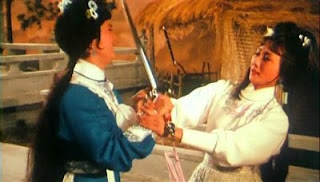
Still from Great Wall's wuxia film, The Jade Bow (1966).