Showing posts with label rebellion. Show all posts

Monday, 2 December 2013

Chang Cheh via Baudrillard

Jimmy Wang Yu's sacrificial suicide in The Assassin (Chang Cheh, 1967). Entering a "symbolic" economy beyond the logic of rational exchange and accumulation. 


From the end of the first chapter of Jean Baudrillard's Symbolic Exchange and Death:

"Since it [the system of contemporary society] thrives on my slow death [in labour], I will oppose it with my violent death. and it is because we are living with slow death that we dream of a violent death. Even this dream is unbearable to power." (p.43)

Baudrillard isn't the most trendy philosopher any more, but the passage could be a way of interpreting the "dream of a violent death" proffered in, above all, Chang Cheh films. What matters in these, much more than beating the bad guy, or even winning history, is achieving a glorious death. And it is in such embrace of sacrifice that the films imagine the heroes – often class outsiders – as wresting back their subjectivity. It is also in such gestures that they keep alive the potential to reclaim the future from subjugation and domination. 

Here we are back, of course, in the logic of sacrificial expenditure in the mould of Marcel Mauss, set against the accumulative logic of the acquisitive villains of the movies. The gift economy is set against the economy of calculation. Kung fu training as Bataille-esque expenditure.


Thursday, 7 February 2013

Fashioning the Kung Fu Revolution? Flowing Robes, Zhongshan Suits and the "Army in Black Pyjamas"

This evening I attended a very interesting talk at Middlesex University (where I work), by Fashion Theorist / Design Historian Jane Tynan, whose research has mainly investigated military dress. Her talk was about the ways that the Irish revolutionaries of the abortive 1916 Easter Rising set out to create an identity for themselves through uniform. Though many of the leaders of the movement clearly had quite grand ambitions for fashioning their troops as a modern, disciplined force, in practice for activists on the ground uniform was necessarily a matter of sporadic, bricolaged elements, and the images that ended coming out of the rising were of a rather ragtag, motley, anarchic anti-colonial force.

The talk made me think of a paragraph that ended up on the "cutting room floor" of an article I've recently submitted to a journal. The paragraph was about the ways that dress in Hong Kong kung fu films, in the late 60s and early 70s, increasingly moved away from the flowing, aristocratic robes of the earlier wuxia films towards the peasant "black pyjamas" of Bruce Lee.  Vijay Prashad has suggested in his fascinating book Everybody Was Kung Fu Fighting, that in the context of the anti-colonial unrest of the era, Lee's outfit was powerfully loaded in terms of class and anti-colonial identity – for Prashad (who was himself at the time of the release of Lee's films a teenager starting to become involved in an Indian Marxism profoundly influenced by Maoism), Lee's attire could hardly but remind a viewer of the Vietnamese "army in black pyjamas" that also repeatedly graced the screens of the era with images of Asian underdogs kicking US imperialist butt...

(Bruce Lee in Fist of Fury, 1972 - kicking imperialist butt whilst wearing black pyjamas, the uniform of Asian anti-colonial resistance...)


This is also a kind of an imagining – or at least a re-imagining – of  the "fashioning" of early twentieth-century revolt...

A further sartorial figure within this 1970s Hong-Kong attempt to imagine – and re-enact – the style of revolution was, of course, the Zhongshan suit that was worn so stylishly by Bruce Lee in Fist of Fury (1972).  Lee's Zhongshan is white, which, of course, in China, is the colour of mourning. This, though, in the context of Lee's character's fury against the murder of his teacher by a foreign occupying power, is a peculiarly politicised, nationalist, anti-colonial kind of mourning.

(Bruce Lee's white Zhongshan in Fist of Fury)

The Zhongshan must have been  a profoundly loaded piece of clothing in the early 70s. The Zhongshan suit, in fact, is named after the nationalist revolutionary Sun Yat-sen, whose most popular name amongst Chinese is in fact Sun Zhongshan (zhong means centre, and shan means mountain). The Zhongshan was a suit designed by the nationalist revolutionaries to express their political values immediately after the revolution of 1912. (Sun himself is said to have had a hand in its design.) It was, first and most obviously, a rejection of the Manchurian styles of dress of the Qing Dynasty, which had been used very much as a form of social control. The style of the Zhongshan seemed to borrow much from the Western suit, but clearly gave it an oriental twist, both making a claim for modernity, but also marking a difference to the hated Western powers which had beset China over the preceding centuries. In fact, the suit made a clear reference to contemporary Japanese military cadet uniforms, which Sun would have seen during the years of his exile there, with Japan also serving as the model of a successfully modernising East Asian nation. (I can hardly but make a nod here to Jane Tynan's discussion this evening of the militarisation which must have pervaded Irish society at exactly this point in time, with the development of the militias who she discussed in her talk, and who went on to take part in the 1916 uprising. The zhongshan was also a means to bring a military iconography into the everyday.)

The Zhongshan, however, is better known in the West now as the "Mao suit" – the Chinese communists took up the style during their alliance with Sun Yat-sen's nationalist party, and the fashion stuck with them. One wonders quite how Bruce Lee's (super-sylish, minimal and perfectly tailored) Zhongshan would have been read at what was still the height of the Cultural Revolution, where the Maoist Zhongshan (rather less fashionable though this version may have been!) was very much the uniform of the day for mainland males, made to symbolise the unity of the Chinese proletariat. In the wake, still, of the 1967 disturbances, and in the shadow of a continuing student movement, how would this clothing have made sense in Hong Kong in 1972?

(Both Mao and Chang Kai Shek are pictured here wearing the Zhongshan.)

Interestingly, director Chang Cheh (discussed elsewhere on this blog, with regards to the ways that his work was intertwined with the 1967 Hong Kong riots, and the ways his films are haunted by this radical moment) has claimed that Lee took these suits from his own prior film, Vengeance! (1970)Indeed, in this, David Chiang also wears both black and white suits that Lee's own are very close to in style, and Chiang even perhaps outdoes Lee in looking dapper and stylish, the white Zhongshan, in Vengeance!, serving as a canvas for Chang's signature motif of a drenching in lurid red blood, the glamour of the garment gaining from Chang's tragic heroism.

(David Chiang's black Zhongshan in Vengeance!, 1970)


It's interesting that when Chang discusses the suit he (or at the very least his translator) calls it a "white student uniform (or Zhongshan suit)" [The Making of Martial Arts Films, p.22] - making a connection to student movements. In this regard (and in particular in the light of Chang's attempt earlier in the same essay to link his films to the student movements of the 60s), Vengeance! starts to become legible as a kind of a political allegory, with David Chiang's youthful hero figuring as a terrible force of retribution. His individual struggle against the corrupt system of power, wealth and authority that has murdered his brother and attempted to cover up the crime starts to signify a larger failure of established hierarchies, and a youthful, iconoclastic revolt against these.

(When David Chiang wears white, you know things are about to turn sour for all involved...)

(David, you'll never get the stains out of that!)

(Is anyone going to be left alive at the end of this film???)


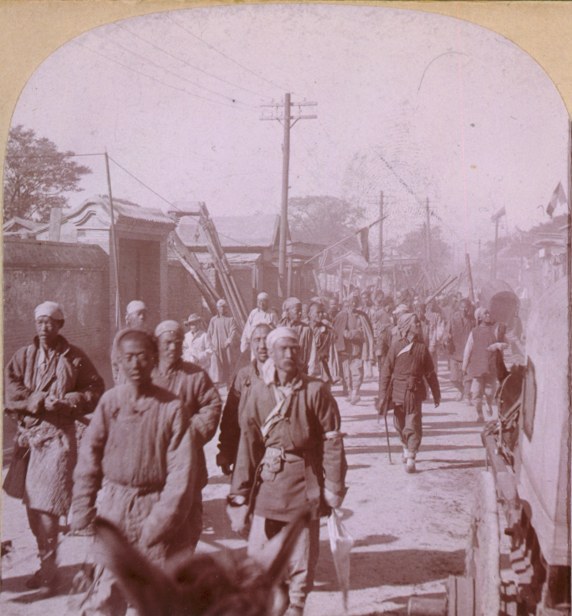
Of course, Jane's talk sent me back to look at other images I've come across – the old photos of the "Boxers" of the Yihetuan (Righteous Harmony Society) that shocked the West at the very start of the twentieth century.


(images of the Boxer Rebellion, from Wikipedia)


Or the attempts in kung fu cinema to imagine the anti-Qing "Shaolin" rebels in the Shaolin cycle.
(lay students survive the burning of the Shaolin Temple, and prepare to spread out to start anti-Qing rebellion across China in Chang Cheh's Shaolin Temple, 1976.)


How do such films attempt to (re)imagine a past of revolution through costume, and how does this relate to the actual attempts of past radicals to figure themselves through dress? There could be a whole research project here...

Monday, 7 May 2012

Hong Kong Riots and Unrest 1966 and 1967 - continued

The following has some colourful first hand accounts and photos of the riots in Hong Kong in the late 1960s.

http://www.britains-smallwars.com/RRGP/HongKong.htm

I found the reference in an article on the history of Shaw Brothers films, which claims that:

"Shaw Brothers and Chang Cheh specifically tried to cater for the audience of 1960s Hong Kong by creating heroes and plots reflective of the times and mood of the 60s [...] This can be pinpointed to 1967 with the Hong Kong Star Ferry riots. Hong Kong became [sic] a state of chaos and rebellion where violence and unrest went on for seven months. Young people in particular were challenging dominant patriarchs and rebelling against the system and the turbulence led to changes in entertainment. The audience needed escapism from the anarchy in reality but the current trends in romantic musicals could not possibly satisfy this new rebellious audience that needed a hero to represent these uncertain times."
http://brns.com/shawbros/pages/shaw3.html


Sunday, 15 January 2012

Resistance

"Resistance is on its way to becoming a word of power, emerging alongside the terms 'revolution' and 'reform' that Hegel saw defining the range of modern politics."
Howard Caygill, "Also Sprach Zapata," Radical Philosophy 171 (Jan/Feb 2011):19.
In this sense, resistance is a third term that seems to problematise some of the binary oppositions characterised in earlier posts here (1 May 2011, 29 May 2011). What does 'resistance' do as a term in a project like mine? Does it serve as a term which opens us a productive thinking both of contemporary political practices, and the kinds of popular cultural resources that might include the kung fu film, and which might be considered, in this context, as resources for resistance? Does 'resistance' serve to elucidate a value for these? Or does it serve to mark their limit?

Most of Caygill's article explores Clausewitz (a rather occidental alternative to Sun Tzu et al!). He explores the way that a certain reading of Clausewitz allows us to think him as a philosopher of "the people's war of resistance" (22). Caygill notes that Clausewitz was setting out in his military theory to understand Napoleon's success, and also to understand how Napoleon could be fought – including the emergence of the guerrilla.
"To account for this change in the character of warfare, Clausewitz proposed a redefinition of war. In section 2 of book 1 of, 'Definition,' he defines the end or Zweck of war as to 'render the enemy incapable of further resistance.' So resistance is absolutely central to war – war addresses the enemy's capacity to resist." (22)
Such a foregrounding of "resistance" seems to speak to the kinds of narratives offered in kung fu films. Though the heroes – members of secret societies, loyalists of defeated dynasties, anti-tyrannical monks – are sometimes referred to in the subtitles or dubs as "revolutionaries," that term is perhaps a little misleading. They usually don't have a clear revolutionary agenda, certainly at least in the terms in which Thomas Taylor Meadows set up the term (i.e. in opposition to mere rebellion).

The plots, furthermore, rarely celebrate victorious uprising, the expulsion of the oppressor. What the heroes of the films succeed in, rather than dealing a final blow to their enemies, is precisely becoming heroes; they often die to do so; but their victory can be understood in the way that their inspirational example, even in personal defeat, keeps alive a larger possibility of resistance. The films are set in the darkest hours of defeat and occupation: either in the deepest depths of Qing rule, or, perhaps (as in the case of a film such as Lau Kar-Leung's Eight-Diagram Pole Fighter), at the moment of the slow defeat of the Song state by the Mongolians back in the thirteenth century. Chinese history is seen, in these tales, as a long struggle, and the films express a hope that if the spirit of resistance and the corporeal capacity to fight (as preserved in the martial arts) remain alive, then the war will not be over and the enemy will not be victorious. It is a vision, of course, that is sustained in a vision of the vast sweep of Chinese history, which has been marked not only between recurrent and lengthy "barbarian" occupation, but also each time by the final reversion to Han rule.

Such narratives, and such an account of the essential nature of resistance, might also offer an alternative template through which to valorise or to speculate on the longue durée (Braudel again!) of popular struggle, and the forms of "resistance" of peasants and the like – whether conceived in terms of medieval European uprisings and practices of cussed daily non-cooperation, Hobsbawm's "social banditry," or the sort of Qing-era protest described in Hung Ho-Fung's Protest with Chinese Characteristics (see image of salt riot recently posted!). Such, once again, are hardly "revolutionary" – and are often dismissed for their failure to be such – but nonetheless they perhaps remain essential in terms of keeping alive an "other" culture in the face of the official discourses of power.

In this regard, another of Caygill's remarks, drawing on the implications of applying a Clausewitzian notion of "resistance" to peoples' struggles against the State, is also very descriptive of the kung-fu scenario, and the "longue durée" of poular stuggle alike:
This ... involves the temporality of resistance. The strategy of the weaker – whether [Maoist] guerrilla or [Ghandian] satyagraha – is a strategy of time; the preservation of the capacity to resist involves a refusal to enter the augmenting cycle of violence that is escalation. This refusal means declining the invitation of the state to escalate violence in its pursuit of what Clausewitz called the 'decisive blow' and instead to threaten the State's capacity to resist by temporal distension, by what Mao in 1937 theorized as the 'prolonged war of resistance'. The war of resistance is above all a war for time – with one enemy proposing escalation and the concentration of struggle in a moment, the other responding by prolonging resistance indefinitely" (23-4).
Caygill's essay ends with a rather upbeat account of such resistance, looking in particular at the reminiscences of members of the early stages of the French Resistance movement against the second world war, who found a special aliveness in acts of resistance, and at the sayings of Subcommmandante Marcos of the more recent Zapatista movement, where resistance – as the preservation of resistance – again becomes a kind of an end and a joy in itself. (As in many ways a martial art is – certainly as depicted in martial arts cinema – in the creation and reproduction of the body's autonomy and power.)

However, is this the point where we have to ask questions about Caygill's argument – and perhaps about the politics of the narratives of martial arts films? Is it enough to be able to continue to resist, in the face of a more powerful enemy? Is this an end in itself? Is it enough to think that whilst we still resist an order we despise this keeps alive the possibility that one day, ground down by the slow pressures of non-conformity, or overcome by some external threat, current arrays of power will die away? Does such a conception of resistance in some ways end up complicit with the power one resists, allowing its continuation? In the end is "resistance" necessary (and important to nurture in a way that some revolutionary or reformist movements run the danger of forgetting) but nonetheless not sufficient?

A last question might rotate around the relationship of Caygill's article to its (and our own) historical context. Such an argument for the importance of "resistance" (rather than revolution) seems profoundly conditioned by a certain pessimism with regard to the kinds of possibility for change alive in the present. What does it say of our times to find "resistance" as the most we can hope for?

There are two ways in which this seeming pessimism might be valenced. The first is to judge it negatively: to find in it a failure of the "optimism of the will" and of the utopian imagination necessary to produce a better world. The second would be to recognise that at moments in history where the progressive or radical left is an "afflicted power" somewhat on the fringe of a field of politics (of "war continued by other means") dominated by the capitalist right, then a tactics of resistance – building its networks and its cultures – is highly appropriate, with more directly "revolutionary" strategies basically non-viable. Today's situation may be such a moment; and so, too, might be the context of the growth of the kung-fu genre in the early 70s in Hong Kong, in the wake of the clampdown on labour, radical and democratic groups at the end of the 1960s. Perhaps in some ways, this commonality is why I believe that the political imaginary of the kung-fu genre resonates so strongly with the present.

Monday, 2 January 2012

Qing-era Salt Riot

"Illegal private salt makers, mostly women, in Yangzhou demolished the official salt-selling station in reaction to the government's intensifying effort to eradicate private salt sales. Source: Dianshizai Hubao, 1897."
From Ho-Fung Hung's Protest with Chinese Characteristics: Demonstrations, Riots, and Petitions in the Mid-Qing Dynasty (New York: Columbia UP, 2011).

Interesting to compare with the European image I took from Braudel in my introduction to this blog...

Saturday, 19 November 2011

Four Riders – Chang Cheh's apocalyptic vision


In January, I am giving a talk at Tate Britain as part of a symposium on the theme of apocalypse, which will be in conjunction with the John Martin exhibition currently on there. The talk will focus on depictions of London, on the apocalyptic city and it will draw on the research on the "sublime" which I've developed over the last few years.

It thus feels part of a rather different body of work from the kung fu research that this blog deals with. However, with the conference only just lined up, I stumbled across a Chang Cheh film the other day that I had not seen before: Four Riders (1972). Oddly enough, it is a film which makes clear reference to the apocalypse, for indeed the riders of Chang's title are the Four Horsemen of the Book of Revelations. Given this synchronicity (and since I'm thinking about apocalypses in any case), I thought I might jot down a few notes on this film.

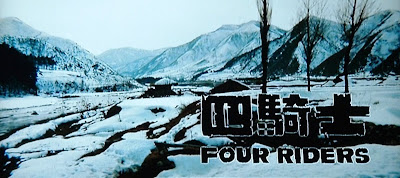
The reference to the apocalypse occurs most clearly in one particular scene where one character, a hospitalised soldier reads the passage from the Bible in which the horsemen are described. As he reads, Chang envisions these riders cinematically as ancient Chinese warriors in generals' armour, riding in slow motion. The opening credits of the film (to which Chang returns in his final shots) also, however, make the reference. They show a desolate – but hauntingly beautiful, sublime even – snow-clad landscape, across which four tiny figures – hardly more than black spots on the screen – are making their way.


Four figures make their way across the snow-covered landscape of Four Riders's opening sequence.

Such apocalyptic images, however, are primarily allegorical. The apocalypse which Chang seems to be alluding to through the film is that of twentieth century history, with its seemingly perpetual unleashing of war, famine, death, and conquest. The film, made in the midst of the Vietnam War, is set at the moment of the ending of the most famous of the preceding explosions of Cold War tension into prolonged, violent conflict in the far East: the Korean hostilities of the 1950-53. As if to highlight the allegorical, rather than historical, nature of his depiction of post-armistice Korea, Chang makes little concession to period detail, with the interiors, costumes and haircuts seeming to locate the film much more squarely in Chang's own 1970s. With many of the outdoor scenes shot on location in Seoul, we have a bleak landscape of neon lights that speak more of a globalising order of capitalism than of the authentic look of the 1950s. This environment, too, it seems, is for Chang a part of the apocalypse of modernity. The film, in fact, in spite of its Korean setting and in spite of its heroes playing the role of soldiers, is a gangster film: a film not so much about war as about the corruption, moral decay and violence of the (post-)colonial city. The tale revolves around a group of demobbed Chinese heroes turning to the city in search of fun and relief from the tensions of war. One of the protagonists comments near the start – with a certain situational irony given the unfolding of events in the film – that any big city is a paradise for those who have money to spend. They find the city, instead, to be a hellish zone of conflict, violence, exploitation, danger and horror. The setting of the film in armistice-moment South Korea seems to function primarily to add a background of totalitarian control and military government to the urban setting so familiar from kung fu films.


Seoul: the capitalist city as apocalypse

After the icy wastelands of the credits, the film opens with one of the four main protagonists, played by Ti Lung, at the moment of the end of the war and the end of his military service, in his army unit, tearing the rank insignia off his lapel and throwing them at the feet of his commanding officer: "Colonel," he says, "As of today I'm no longer in the army any more, and this means you're not my boss now!" He then assaults the shocked Colonel, and this results (for reasons not entirely explained) in a big punch up between the men of his unit, yelping in joy as they fight each other. Ti Lung extricates himself from the melée and when the MPs arrive, they ask him what the fight is about. He answers (lighting a cigarette): "I wouldn't know. But still, it's been a long war. They've got to fight somebody." As the MPs rush in to restrain the men, Ti Lung calmly steals and drives away in an army jeep, off to spend his severance pay (and anything he can get for the jeep) in the big city.


"I wouldn't know. But still, it's been a long war. They've got to fight somebody." Ti Lung – suave and macho as ever – is confronted by an MP.

The scene is significant in setting the tone for the film. It sets up something of the paradoxical politics which pervade the piece. We have in Ti Lung's character something of the archetypal hero of Chang's work of the early 70s: an anti-authoritarian rebel who, as with the xia of ancient Chinese martial tales, is more concerned with being true to himself than the structures of social hierarchy or order. In this regard, the character is a fine example which would bear out Chang's own discussion of his films (quoted in a recent post here) as aligned with the energies of the countercultural movements of the late 60s and early 70s. Authority in this film (as the Colonel in the first scene) is despised, seen as corrupt or at best draconian and incompetent. The military police, who arrive in numbers in this first scene are a constant presence throughout, and we are presented, as the opening scene already implies, with a bankrupt, paranoid order lapsed into the quasi-fascist police state that in fact literally held sway in South Korea for many years after the armistice. The heroes of the film – four Chinese mercenaries leaving the army and meeting up in the city after peace has broken out, played by Ti Lung, David Chiang, Chen Kuan-Tai and Wong Chung – serve as exemplars of an individualism and Romantic rebel integrity that Cheh poses as standing in its face. In the opening credits, as we move through the icy, windswept landscape, the camera lingers on one red flower poking up through the snow. The heroic and noble characters played by Ti, Chiang, Chen and Wong, then, are such flowers, in an apocalyptic modern landscape of authoritarian despotism, absurdly senseless war ("They've got to fight someone!"), and corrupt economic exploitation.


The heroes of Four Riders (Left to right, played by: Ti Lung, Chen Kuan-Tai, Wong Chung and David Chiang). Endangered flowers in a hostile landscape, or an elemental force of justice?

The four are brought together in combatting a group of gangsters who are smuggling drugs out of the country in the uniforms of demobilised American servicemen, a group clearly involved in a series of criminally exploitative businesses, and operating out of an American-themed bar (the "Hello John Club"). Ti's character stumbles across and attempts to intervene in the gang's killing of a GI, and, beaten by the gang and left unconscious, is framed for the murder. The other three – Wang (who he has given a lift to the city), Chen (playing a melancholy soldier, recovering in hospital after being wounded in action), and Chiang (who has become an alcoholic drifter in the city's bars) – join forces to free Ti and (as one would expect from the genre) wreak their bloody revenge on the gang.

The end of the film, a running battle that extends over a number of locations and ends in a gymnasium, stands out even within Chang Cheh's bloody oeuvre as an unrelenting and protracted slaughter, as the four heroes (slowly, of course, themselves being skewered or hacked to pieces in the process) work their way through the entire criminal gang. In this regard, they serve as one of the possible referents of the "four riders" of the title – as a cleaning scourge, if you like, of the evils and corruption of the modern world, a judgment passed on it. However, such a reading hardly seems to do justice to the grimness of Chang's apocalyptic vision in the film. As the remaining heroes, bloody and wounded themselves, finish off the gangsters, the Military Police arrive, surround the building and, believing the heroes to be a part of the gang, cut them down in a hail of bullets. It's an ending that echoes and outdoes that of George Roy Hill's Butch Cassidy and the Sundance Kid (a film which three years previous to Chang's film), but whereas the cowboys seem to go out in blaze of glory, in Chang's altogether more dystopian version the impression is of futility of heroism in the face of an all-powerful, deadly state machinery – one that in spite of its might is nonetheless irrational, absurd and incapable of (or just uninterested in) providing for human happiness or justice. The heroes, in spite of having secured the evidence of their innocence, are gunned down without the chance to present this. Rather than the cavalry rushing in to save the day at the last minute, this Military Police arrives at the end to finish off the massacre, leaving behind no shred of hope, only indiscriminate carnage.

Control triumphs over justice: the scene is sewn up by the Military Police.

What, then, to make of the politics of Chang's vision? (Is it even fair to ask it to have such? It often seems to me that popular cinema is better understood as having a "proto-politics" rather than a developed politics, per se; as being pregnant with a series of quite different political valences, rather than having a particular valence as such.)

Its pessimism, of course, hardly seems fertile for revolutionary endeavour (even if Gramsci contrasted a pessimism of the intellect with an optimism of the will). Furthermore the film's vision of fallen modernity all too easily feeds into conservative discourse, and perhaps makes a certain sense of the fact that Chang's films locate themselves in a fantasised past rather than a modern present, escaping into a zone where alternate moral values to those provided by money and power can be projected – values of heroism, brotherliness, the fight for justice and so on. Such a past (real or imaginary as it may be) nonetheless might well serve as a repository of "heterologies," asserting that the world has been and so potentially still might in the future be different from the way it is now.

However, as Cheh's own understanding of his work of the late 1960s and early 1970s suggests (see my recent post), there is a certain degree to which this film might align itself with a counterculture, setting its values against a post-colonial state which is literally here the South Korea of the 1950s, but is clearly also more generally the Cold War order of 1970s Asia. I believe that we should not only recognise in this grim landscape the totalitarianism which a Hong Kong inhabitant might have feared in the PRC, but also – through the implication of the commercial landscape of Seoul and the globalised links of the criminal gang, with their connections to the US and with an American Boss – that of Hong Kong itself, still a non-democratic state that had, at the end of the 1960s, come down hard on its rebels, revolutionaries and dissidents.

Perhaps for leftists, the political valence of the film might depend in large part on where one stands on questions of the counterculture of the late 1960s and early 1970s. Is this to be understood only as a retrenchment of capitalist values, with its insistence on individualism, hedonism and the like? Or are we to understand its pursuit of freedom and libertarianism as fundamental to any radical project, serving as a vital critique of the more repressive socialist regimes that grew up in the twentieth century as well as to the repressive nature of early-twentieth-century capitalism?


An image of revolutionary hope? Spring after the freeze?

Wednesday, 28 September 2011

Chang Cheh on 60s wuxia and their social context

"swordsmen, assassins, martyrs and death-defying fanatics ... tragic men who defy authority and the establishment": Jimmy Wang Yu as the eponymous hero of Chang Cheh's The Assassin (1967). An icon of anti-authoritarian revolt for the counterculture?
"The 60s and the 70s were the most energetic periods of Hong Kong – the period when young people exerted themselves. The age of love tales was past. The masses were striving ahead in a rebellious mood and the colonial administration was receiving a shock to the system ... The martial arts pictures represented this spirit of the times. After I made The One-Armed Swordsman (1967), riots broke out in Kowloon. Then, during the riots, I made The Assassin (1967). In an [sic] Ming Pao Monthly article published on May 1968, titled 'Hong Kong's Anti-Establishment Movies and the Mass Movement,' Law Kar wrote: 'Zhang Che's movie characters are young swordsmen, assassins, martyrs and death-defying fanatics. His heroes are tragic men who defy authority and the establishment.' At the time, people called my movies 'violent', and 'bloody'. I always thought this was a very shallow way of looking at my movies."
From Chang Cheh's essay, "Creating the Martial Arts Film and the Hong Kong Cinema Style," in The Making of Martial Arts Films: As Told by Filmmakers and Stars (Hong Kong: Hong Kong Film Archive, 1999).

Chang Cheh was one of the key directors who transformed the martial arts genre in Hong Kong cinema during the late 1960s, pioneering the "kung fu" film. It's interesting to see him contextualise his practice in this way, considering that he is often counted a cultural conservative, with politics far from the radical left.

Sunday, 29 May 2011

More on Rebellion and Revolution

One of the many places that one might pick up the problem of the unstable distinction between 'rebellion' and 'revolution' is in current far-left philosophical debates. If according to some the 'revolutionary' for a while seemed somewhat out of fashion in left wing thought (I'm not quite sure it ever was), it is certainly important again in the work of such thinkers as Alain Badiou and Slavoj Zizek.

To open up a can of worms, in this post I'm going to make some all-too-brief comments on Badiou and the rhetoric of revolution.

It's a topic that comes up in Adrian Johnston's recent book Badiou, Zizek and Political Transformations: The Cadence of Change. Johnston notes that for both of these thinkers, what's centrally at stake is the possibility of thinking 'reality-shattering shifts' (xxviii) and hence of a world radically different from our own – a world which does not consist only of variations on the theme of the already-existing status quo. For Badiou the 'event' and for Zizek the 'act' (which Johnston sees as itself being a term drawing on an evental logic) are ways of imagining how such radical alterations come about. The Badiouian event is an 'abrupt rupture [...] interrupting the cohesion and continuity of whatever counts as the establshed order of things [...] [It is] that which, apparently out of nowhere, suddenly and unexpectedly catalyzes processes of transformation.' (xxviii) They are, this is to say, about revolutionary change. Badiou's writing, Johnston notes (7), is peppered with an aesthetic and rhetoric that privileges ways of imagining change that rely on a vocabulary of cataclysm and violent upheaval. (It is, this is to say, posited around a stylistic 'aesthetic' of revolution as sublime.)

There is an implicit opposition working here, which may in some respects relate to the problem I have outlined in my last post, though the terms in which it is staged are slightly different. Here, rather than rebellion, the opposite term of revolution is, essentially, reformism. Badiou and Zizek place themselves in a long line of radical theorists form whom the radical rupture of revolution is held up against some mere fiddling with details that in fact serves only to shore up the system.

There are, of course, differences between the notion of 'rebellion' as defined in my previous post (i.e. as an attempt to topple a particular holder of power, whilst preserving an overall system), and that of 'reformism' in this sense (which is more to do with the issues than personalities). However, in their polar position to the revolution, the two share quite a lot structurally. Such structural similarities are reinforced by the actualities of the actual struggles to which they might refer: a struggle against a ruler or ruling elite is hardly meaningful except in relation to some kind of abuse of power or an unpopular policy with which they are associated. Similarly, campaigns against policies are usually (though of course not universally) carried out in tandem with an opposition to instrumental individuals who are conceived as the authors of such policy, and who rapidly become imagined as an 'enemy'. (This last might perhaps need qualification, in that the identification of the enemy will often only be partial and may also be innacurate. Thus a particular ruler might be marked out, but the unpopular policies they push through may be at the service of an elite 'pressure group' who remain in the shadows and benefit from the policy, who remain, even after the unseating of the ruler, at the heart of a system of power and influence, privilege and profit. I digress, however, and in any case the same problems may well beset those who seek more properly revolutionary change...)

One of the things posed as marking the difference between 'rebellion' and 'reform' is the link between reform and a gradualism which such authors as Badiou and Zizek see as impossible or illusory, understanding 'real' change as sudden, cataclysmic and disjunctive. 'Rebellion' in the sense in which Meadows used it would lie even further along the same end of a spectrum at the other end of which was revolution, implying no change at all – a restoration of values, rather than their transformation. However, even this difference, at least as it finds its place within a revolutionist rhetoric, may itself collapse: after all, the point for such authors is that reformism is ultimately impossible, that things will not get better bit by bit, since the changes in question do not affect a core truth of the status quo, which fundamentally remains what it is, and is only revitalised by the processes of such struggle.

But do we start to run into trouble if taking up such a position? The difficulty would seem to me to be in accounting for a change which is no change – the modification which leaves things as they are. This seems a very particular way of imagining society (and/or politics, culture, etc.) that delineates between the essential and the merely contingent, imagining a set of 'core' things which determine the other things in society with no reciprocal influence. It is a model ultimately rather like the famous base/superstructure distinction: mere fiddling with culture or philosophy will not have an effect on things whilst the economic base remains the same. It raises the problem of just what is or is not significant change as opposed to superficial change – especially when we consider the problem of cause and effect. Johnston notes that some changes may seem trivial but have far-reaching effects, whilst others may seem to shake things up to the core but actually rapidly land us back where we started. What, then, if such distinction (between cataclysmic change and the small change, between revolution and reform and between revolution and rebellion) does not hold?

This dilemma poses a core problem for Badiou's work (as I've managed to decipher it at least) and as a body of writing which sets out to privilege revolution over reform it returns repeatedly to ways of upholding this distinction. Badiou's response to what amounts to a profound dilemma for the radical left is to set out an ontology – based in set theory – that seems to categorise different kinds of change, thus providing a theoretical grounding for judgments between significant and insignificant. At different moments in his career, Badiou seems to have formulated these differently. What is interesting in Johnston's account of these changes is that it highlights the fact that Badiou seems increasingly to be discovering shades of grey between the radical 'event' of revolutionary change and the mere novelty that leaves everything the same.

As described by Johnston (8), In "Beyond Formalization" (2002), Badiou categorised four kinds of change:-
1. modifications (which are consistent with the current 'transcendent regime')
2. weak singularities (novelties with 'no strong existential consequences')
3. strong singularities (important existential change, but still measurable)
4. events proper (whose consequences are 'virtually infinite')

What still seems a problem to me here, is that though it might be possible to uphold a theoretical or mathematical difference in set theory between measurable and immeasurable change (which is where it would seem Badiou would want to locate the difference between the start of a revolution which changes everything and a campaign for higher wages or more holiday or some such thing ), in the case of our messy, complexly interconnected social/political/cultural world, the distinction may never be so clear. After all, does an achieved demand for more wages end with those increased wages?Or are there other implications – a shift of power between workers and bosses, altered legislation, changing consumption patterns of working people, the encouragement of others to strike, the growth in solidarity of those that struck for that aim, altered subjectivities...? How would we possibly 'measure' all of this?

In Logiques du mondes Badiou went even further in laying out the grey area between the event and the novelty. In this work, change, or 'becoming' is first split into the distinction between 'modification' (which as before is some kind of change which has no real content or consequence) and 'site', a place with the potential to give rise to real change. Such a 'site' could, in turn involve either the 'occurrence' which lacks a 'maximal degree of intensity' or the 'singularity' which has this. The singularity in its turn can be either 'strong' or 'weak'. The consequences of the weak singularity are not 'maximal' whilst those of the strong are. (See Johnston, 8.)

It seems to me, however, (and I'd be glad to be corrected by a Badiou scholar!) that whilst Badiou does establish a kind of a framework within which there are ontological distinctions between kinds of change, and though these have a form of logical coherence, such a framework would be only a necessary precondition of the ability to distinguish between the revolutionary and the merely rebellious or reformist in practice, rather than that which is sufficient in order to do so. As I hope my example above of the demand for more pay suggests (even if it's not the most perfect one!), in practice the social world we live in is far too complex and interconnected to posit any human action as having merely finite or measurable consequence. It seems to me that most human endeavour would seem to be positioned not either on the polar opposites of pure event or pure (and mere) modification, but in the grey zone Badiou's theory has found itself increasingly having to admit. And in this grey zone – neither mere rebellion nor pure revolution, we would probably have to locate most political struggle (that of peasants and workers for better conditions or less tyrranical rulers, trades union activity, perhaps even most of the activism of people in revolutionary parties today) and perhaps most (popular) cultural production, with its working over of social contradictions that it can never ideologically contain and which it aways places back in motion. (Perhaps part of the great value of Cultural Studies has been to suggest, precisely, that the cultural 'novelties' of consumption are far less finite in their outcomes than they seem at first glance, whatever their powerful producers would want of them.)

Johnston's book begins to make this problem in Zizek and Badiou clear – and in fact very perceptively argues that the kind of focus on the grand transformation which Badiou and Zizek foreground (seemingly coming from nowhere, unexpectedly and beyond analysis or pre-calculation), eschewing the smaller and more piecework struggles of everyday activism, may well 'risk discouraging in advance precisely the sorts of efforts of transforming the world of today that they so ardently desire' (xxviii).

Sunday, 1 May 2011

Revolution vs. rebellion?

Jet Li, Takeshi Kaneshiro and Andy Lau in Warlords (2007), set amidst the Taiping Rebellion.

"Of all the nations that have attained a degree of civilisation, the Chinese are the least revolutionary and the most rebellious."
Thomas Taylor Meadows, The Chinese and their Rebellions, Viewed in Connection with their National Philosophy, Ethics, Legislation and Administrations (London, 1855), 25.


Meadows had been British consul to China, and his strange book is largely a proposal that the Chinese imperial examinations should serve as a model for creating a meritocratic civil service for Britain. For Meadows the long stability of the form of the Chinese imperial state (in spite of changing dynasties) was due largely to the creation of the class of scholar-bureaucrats which the examinations fostered.


His statement above, however, is of interest to me since it might prompt some of the problems which would dog an understanding of kung fu cinema as a cinema with something to say to revolutionaries. Might we not say the same thing about these films as Meadows does about China: that they are the apotheosis of rebellion, but that they are not the least bit revolutionary?


But Meadows's book is brought up here as a place where contradictions and problems might gravitate to the point of hyperdensity at which they go supernova. Meadows's statement, after all, hits us with the historical equivalent of dramatic irony. How could one say such a thing about the land that gave us Mao, and exported Marxist guerilla insurgency not only across Asia but also the world? Since Meadows wrote, where has been more revolutionary than China, that great idol of the revolts of 1968? To make such a statement as Meadows nowadays would seem at the very least to require a rather complex redefinition of what counts as radical or revolutionary. (Mao as a kind of a latter-day Confucian…) But I would argue that the question of what counts as properly radical is, in any case, something that needs to be made problematic.


For Meadows, the distinction is simple enough. He glosses his argument thus:

"Revolution is a change in the form of government and of the principles on which it rests: it does not necessarily imply a change of rulers. Rebellion is a rising against the rulers which, far from necessarily aiming at a change of governmental principles and forms, often originates in a desire of preserving them intact. Revolutionary movements are against principles; rebellions against men" (25).


In the light of such criteria, at first glance there is a lot of common sense in Meadows's assessment, even if China was, as he was writing, undergoing one of the biggest and most awful civil wars that history has given us: the Taiping Rebellion in which at least 20 million people lost their lives. From an English perspective, in 1855, and in contrast to the European upheavals of the previous decade, with all the radical theory that fuelled these – this is the decade, after all, in which the Communist Manifesto was written – China's turmoil might have seemed rather backward, and lacking in the genuine revolutionary impetus of the thoroughgoing critiques proposed by Marx and the like. Hong Xiquan (in spite of his millennial theology) could easily be imagined by Westerners as simply a man who intended to set himself up as an alternative Emperor in the stead of the Qing dynasty, and who would be expected to rule in just the same way that they, and the dynasties of the preceding two thousand years, had always done.


Marx himself would seem to concur in his articles on the Taiping uprising in Die Presse:

"Some time before the tables began to dance, China--this living fossil--started revolutionizing. By itself there was nothing extraordinary in this phenomenon, since the Oriental empires always show an unchanging social infra-structure coupled with unceasing change in the persons and tribes who manage to ascribe to themselves the political super-structure" (cited by Daniel Little, "Marx and the Taipings," Understanding Society, Blogger.com at Feb 13 2009 (accessed 8 April 2011).)


With the image of dancing tables – it also figures in a footnote to Chapter 1 of Capital – Marx is referring to the craze in the 1850s for seances, nicknamed at the time "table turning," an enthusiasm he suggested was a substitute for rebellion, emerging in the context of the blocked desires created by the defeat of the 1848 uprisings. Chiming with such spinning tables, the 'revolutionising' of China in the Taiping uprising becomes an empty rotational spectacle, rather than any meaningful turning of history's wheels, and the European fascination with the phenomenon is, like that of the occult, a mere pathological symptom of the impossibility of real rebellion at home.


But Marx's and Meadows's judgements alike are coloured by an orientalism which – as Daniel Little notes in an interesting blog post on Marx and the Taiping – imagines the East as eternal and the West as the locus solus of historical change. Little notes that Marx's usual acuity with regard to class is missing in his discussions of China, and any proper examination of the Taiping movement – its social programme, for example, or the reasons why a peasantry flocked to it – are foreclosed, and that recent scholarship has done much to complexify such a vision of the Taiping as merely aiming to replace one Emperor with another.


In this regard, and especially in the light of the nationalist and communist revolutions of the twentieth century, China's history might start to look much more revolutionary than merely rebellious. Were the peasant revolts that echoed through its histories, from the "yellow turbans" of 184-205 AD that ended the rule of the Han dynasty to the Boxer Rebellion at the dawn of the twentieth century, only about restoring and rejuvenating the order of the status quo, or can they be seen as involving radical social projects? The yellow turbans, famously, were a Taoist sect which espoused equal rights and equal distribution of land. (Terry Kleeman, in his book Great Perfection has documented a similar utopian and millennial Taoist sect which held out as a separate state across much of present-day Sichuan for over half a century in the tumultuous fourth century AD.) As Little notes, whilst Marx and Meadows saw nothing truly revolutionary in the Taipings, for Mao they figured as heroic forebears engaged in a proto-communist endeavour.


The historical ironies that surround Meadows's remarks, then, as they are visible from this end of the twentieth century, point to a certain problematic which was already in place at the time they were written. The attractive neatness of the formula has the hallmark of a simplification through which history is made malleable to ideological manipulation. The easy dichotomy between rebellion and revolution hides a surreptitious set of distinctions between what is or is not "essential" or "fundamental" in change (and what are merely superficial alterations); and, we might add, recent scholarship would suggest that the judgment about these things may well be much more culturally and historically relative than either Marx or Meadows imagined when they were writing.

Raising this, of course, at the current early stage in proceedings of this research, is more to lay out a question than provide an answer as to how we might deconstruct or dialecticise this pair of terms, how they might play out in Chinese history, and how the impetus for 'rebellion' and 'revolution' may be at stake in martial art films. This is all work to be done. The usual assumption (as I note above) would tend to be that martial arts movies are only "rebellious" (seen as a bad, watered-down, unproductive thing, mere table-turning, if you like, spectacle and not substance) rather than in any sense being truly "revolutionary" (in the sense of opening on to "real change"). There are, of course exceptions: Vijay Prashad and M.T. Kato both find in Bruce Lee an authentic revolutionary hero – Kato even talks about a kung fu "cultural revolution". But in these, just as in the case of those who think that martial arts films never amount more than pseudo-revolutionary posturing, there is the mobilisation of this pair of terms to come to a judgment about the political meaning of the kung fu genre or its particular films and stars.


Of course, there are wider stakes too. The discourses of or around "popular culture" and its value more generally have revolved around this point of whether it has seeds of revolutionary (real, fundamental, meaningful) change, or whether it only involves those surface novelties which allow capitalism to remain, under the surface, always the same. (If some might view martial arts films as all rebellion and no revolution, this is only because this is an attitude generally taken up towards popular culture more generally.) These issues, then, lay at the heart of the discipline of Cultural Studies (and its debates with its opponents on the left), and more generally around the New Left movement from which it emerged, as it tried to rethink a radical but more 'democratic' politics in the face of existing totalitarian socialisms. It also haunts the current returns (in Zizek and others, for example) to a position which sees in the New Left (and its investments in the popular) suspiciously liberal traits.